Equipment
Ingredients
Dry Ingredients
- 300 g whole wheat flour
- 200 g all-purpose flour
- 12 g fine sea salt
- 10 g fennel seeds
Wet Ingredients
- 200 ml dry white wine, room temperature
- 125 ml extra virgin olive oil
Boiling Water
- 3000 ml water
- 15 g coarse salt
Nutrition (per serving)
Nutrition is estimated per serving. Nutrients without complete source data are omitted.
Full nutrition
- Calories
- 76 kcal
- Protein
- 1 g
- Carbohydrates
- 10 g
- Fat
- 3 g
- Fiber
- 1 g
- Sugar
- 0 g
- Sodium
- 117 mg
- Saturated Fat
- 0 g
- Monounsaturated Fat
- 2 g
- Polyunsaturated Fat
- 0 g
- Potassium
- 43 mg
- Calcium
- 7 mg
- Iron
- 0.4 mg
- Magnesium
- 11 mg
- Phosphorus
- 32 mg
- Zinc
- 0.3 mg
- Vitamin A
- 0 mcg
- Vitamin C
- 0 mg
- Vitamin E
- 0.5 mg
- Vitamin K
- 2 mcg
- Vitamin B6
- 0.0 mg
- Thiamin
- 0.03 mg
- Riboflavin
- 0.02 mg
- Niacin
- 0.5 mg
- Folate
- 3 mcg
- Water
- 6 g
- Alcohol
- 1 g
Sources: USDA FoodData Central
Method
In a large mixing bowl, combine the whole wheat flour, all-purpose flour, fine sea salt, and fennel seeds. Stir to distribute the ingredients evenly.
Make a well in the center of the dry ingredients. Pour in the dry white wine and extra virgin olive oil. Knead the mixture until a smooth, slightly stiff, elastic dough forms, which will take about 10 minutes.
Cover the dough with a damp kitchen towel or plastic wrap. Let it rest at room temperature for 30 minutes to relax the gluten, making it easier to shape.
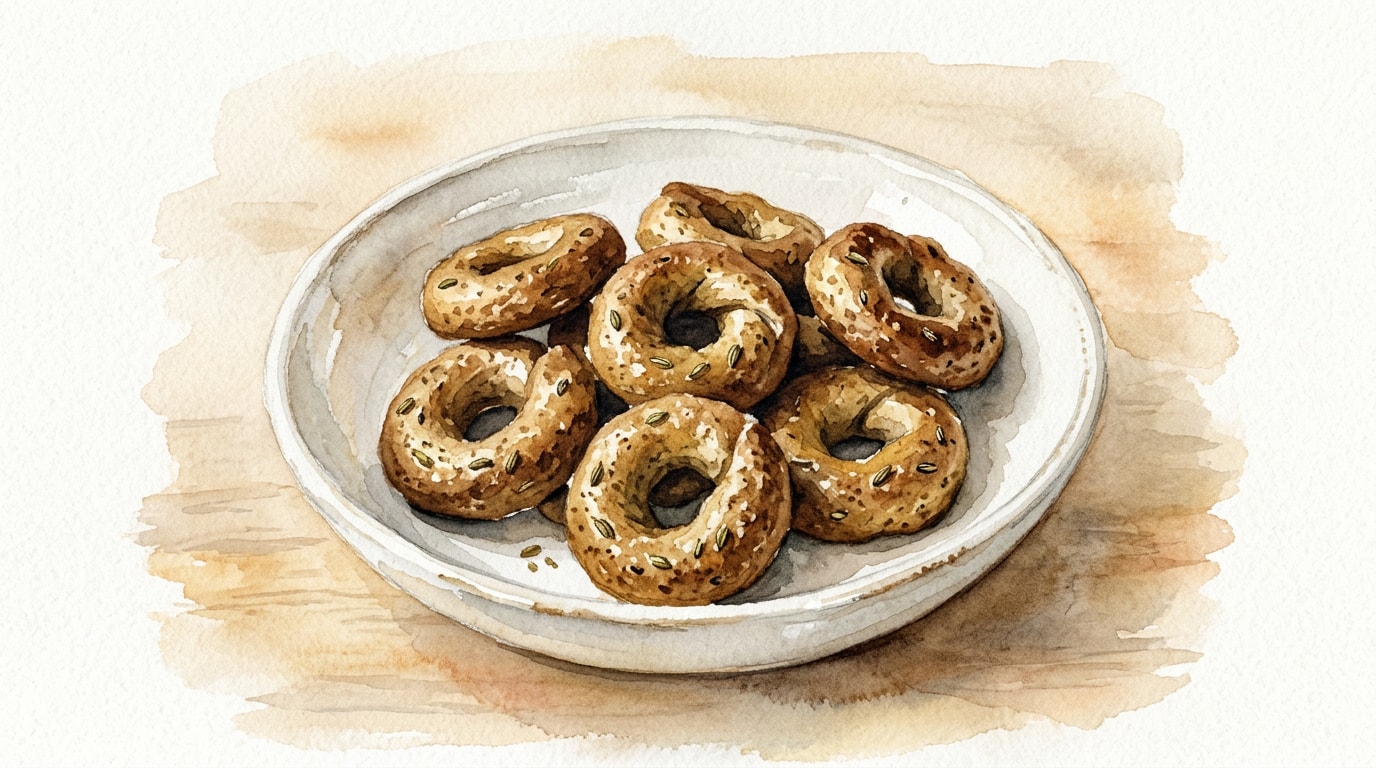
Pinch off small pieces of dough, weighing about 20 grams each. Roll each piece into a small rope about 8 to 10 centimeters long. Overlap and pinch the ends firmly together to form a ring.
Bring the large pot of water to a boil and add the coarse salt. Drop the taralli into the boiling water in small batches of 6 to 8 rings.
Wait for the taralli to naturally float to the surface, which takes about 1 to 2 minutes. Once they float, immediately remove them using a slotted spoon.
Transfer the boiled taralli to a clean, dry kitchen towel. Let them air dry for at least 15 minutes. This step is crucial for achieving a crisp exterior during baking.
While the taralli are drying, preheat the oven to 200°C or 390°F. Line a baking sheet with parchment paper.
Transfer the dried taralli to the prepared baking sheet, leaving a little space between each ring. Bake in the preheated oven for 25 to 30 minutes until deeply golden brown and crisp.
Remove the baking sheet from the oven and immediately transfer the taralli to a wire cooling rack. Allow them to cool completely; they will continue to harden and develop their signature rusk-like snap as they cool.
Chef's Notes
- The boiling process, known in Italian as tarallatura, is what gives taralli their distinctive shiny exterior and crisp, snappy interior. Without it, you are simply baking breadsticks.
- Do not be tempted to use entirely whole wheat flour unless you prefer a very dense snack. The addition of all-purpose or Tipo 00 flour lightens the crumb and provides the necessary gluten structure for a delicate crunch.
- Flavor variations are endless. If you dislike fennel, substitute it with crushed black pepper, chili flakes, or finely chopped fresh rosemary.
Storage
Freezer: 3 months — Freeze fully baked taralli in an airtight container. Thaw at room temperature and refresh in the oven for 5 minutes.
Troubleshooting
Taralli are hard and tooth-breaking instead of crisp and flaky
Cause: The dough was over-kneaded, not enough oil was used, or the boiling step was skipped.
Fix: Cannot be fixed
Prevention: Ensure accurate liquid measurements and never skip the boiling step (tarallatura) as it gelatinizes the starches for a flaky bite.
Taralli unroll or open up during boiling
Cause: The ends were not pinched together firmly enough during shaping.
Fix: Pinch them back together immediately after removing from the water while they are still hot and pliable.
Prevention: Press the overlapping ends of the dough cylinders very firmly together when forming the rings.
Taralli lack flavor
Cause: Insufficient salt in the dough or low-quality olive oil used.
Fix: Cannot be fixed once baked.
Prevention: Use the specified amount of fine sea salt and choose a robust, high-quality extra virgin olive oil.
Cultural Context
Taralli originated in the southern Italian regions of Apulia and Campania as a resourceful peasant food designed to use up leftover bread dough. By enriching the dough scraps with olive oil and local white wine, bakers created a shelf-stable snack that could sustain workers in the fields. Today, they are a beloved staple of the Italian aperitivo, traditionally offered alongside wine or cured meats.