Equipment
* optional
Ingredients
Fruit
- 10 hachiya persimmons, firm and unripe
Processing
- 3000 ml water, boiling
- 50 ml shochu or vodka
Nutrition (per serving)
Nutrition is estimated per serving. Nutrients without complete source data are omitted.
Full nutrition
- Calories
- 152 kcal
- Protein
- 1 g
- Carbohydrates
- 37 g
- Fat
- 0 g
- Fiber
- 7 g
- Sugar
- 25 g
- Sodium
- 2 mg
- Saturated Fat
- 0 g
- Monounsaturated Fat
- 0 g
- Polyunsaturated Fat
- 0 g
- Potassium
- 322 mg
- Calcium
- 16 mg
- Iron
- 0.3 mg
- Magnesium
- 18 mg
- Phosphorus
- 34 mg
- Zinc
- 0.2 mg
- Vitamin A
- 162 mcg
- Vitamin C
- 15 mg
- Vitamin E
- 1.5 mg
- Vitamin K
- 5 mcg
- Vitamin B6
- 0.2 mg
- Thiamin
- 0.06 mg
- Riboflavin
- 0.04 mg
- Niacin
- 0.2 mg
- Folate
- 16 mcg
- Water
- 164 g
- Alcohol
- 2 g
Sources: USDA FoodData Central
Method
Carefully trim the green calyx and leaves from the top of each persimmon using a paring knife, being extremely cautious not to cut or break off the T-shaped stem.
Using a sharp peeler, peel the skin entirely off each persimmon. Leave a tiny rim of skin at the very top near the stem intact to prevent the string from slipping.
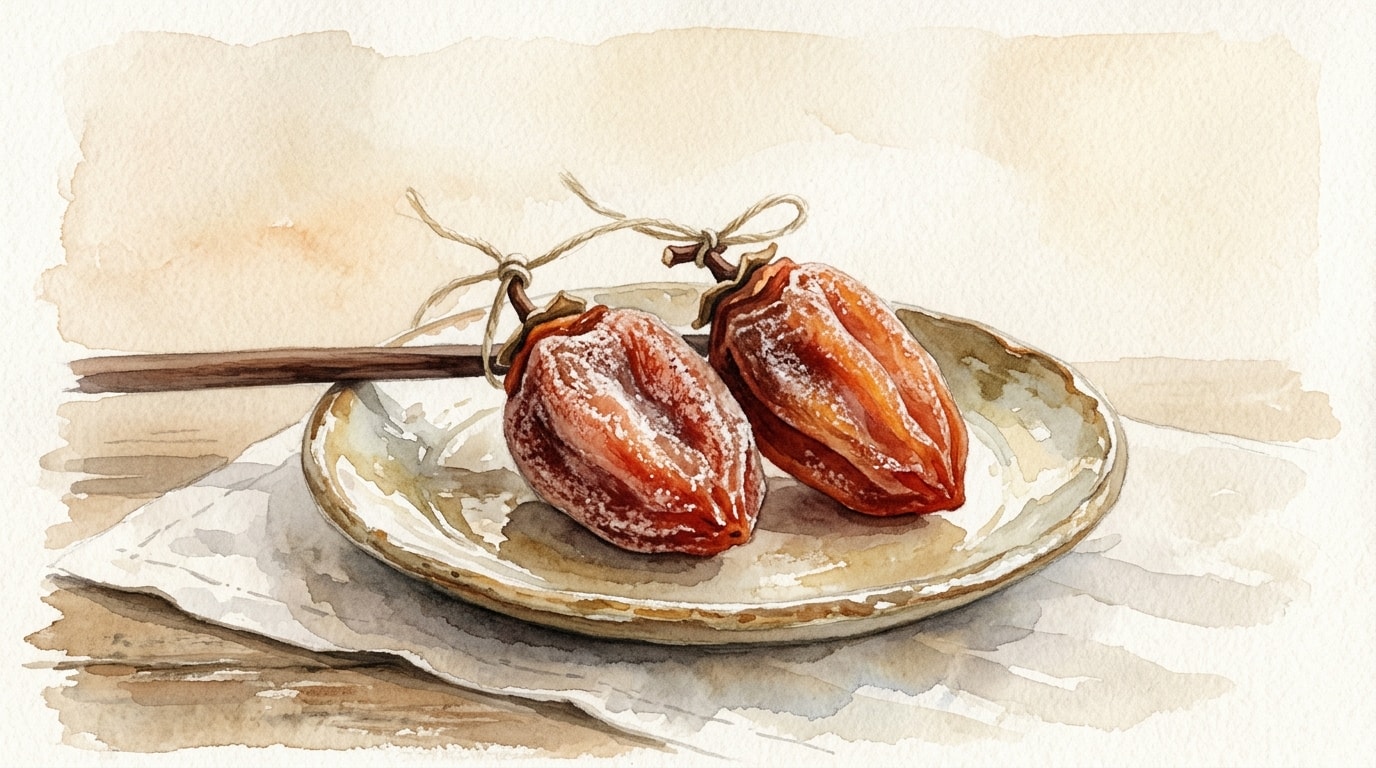
Cut pieces of cotton twine about 60 centimeters long. Tie one end of the twine securely around the T-stem of one persimmon, and the other end to the stem of a second persimmon, creating a connected pair.
Bring a large pot of water to a rolling boil at 100°C/212°F.
Holding the twine, submerge each pair of persimmons into the boiling water for 5 to 10 seconds. This blanching process sterilizes the exterior to discourage mold growth.
Drape the twine over a bamboo pole or drying rack in a highly ventilated, cool, dry location with indirect light. Ensure the persimmons do not touch each other, walls, or any other surfaces.
Allow the fruit to dry untouched for 5 to 7 days, or until a leathery outer skin forms. Once the skin is resilient enough not to tear, begin gently massaging each persimmon with clean hands for a few seconds every day.
Continue the daily gentle massaging routine for 3 to 4 weeks. The persimmons are finished when they are entirely soft, dark amber or brown, and naturally coated in a white, powdery bloom of crystallized sugars.
Chef's Notes
- The T-stem is essential for hanging. If you can only source persimmons without stems, you can carefully insert a sanitized, rust-proof stainless steel screw into the dense top to anchor your twine.
- The white powder that eventually coats the hoshigaki is absolutely not mold, but rather natural fructose crystals migrating to the surface during the slow drying and massaging process.
- Massaging is the most crucial step. It breaks up the hard inner fibers of the fruit and ensures the persimmon dries evenly into a soft, jelly-like consistency.
- Always massage the fruit with rigorously clean, dry hands or wear fresh food-safe gloves to avoid introducing bacteria to the curing fruit.
Storage
Refrigerator: 3 months — Wrap individually in parchment paper and store in an airtight container.
Freezer: 6 months — Wrap tightly to prevent freezer burn; they will not freeze rock solid due to high sugar content.
Troubleshooting
Fuzzy green, black, or heavy white mold spots form on the fruit
Cause: Inadequate air circulation, high humidity, or fruits touching each other while hanging.
Fix: Cannot be fixed if the mold is dark or widespread; discard the affected fruit immediately to save the remaining batch.
Prevention: Ensure constant airflow using an oscillating fan, maintain wide spacing, and mist lightly with alcohol during the first week.
Persimmons dry into a rock-hard, leathery lump
Cause: Failure to massage the fruit regularly, or the curing environment was too hot and dry causing the exterior to harden before the interior could cure.
Fix: Cannot be fixed
Prevention: Begin massaging as soon as the outer skin can withstand pressure, and ensure consistent, gentle daily kneading to break up the fibers.
Cultural Context
Hoshigaki is a traditional Japanese wagashi with roots dating back over a thousand years. Originally developed as an essential method to preserve the autumn harvest through harsh winters, this slow, meditative process transforms incredibly astringent, practically inedible Hachiya persimmons into prized delicacies of profound, complex sweetness.