Equipment
Ingredients
Main Ingredients
- 4 bone-in skin-on chicken thighs, patted completely dry
- 500 g shallots, peeled and halved lengthwise
- 60 ml sherry vinegar
- 30 g unsalted butter, cold and cubed
- 10 g fresh thyme, whole sprigs
Seasoning
- 6 g kosher salt
- 2 g black pepper, freshly ground
Nutrition (per serving)
Nutrition is estimated per serving. Nutrients without complete source data are omitted.
Full nutrition
- Calories
- 600 kcal
- Protein
- 36 g
- Carbohydrates
- 27 g
- Fat
- 39 g
- Fiber
- 4 g
- Sugar
- 10 g
- Sodium
- 767 mg
- Saturated Fat
- 13 g
- Trans Fat
- 0 g
- Monounsaturated Fat
- 16 g
- Polyunsaturated Fat
- 7 g
- Cholesterol
- 212 mg
- Potassium
- 849 mg
- Calcium
- 75 mg
- Iron
- 4.9 mg
- Magnesium
- 67 mg
- Phosphorus
- 394 mg
- Zinc
- 3.1 mg
- Vitamin A
- 103 mcg
- Vitamin C
- 14 mg
- Vitamin D
- 0.2 mcg
- Vitamin E
- 0.7 mg
- Vitamin K
- 7 mcg
- Vitamin B6
- 1.1 mg
- Vitamin B12
- 1.3 mcg
- Thiamin
- 0.22 mg
- Riboflavin
- 0.32 mg
- Niacin
- 9.5 mg
- Folate
- 50 mcg
- Water
- 236 g
Sources: Aggregated Public Data, USDA FoodData Central
Method
Pat the chicken thighs completely dry with paper towels. Season generously on all sides with the kosher salt and black pepper. Wash your hands, utensils, and surfaces immediately after handling the raw poultry to prevent cross-contamination.
Preheat your oven to 200°C / 400°F.
Place the seasoned chicken thighs skin-side down in a cold cast iron skillet. Place the skillet over medium heat and cook undisturbed until the subcutaneous fat renders out and the skin becomes deeply golden and shattered-crisp. This process allows the fat to melt slowly without burning the skin.
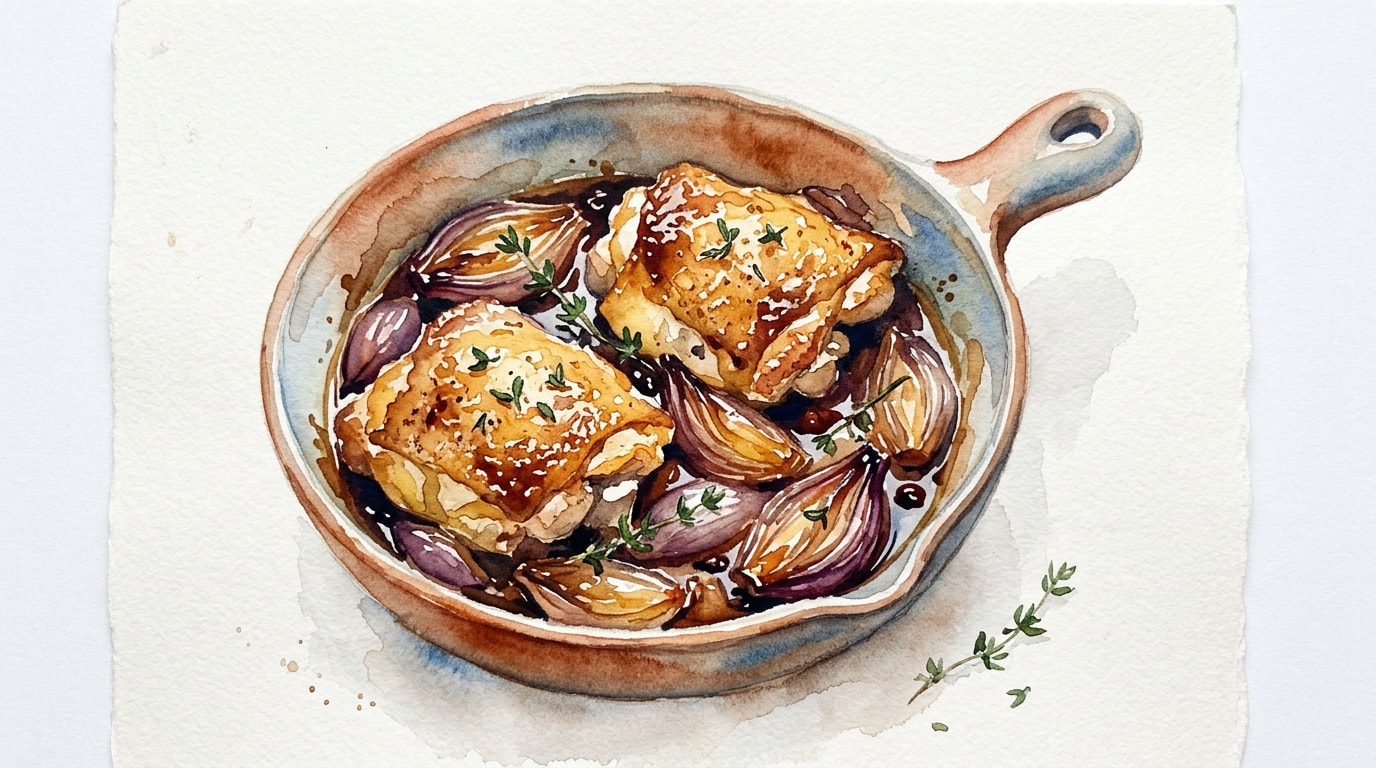
Using tongs, transfer the chicken thighs temporarily to a plate. Carefully pour off all but approximately 30ml of the rendered chicken fat from the skillet. Arrange the halved shallots cut-side down in the remaining hot fat. Scatter the fresh thyme sprigs evenly over the shallots, then place the chicken thighs skin-side up directly on top.
Transfer the loaded skillet to the preheated oven. Roast until the shallots are meltingly tender and the chicken is fully cooked, reaching a safe internal temperature of 74°C / 165°F at the thickest part near the bone.
Carefully remove the hot skillet from the oven. Transfer only the chicken thighs to a warm resting plate, leaving the caramelized shallots, thyme, and pan drippings in the skillet.
Place the skillet with the shallots back onto the stovetop over medium-high heat. Pour in the sherry vinegar, using a wooden spoon to scrape up the caramelized fond from the bottom of the pan. Simmer vigorously until the sharp vinegar smell mellows and the liquid reduces into a sticky, syrupy glaze.
Remove the skillet entirely from the heat source. Add the cold cubed butter and swirl the pan constantly until the butter melts and emulsifies into the reduced vinegar, creating a rich, glossy sauce that coats the shallots. Discard the spent thyme stems. Spoon the glazed shallots and sauce around the rested chicken thighs to serve.
Chef's Notes
- Starting skin-on chicken in a cold cast iron skillet is arguably the most important technique in poultry cooking. It acts as a slow-rendering process, giving you shatteringly crisp skin and pure liquid gold schmaltz to roast the vegetables in.
- Do not rush the vinegar reduction. Sherry vinegar contains complex, nutty flavor compounds that only reveal themselves once the harsh, volatile acetic acid has been cooked away.
- Leaving the shallots cut-side down during the roasting phase allows them to act as a roasting rack for the chicken while absorbing the savory juices and caramelizing deeply against the hot cast iron.
- For the most stable pan sauce emulsion, ensure your butter is cubed and very cold. Swirling it off the heat gently incorporates the fat without breaking the milk solids.
Storage
Refrigerator: 3 days — Chicken skin will lose crispness in the refrigerator. Reheat in an oven or air fryer to recrisp.
Reheating: Reheat uncovered in a 175 C / 350 F oven until warmed through and skin is revived.
Troubleshooting
Chicken skin is pale and rubbery
Cause: The pan was heated before adding the chicken, or the chicken was not patted dry, causing the meat to steam rather than fry in its own fat.
Fix: Place the cooked chicken thighs under a high broiler for 1 to 2 minutes at the very end of cooking, watching closely to prevent burning.
Prevention: Always start skin-on poultry in a completely cold pan to allow the fat to render slowly. Ensure surface moisture is blotted away.
The pan sauce separates and looks oily
Cause: The butter was too warm, or the pan was kept over active heat while the butter was being incorporated.
Fix: Add a splash of cold water to the skillet and whisk vigorously off the heat to force the emulsion back together.
Prevention: Use ice-cold butter cubes and always swirl them in off the heat to form a stable emulsion.
The glaze tastes unpleasantly sharp and acidic
Cause: The vinegar was not reduced sufficiently to cook off its harsh volatile acids.
Fix: Return the pan to medium heat, add a splash of chicken stock or water, and reduce again until the flavor mellows.
Prevention: Allow the vinegar to bubble and reduce until it visibly thickens into a syrup before adding the butter.
Cultural Context
This preparation draws heavy inspiration from the classic French preparation Poulet au Vinaigre, a cornerstone of Lyonnaise cuisine famously championed by Chef Paul Bocuse. The traditional method utilizes sharp vinegar to cut through rich poultry fat, creating an aggressive yet perfectly balanced sauce. By adapting it into a modern one-pan format, we retain the rustic soul of the original dish while maximizing textural contrast with supremely crispy skin.