Equipment
* optional
Ingredients
Aromatics and Spices
- 1 yellow onion, finely diced
- 3 garlic, minced
- 20 g fresh ginger, peeled and finely grated
- 30 ml coconut oil
- 6 g ground cumin
- 6 g ground coriander
- 3 g ground turmeric
- 2 g chili powder
- 6 g fine sea salt
Sauce
- 400 g canned chopped tomatoes
- 400 ml coconut milk, full fat, shaken
- 100 ml water
Turkey and Finish
- 400 g cooked turkey meat, shredded or cut into 2cm pieces
- 1 lime, juiced
- 15 g fresh coriander leaves, roughly chopped
Nutrition (per serving)
Nutrition is estimated per serving. Nutrients without complete source data are omitted.
Full nutrition
- Calories
- 481 kcal
- Protein
- 34 g
- Carbohydrates
- 18 g
- Fat
- 32 g
- Fiber
- 4 g
- Sugar
- 8 g
- Sodium
- 905 mg
- Saturated Fat
- 25 g
- Trans Fat
- 0 g
- Monounsaturated Fat
- 3 g
- Polyunsaturated Fat
- 2 g
- Cholesterol
- 101 mg
- Potassium
- 930 mg
- Calcium
- 111 mg
- Iron
- 7.5 mg
- Magnesium
- 114 mg
- Phosphorus
- 383 mg
- Zinc
- 3.7 mg
- Vitamin A
- 36 mcg
- Vitamin C
- 18 mg
- Vitamin D
- 0.3 mcg
- Vitamin E
- 1.9 mg
- Vitamin K
- 18 mcg
- Vitamin B6
- 0.9 mg
- Vitamin B12
- 0.9 mcg
- Thiamin
- 0.19 mg
- Riboflavin
- 0.37 mg
- Niacin
- 11.7 mg
- Folate
- 47 mcg
- Water
- 301 g
- Alcohol
- 0 g
- Caffeine
- 0 mg
Sources: USDA FoodData Central, Aggregated Public Data
Method
Finely dice the onion, mince the garlic, and grate the ginger. Shred or cut the cooked turkey into bite-size pieces, removing any skin, bone or gristle, and measure the ground spices into a small bowl so they are ready to add all at once.
Heat the coconut oil in a large saucepan over medium heat. Add the diced onion with a pinch of the salt and cook, stirring often, for about 8 minutes until soft, translucent and just turning golden at the edges.
Stir in the garlic, ginger and all the ground spices. Cook for 1 minute, stirring constantly, until the mixture is intensely fragrant and coats the onion in a deep golden paste. If the pan looks dry, add a splash of water.
Pour in the chopped tomatoes and their juices plus the water. Bring to a gentle simmer, then cook uncovered for 10 minutes, stirring once or twice, until the sauce thickens slightly and darkens to a rich brick red.
Stir in the coconut milk and the cooked turkey. Simmer gently for about 7 minutes, stirring occasionally, until the turkey is piping hot all the way through and registers 74°C (165°F) on a thermometer inserted into the largest piece. Because the turkey is already cooked, you are reheating it safely rather than cooking it from raw.
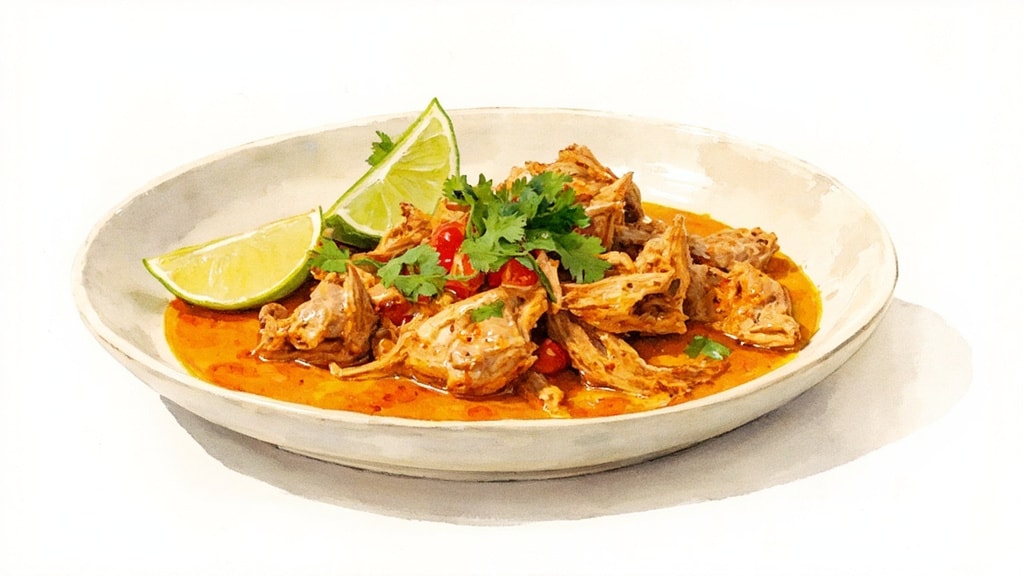
Remove from the heat, stir in the lime juice, and taste, adding more salt if needed. Scatter over the coriander and serve over steamed rice or with warm flatbread.
Chef's Notes
- Leftover roast turkey is often seasoned already, so taste before adding the full amount of salt at the end.
- A small grated carrot simmered into the tomato base softens the acidity of canned tomatoes if they taste sharp.
- Dark turkey meat stays juicier than breast in a simmered sauce; if using only breast meat, keep the final simmer as short as safely possible while still reaching 74°C (165°F).
- This is a practical way to use cooked meat within its safe window: make sure the leftover turkey was refrigerated within 2 hours of its original cooking and used within 3 to 4 days.
Storage
Refrigerator: 3 days — Cool within 2 hours of cooking and refrigerate promptly in a shallow, covered container.
Freezer: 2 months — Freeze in airtight portions; the coconut sauce may separate slightly on thawing but re-emulsifies when stirred over heat.
Reheating: Reheat gently in a saucepan over medium-low heat, stirring occasionally, until steaming and the thickest part reaches 74°C (165°F) throughout.
Troubleshooting
Sauce is thin and watery
Cause: Tomatoes were very juicy or the sauce did not reduce enough before the coconut milk was added
Fix: Simmer uncovered for a few extra minutes, stirring, until it reaches a coating consistency
Prevention: Let the tomato base simmer the full 10 minutes until visibly thickened before adding coconut milk
Turkey is dry or stringy
Cause: Cooked turkey was simmered too long or the sauce boiled hard after the meat was added
Fix: Stir in a splash more coconut milk and serve over rice; the extra sauce helps mask dryness
Prevention: Add the turkey only for the final gentle simmer and stop as soon as it reaches 74°C (165°F)
Curry tastes flat or bitter
Cause: Spices were under-toasted or slightly scorched, or the sauce lacks acid and salt
Fix: If merely flat, add salt and lime juice in small increments; if truly burnt-bitter, the base cannot be rescued and should be restarted
Prevention: Toast spices for no more than about 1 minute over medium heat and finish with lime juice to brighten
Cultural Context
Curry-style dishes built from aromatic spices, tomatoes and coconut milk draw on the broad family of South and Southeast Asian home cooking, where sauces are endlessly adapted to whatever protein is on hand. Using leftover roast meat in a spiced sauce is a thrifty tradition found in many cuisines, echoing dishes like Anglo-Indian curries that emerged around using up the Sunday roast. This version is a gentle, home-style interpretation rather than a recipe tied to one specific region.