Equipment
Ingredients
Main Ingredients
- 1000 ml water
- 10 g fine sea salt
- 200 g coarse yellow cornmeal
- 50 g unsalted butter, diced, room temperature
- 50 g parmesan cheese, finely grated
Nutrition (per serving)
Nutrition is estimated per serving. Nutrients without complete source data are omitted.
Full nutrition
- Calories
- 374 kcal
- Protein
- 9 g
- Carbohydrates
- 51 g
- Fat
- 15 g
- Fiber
- 4 g
- Sugar
- 1 g
- Sodium
- 1154 mg
- Saturated Fat
- 8 g
- Monounsaturated Fat
- 4 g
- Polyunsaturated Fat
- 0 g
- Cholesterol
- 35 mg
- Potassium
- 159 mg
- Calcium
- 162 mg
- Iron
- 3.5 mg
- Magnesium
- 135 mg
- Phosphorus
- 331 mg
- Zinc
- 2.2 mg
- Vitamin A
- 122 mcg
- Vitamin D
- 0.1 mcg
- Vitamin E
- 0.3 mg
- Vitamin K
- 1 mcg
- Vitamin B6
- 0.0 mg
- Vitamin B12
- 0.2 mcg
- Thiamin
- 0.01 mg
- Riboflavin
- 0.05 mg
- Niacin
- 0.0 mg
- Folate
- 1 mcg
- Water
- 256 g
Sources: Aggregated Public Data, USDA FoodData Central
Method
Bring the water and salt to a rolling boil in a heavy-bottomed saucepan over high heat (100°C/212°F).
Gradually pour the cornmeal into the boiling water in a slow, steady stream while whisking continuously to prevent lumps from forming.
Reduce the heat to the lowest possible setting. Swap the whisk for a wooden spoon and stir thoroughly. Cover and simmer gently.
Uncover and stir vigorously every 5 to 10 minutes, making sure to scrape the bottom and corners of the saucepan to prevent sticking and burning.
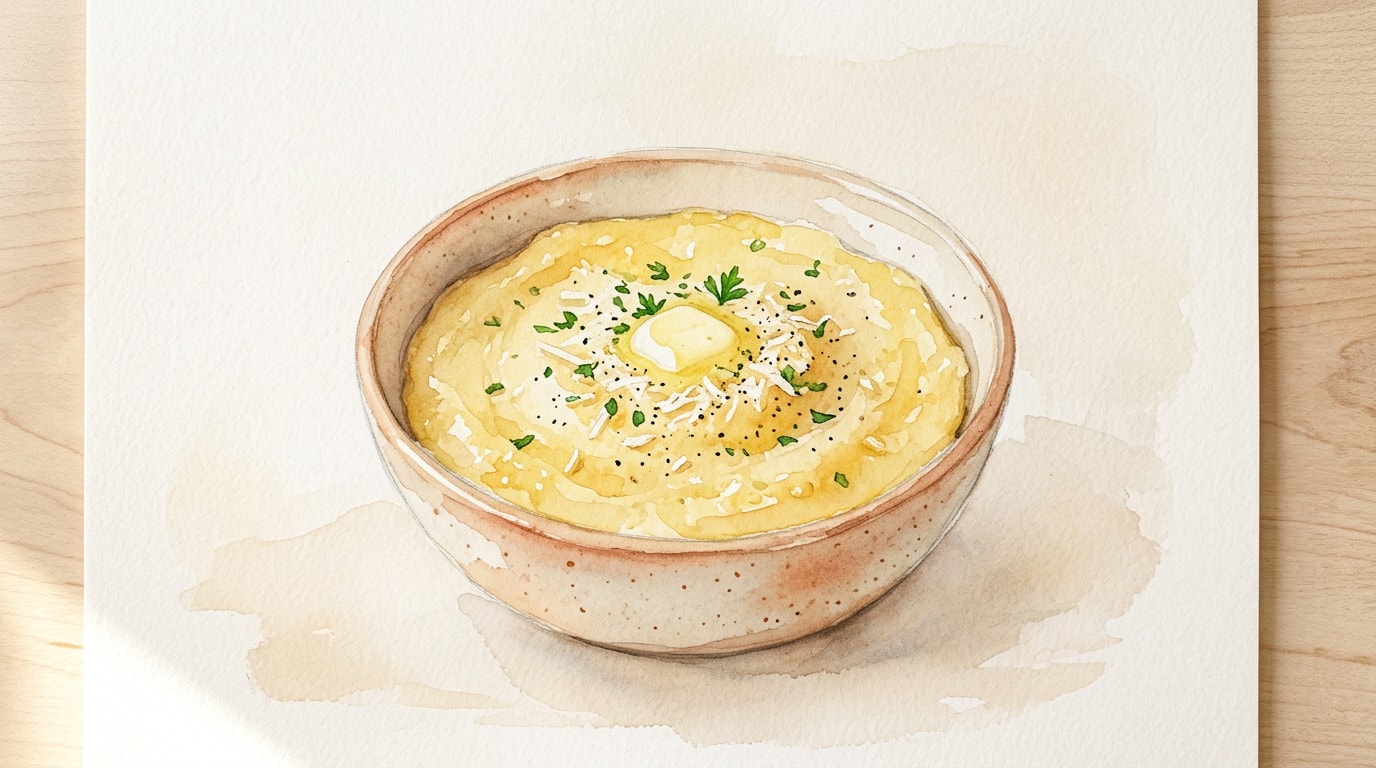
Remove the saucepan from the heat. Add the diced butter and grated parmesan cheese. Fold vigorously until completely melted, emulsified, and luxuriously creamy.
Taste for seasoning, adjusting salt if necessary. Serve immediately while hot and fluid, as the mixture will begin to set rapidly as it cools.
Chef's Notes
- For an even richer base, substitute up to half of the water with whole milk or a light chicken stock.
- The key to perfectly smooth polenta is the rain method: dusting the cornmeal into the water from high up while constantly whisking to ensure rapid hydration.
- If your polenta sets before you are ready to serve or plate, simply place it back over very low heat and whisk in a few tablespoons of boiling water to restore its loose, fluid texture.
- Using a heavy-bottomed pan is absolutely non-negotiable; thin-walled pans will inevitably lead to scorched polenta at the base long before the grains are fully cooked.
Storage
Refrigerator: 4 days — Will solidify when chilled. Slice and fry, or reheat with extra liquid to restore creaminess.
Freezer: 2 months — Freeze in solid blocks. Thaw overnight before frying or grilling.
Reheating: Reheat gently on the stove over low heat, vigorously whisking in water, milk, or stock until perfectly creamy again.
Troubleshooting
Lumpy polenta
Cause: Adding the cornmeal too quickly or failing to whisk vigorously during the initial addition.
Fix: Use an immersion blender briefly off the heat to smooth out the lumps, though this may slightly alter the traditional rustic texture.
Prevention: Pour cornmeal in a very slow, continuous stream while whisking constantly.
Polenta is too thick or stiff
Cause: Excess evaporation or cooking too long without monitoring hydration.
Fix: Vigorously whisk in a splash of very hot water or hot stock until the desired fluid consistency is reached.
Prevention: Keep the saucepan covered between stirring intervals and monitor the liquid level.
Scorched bottom
Cause: Heat was left too high or the saucepan is too thin, conducting heat unevenly.
Fix: Cannot be fixed. Do not scrape the bottom, simply transfer the unburnt top layer to a new pot.
Prevention: Use a heavy-bottomed pot and keep the heat at the absolute lowest setting after the initial boil.
Cultural Context
Historically a humble peasant food from Northern Italy, polenta was originally prepared using grains like spelt or chestnut flour before the introduction of maize from the Americas in the 16th century. It has since evolved into a versatile staple across the Mediterranean, serving as an exceptional blank canvas for rich meat ragouts, braised dishes, and earthy wild mushrooms.