Equipment
Ingredients
Roast Beef
- 1500 g top sirloin roast, trimmed and tied
- 30 ml vegetable oil
- 15 g kosher salt
- 5 g black pepper, freshly cracked
Aromatics (For Roasting)
- 1 yellow onion, roughly chopped
- 2 carrots, roughly chopped
- 2 celery stalks, roughly chopped
- 1 garlic head, halved horizontally
- 4 fresh thyme
Au Jus
- 250 ml dry red wine
- 1000 ml beef stock
- 30 ml worcestershire sauce
Assembly
- 4 baguette or hoagie rolls
- 4 provolone cheese, sliced
- 30 g unsalted butter, softened
Nutrition (per serving)
Nutrition is estimated per serving. Nutrients without complete source data are omitted.
Full nutrition
- Calories
- 1289 kcal
- Protein
- 126 g
- Carbohydrates
- 71 g
- Fat
- 51 g
- Fiber
- 5 g
- Sugar
- 5 g
- Sodium
- 2403 mg
- Saturated Fat
- 20 g
- Monounsaturated Fat
- 3 g
- Polyunsaturated Fat
- 1 g
- Cholesterol
- 30 mg
- Potassium
- 2536 mg
- Calcium
- 278 mg
- Iron
- 15.5 mg
- Magnesium
- 38 mg
- Phosphorus
- 523 mg
- Zinc
- 5.7 mg
- Vitamin A
- 430 mcg
- Vitamin C
- 13 mg
- Vitamin D
- 0.1 mcg
- Vitamin E
- 0.6 mg
- Vitamin K
- 16 mcg
- Vitamin B6
- 0.3 mg
- Vitamin B12
- 0.3 mcg
- Thiamin
- 0.09 mg
- Riboflavin
- 0.14 mg
- Niacin
- 0.7 mg
- Folate
- 29 mcg
- Water
- 174 g
- Alcohol
- 6 g
Sources: Aggregated Public Data, USDA FoodData Central
Method
Preheat your oven to 175°C/350°F. Pat the sirloin roast completely dry with paper towels. Season aggressively on all sides with salt and cracked black pepper.
In a large skillet or roasting pan over medium-high heat, add the vegetable oil. Sear the beef on all sides until a deep brown crust forms, about 3-4 minutes per side.
Remove the beef from the pan temporarily. Add the onions, carrots, celery, garlic, and thyme to the pan. Sauté for 3-4 minutes until slightly browned. Place the roasting rack over the vegetables and set the beef on top. Transfer to the oven.
Roast until an instant-read thermometer inserted into the thickest part of the beef reads 52°C/125°F for medium-rare. Carryover cooking will raise the temperature further during resting.
Transfer the beef to a cutting board and tent loosely with foil. Let it rest for at least 20 minutes. Do not skip this step, or the juices will run out.
Place the roasting pan with the vegetables back on the stove over medium-high heat (or transfer contents to a pot). Add the red wine to deglaze, scraping up the browned bits (fond) from the bottom. Simmer until reduced by half.
Add the beef stock and Worcestershire sauce. Bring to a simmer and cook for 10-15 minutes to marry the flavors. Strain the liquid through a fine mesh sieve into a clean saucepan, pressing on the vegetables to extract all flavor. Discard vegetables. Keep the jus warm.
Slice the baguettes open and butter the insides. Toast briefly under a broiler or in a toaster oven. If using cheese, place slices on the bread and melt under the broiler for 1 minute.
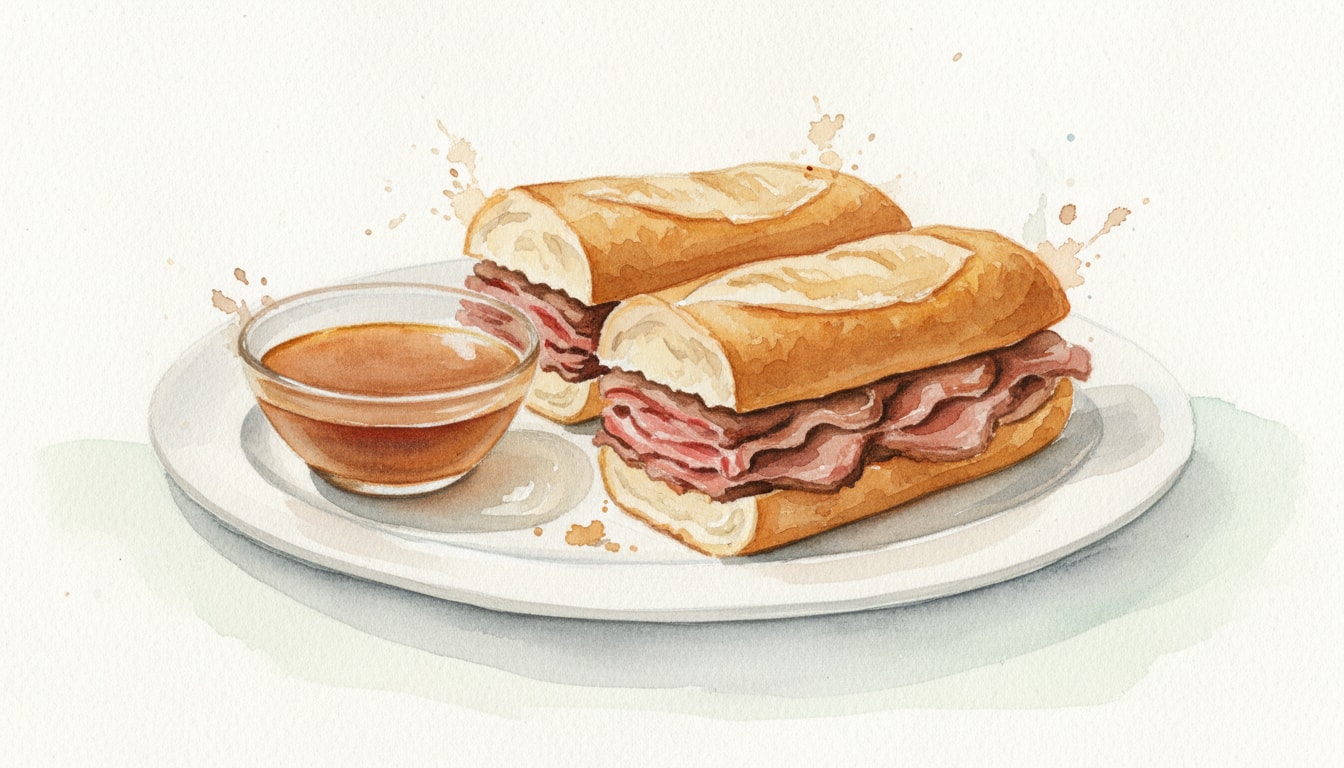
Slice the rested beef as thinly as possible against the grain. Pile generous amounts of beef onto the toasted bread. Serve immediately with individual bowls of warm jus for dipping.
Chef's Notes
- To achieve deli-style thin slices at home, place the rested, cooked beef in the freezer for 15-20 minutes before slicing. This firms up the meat and allows for much thinner cuts.
- The 'jus' is not a thick gravy; it is a broth. Do not thicken it with flour or roux unless you prefer a non-traditional dipping sauce.
- Top Sirloin is flavorful but leaner than ribeye. Do not cook it past medium (60°C/140°F) or it will become dry. The dipping sauce helps, but proper cooking is key.
- Toast the bread thoroughly. The crust needs to be sturdy enough to hold the wet beef and survive the dip without disintegrating immediately.
Storage
Refrigerator: 3 days — Store beef and jus in separate airtight containers to prevent bread sogginess.
Freezer: 2 months — Freeze sliced beef in the jus to prevent freezer burn.
Reheating: Gently warm beef in the jus over low heat until heated through. Do not boil or the meat will toughen.
Troubleshooting
Beef is tough or chewy
Cause: The meat was sliced too thick or with the grain, or overcooked
Fix: Dice the meat small and simmer it in the jus for 5 minutes to soften
Prevention: Use a very sharp knife to slice paper-thin sheets against the grain; do not cook past 55°C internal
Jus tastes thin or watery
Cause: Not enough reduction or lack of fondant (browned bits) in the pan
Fix: Simmer the jus longer to reduce volume or whisk in a slurry of 1 tsp cornstarch and water for body
Prevention: Ensure good searing of beef and vegetables before adding liquid
Cultural Context
Despite its name, the French Dip is an American invention, likely originating in Los Angeles in the early 20th century at either Philippe the Original or Cole's Pacific Electric Buffet. The 'French' in the name refers to the style of bread used (baguette) rather than the country of origin.