Equipment
* optional
Ingredients
Sushi Rice
- 300 g short grain sushi rice, rinsed well and drained
- 360 ml water
Sushi Vinegar
- 45 ml rice vinegar
- 25 g white sugar
- 5 g fine sea salt
Braised Shiitake
- 20 g dried shiitake mushrooms, rehydrated in warm water for 30 minutes, stems removed
- 150 ml water
- 30 ml soy sauce
- 15 ml mirin
- 15 g sugar
Seasoned Carrots
- 100 g carrots, peeled
Dashi-maki Tamago
- 3 eggs
- 45 ml kombu dashi
- 10 g sugar
- 5 ml light soy sauce
- 10 ml neutral cooking oil
Assembly
- 4 nori sheets, full sized roasted seaweed sheets
Nutrition (per serving)
Nutrition is estimated per serving. Nutrients without complete source data are omitted.
Full nutrition
- Calories
- 323 kcal
- Protein
- 11 g
- Carbohydrates
- 59 g
- Fat
- 6 g
- Fiber
- 7 g
- Sugar
- 24 g
- Sodium
- 1478 mg
- Saturated Fat
- 2 g
- Monounsaturated Fat
- 0 g
- Polyunsaturated Fat
- 0 g
- Potassium
- 752 mg
- Calcium
- 99 mg
- Iron
- 2.7 mg
- Magnesium
- 42 mg
- Phosphorus
- 168 mg
- Zinc
- 1.7 mg
- Vitamin A
- 930 mcg
- Vitamin C
- 5 mg
- Vitamin E
- 1.4 mg
- Vitamin K
- 27 mcg
- Vitamin B6
- 0.3 mg
- Thiamin
- 0.14 mg
- Riboflavin
- 0.12 mg
- Niacin
- 2.1 mg
- Folate
- 16 mcg
- Water
- 136 g
Sources: Aggregated Public Data, USDA FoodData Central
Method
Combine the rinsed sushi rice and 360ml of water in a rice cooker or pot. Cook until tender, reaching an internal boiling temperature of 100°C/212°F before simmering.
While the rice cooks, combine the rice vinegar, 25g of sugar, and salt in a small bowl. Stir until fully dissolved to create the sushi vinegar.
Slice the rehydrated shiitake mushrooms into thin strips.
In a small saucepan, combine the sliced mushrooms, 150ml water, 30ml soy sauce, mirin, and 15g sugar. Simmer gently until the liquid is almost completely absorbed and syrupy.
Cut the peeled carrots into long, uniform julienne strips.
Blanch the julienned carrots in boiling water at 100°C/212°F for 2 minutes until tender but still crisp. Drain well and pat dry.
Whisk the eggs, kombu dashi, 10g sugar, and light soy sauce. Heat an oiled tamagoyaki pan over medium heat. Pour in a thin layer of egg, let it set, then roll it into a log. Repeat, adding oil and egg layers, to build a thick, rectangular omelette.
Transfer the hot cooked rice to a wide mixing bowl. Pour the sushi vinegar evenly over the top. Use a spatula to gently slice and fold the rice, being careful not to smash the grains, while fanning to cool it to body temperature.
Slice the cooled tamagoyaki lengthwise into 4 long, thick strips.
Place a nori sheet shiny side down on the bamboo mat. Wet your hands and spread one quarter of the rice evenly across the nori, leaving a 2 centimeter border completely bare at the top edge.
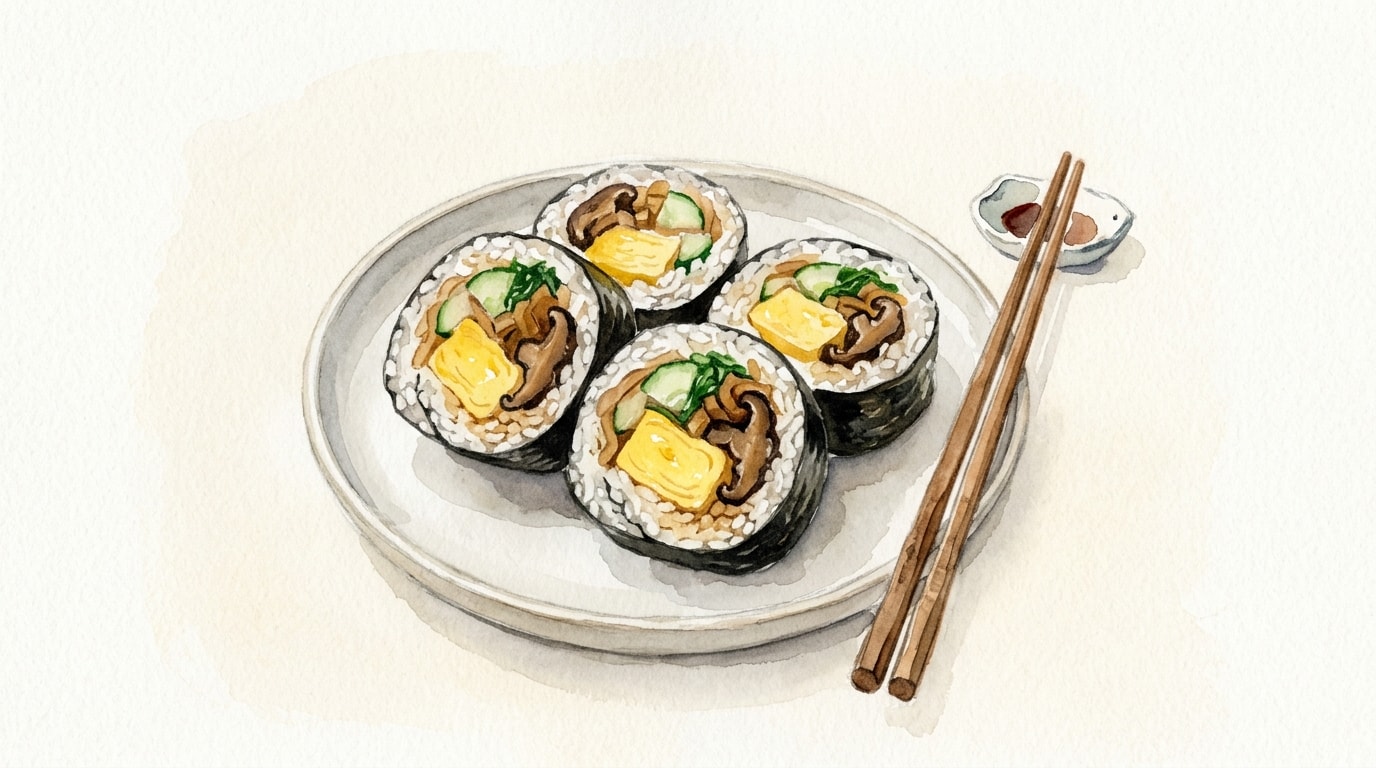
Arrange a strip of tamagoyaki, a line of braised shiitake, and a row of blanched carrots horizontally across the lower third of the rice.
Lift the bottom edge of the bamboo mat with your thumbs while holding the fillings in place with your fingers. Roll the mat over to encase the fillings, squeezing gently to compress. Lift the edge of the mat and finish rolling to seal the exposed nori border.
Wipe a very sharp knife with a damp, lightly vinegared cloth. Cut the roll in half, then line the halves up and cut into 4 equal slices to yield 8 pieces per roll. Repeat the assembly and cutting for the remaining rolls.
Chef's Notes
- Keep a bowl of tezu, a mixture of water and a splash of rice vinegar, nearby. Moistening your hands before handling the rice is crucial to prevent it from sticking to your fingers.
- When slicing the rolls, do not use a heavy sawing motion. Let the weight of the knife do the work, using a long, smooth drawing stroke from the heel of the blade to the tip.
- Ensure all fillings are completely cooled to room temperature before rolling. Warm fillings will steam the nori, making it chewy and difficult to cut.
- For the best flavor, use high quality short-grain Japanese sushi rice. Medium or long grain varieties do not possess the necessary stickiness to hold the roll together.
Storage
Refrigerator: 1 day — Rice will harden in the refrigerator. Best eaten fresh at room temperature.
Troubleshooting
The futomaki falls apart when sliced
Cause: The roll was not compressed firmly enough during shaping, or the knife was dull and dragged the nori.
Fix: Use the bamboo mat to re-shape and compress the roll before attempting to cut the remaining portion.
Prevention: Apply firm, even pressure along the entire length of the bamboo mat after the initial roll over the fillings. Wipe the knife blade with a damp cloth between every single cut.
Sushi rice is mushy and sticky
Cause: Too much water used during cooking, or the rice was vigorously stirred rather than gently folded.
Fix: Cannot be fixed. Use for a sushi bowl instead of rolling.
Prevention: Ensure accurate water measurement and use a sharp cutting motion to fold in the vinegar while rapidly cooling the rice with a fan.
Cultural Context
Futomaki translates to fat rolled sushi, distinguished from thin hosomaki by its impressive diameter and multiple fillings. It is a staple of Japanese bento boxes, picnics, and festive occasions. A special uncut version, known as Ehōmaki, is traditionally eaten whole during the Setsubun festival in spring while facing the year's lucky direction to invite good fortune.