Equipment
Ingredients
Pork and Crackling
- 2000 g boneless pork shoulder, rolled and tied, skin on
- 1000 ml boiling water
- 30 g flaky sea salt
- 15 ml olive oil
Roasting Trivet
- 2 yellow onion, halved
- 2 carrot, roughly chopped
- 250 ml water
Apple Sauce
- 4 granny smith apples, peeled, cored, and diced
- 30 g caster sugar
- 20 ml lemon juice
- 50 ml water
Nutrition (per serving)
Nutrition is estimated per serving. Nutrients without complete source data are omitted.
Full nutrition
- Calories
- 627 kcal
- Protein
- 67 g
- Carbohydrates
- 27 g
- Fat
- 27 g
- Fiber
- 5 g
- Sugar
- 18 g
- Sodium
- 2221 mg
- Saturated Fat
- 9 g
- Monounsaturated Fat
- 13 g
- Polyunsaturated Fat
- 3 g
- Cholesterol
- 223 mg
- Potassium
- 1441 mg
- Calcium
- 77 mg
- Iron
- 4.5 mg
- Magnesium
- 85 mg
- Phosphorus
- 712 mg
- Zinc
- 10.7 mg
- Vitamin A
- 290 mcg
- Vitamin C
- 10 mg
- Vitamin E
- 0.8 mg
- Vitamin K
- 9 mcg
- Vitamin B6
- 1.5 mg
- Vitamin B12
- 2.8 mcg
- Thiamin
- 3.00 mg
- Riboflavin
- 1.10 mg
- Niacin
- 14.8 mg
- Folate
- 36 mcg
- Water
- 455 g
Sources: Aggregated Public Data, USDA FoodData Central
Method
The day before roasting, place the pork shoulder skin-side up on a wire rack over the sink. Carefully pour the boiling water over the skin. This scalds the skin, causing it to shrink and opening the pores for better fat rendering.
Thoroughly pat the pork completely dry with paper towels. A perfectly dry skin is the most important factor in achieving crispy crackling.
Using a very sharp utility knife, score the pork skin in parallel lines about 1cm apart. Cut through the tough skin and the fat layer, but be careful not to pierce the red meat underneath. Wash your hands thoroughly with soap and warm water after handling the raw meat to prevent cross-contamination.
Rub half of the flaky sea salt generously into the scored skin, ensuring it gets deep into the cuts. Place the pork uncovered in the refrigerator overnight to aggressively draw out surface moisture.
The next day, remove the pork from the refrigerator 1 hour before you intend to cook it to let it come closer to room temperature. Wipe away any moisture that has pooled on the skin.
Preheat your oven to 240 degrees Celsius or 465 degrees Fahrenheit. Place the halved onions and chopped carrots in the bottom of a roasting pan, then pour in 250ml of water to prevent the vegetables and dripping fat from burning and smoking.
Rub the skin of the pork with the olive oil and massage in the remaining flaky sea salt. Place the pork on a wire rack situated directly above the vegetables in the roasting pan.
Roast the pork in the hot oven at 240 degrees Celsius or 465 degrees Fahrenheit for 30 minutes. The intense initial heat will cause the skin to blister, puff up, and begin to crackle.
Reduce the oven temperature to 160 degrees Celsius or 320 degrees Fahrenheit. Continue roasting for approximately 2.5 hours. The pork is safe to eat when a meat thermometer inserted into the thickest part reads 71 degrees Celsius or 160 degrees Fahrenheit, but taking it to 85 degrees Celsius or 185 degrees Fahrenheit yields a more tender, pull-apart texture.
While the pork is in its final hour of roasting, prepare the apple sauce. In a saucepan over medium heat, combine the diced apples, caster sugar, lemon juice, and 50ml of water.
Simmer the apple mixture gently for 15 to 20 minutes, stirring occasionally. The apples will soften and collapse into a chunky, fragrant sauce. Remove from the heat and set aside to cool slightly.
Remove the pork from the oven and transfer it to a clean cutting board. Let it rest entirely uncovered for 30 to 45 minutes. Do not tent it with foil, as the trapped steam will ruin the crackling.
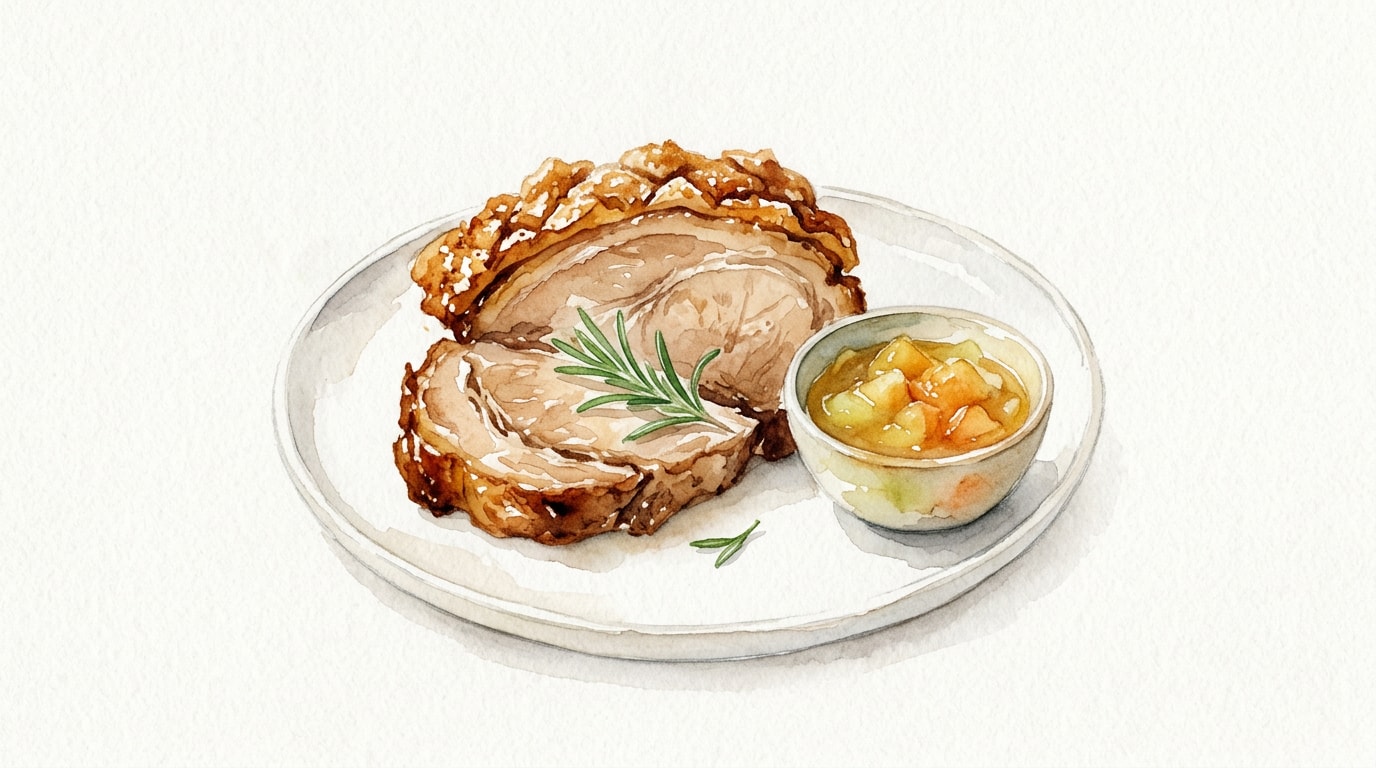
To serve, use a heavy knife to remove the layer of crackling in one piece, then chop it into portions. Carve the rested pork into thick slices and serve warm alongside the homemade apple sauce.
Chef's Notes
- Scoring the pork correctly is critical: use a clean box cutter or scalpel for precise cuts. If you cut into the meat, juices will bubble up during cooking and steam the skin, preventing a crisp crackling.
- Never tent roast pork with foil while it rests. The trapped residual heat will generate steam, turning your carefully cultivated crackling completely soggy.
- Bramley apples are the traditional choice for British apple sauce as they collapse beautifully into a puree, but Granny Smith provides an excellent, readily available alternative with the right level of tartness.
- If your oven struggles to reach high heat, you can blast the pork skin with a culinary blowtorch before carving to encourage further blistering.
- The vegetables used as a trivet will absorb incredible flavor from the pork fat. Puree them into a gravy if you decide to make one from the pan juices.
Storage
Refrigerator: 3 days — Store pork and apple sauce in separate airtight containers. Crackling will lose its crispness.
Freezer: 1 month — Freeze meat and sauce separately. Do not freeze the crackling.
Reheating: Reheat meat gently in the oven at 150 degrees Celsius. To recrisp crackling, remove it from the meat and place under a hot broiler for 2 to 3 minutes.
Troubleshooting
The skin is rubbery and did not crackle.
Cause: The skin held too much moisture or the initial oven temperature was too low.
Fix: Remove the skin from the rested meat, place it on a foil-lined baking sheet, and place under a hot broiler for 2 to 5 minutes, watching constantly to prevent burning.
Prevention: Ensure the skin is bone-dry before oiling, chill uncovered overnight, and verify oven temperature with an independent thermometer.
The meat is dry and tough.
Cause: The pork was overcooked or cooked at too high a temperature for the duration.
Fix: Slice the meat thinly and serve it moistened with a gravy made from the pan drippings.
Prevention: Use a probe meat thermometer to monitor the internal temperature and do not skip the resting phase.
Apple sauce is too watery.
Cause: Apples released more juice than expected or the lid was kept on the pot.
Fix: Return to a medium heat and simmer uncovered until the excess moisture has evaporated.
Prevention: Simmer uncovered to allow evaporation.
Cultural Context
The Sunday roast is a cherished pillar of British culinary identity, traditionally gathering families at the end of the week. Roast pork is particularly celebrated for its contrasting textures: the rich, yielding meat against the shattered crunch of the crackling. Serving it with a tart, acidic apple sauce is a centuries-old practice designed to cleanse the palate and cut through the heavy, luscious fat of the shoulder cut.