Equipment
* optional
Ingredients
Dough
- 400 g flour type 00, mounded
- 4 eggs, room temperature
- 2 g fine sea salt
- 5 ml olive oil
Adjustments
- ml tepid water
- g extra flour
Nutrition (per serving)
Nutrition is estimated per serving. Nutrients without complete source data are omitted.
Full nutrition
- Calories
- 458 kcal
- Protein
- 17 g
- Carbohydrates
- 78 g
- Fat
- 7 g
- Fiber
- 3 g
- Sugar
- 0 g
- Sodium
- 274 mg
- Saturated Fat
- 2 g
- Trans Fat
- 0 g
- Monounsaturated Fat
- 3 g
- Polyunsaturated Fat
- 2 g
- Cholesterol
- 205 mg
- Potassium
- 184 mg
- Calcium
- 46 mg
- Iron
- 5.7 mg
- Magnesium
- 29 mg
- Phosphorus
- 218 mg
- Zinc
- 1.4 mg
- Vitamin A
- 88 mcg
- Vitamin D
- 1.1 mcg
- Vitamin E
- 0.8 mg
- Vitamin K
- 1 mcg
- Vitamin B6
- 0.1 mg
- Vitamin B12
- 0.5 mcg
- Thiamin
- 0.82 mg
- Riboflavin
- 0.75 mg
- Niacin
- 6.0 mg
- Folate
- 211 mcg
- Water
- 59 g
Sources: USDA FoodData Central
Method
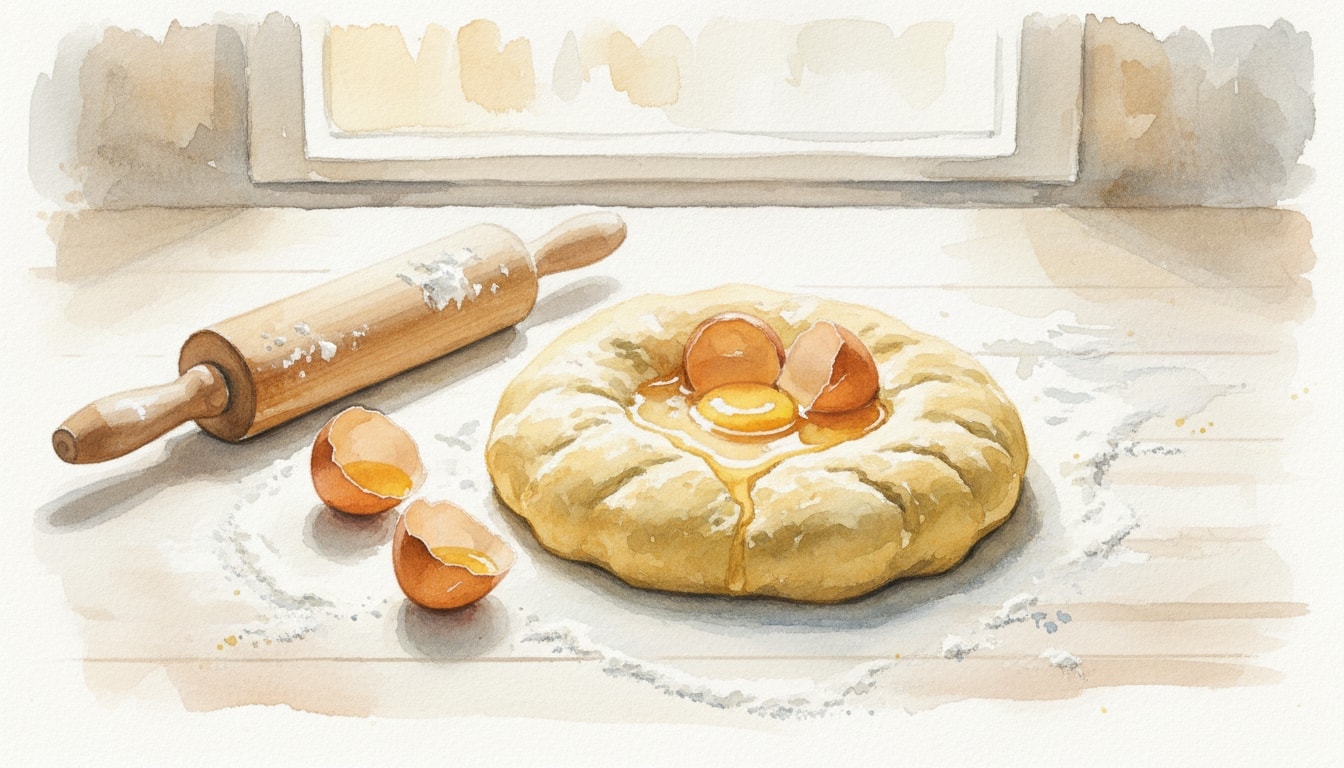
Pour the flour onto a wooden board or clean work surface. Create a deep well in the center using the bottom of a bowl or your fist, ensuring the walls are high enough to contain the eggs (the 'fontana' method).
Crack the eggs into the well. Add the salt and olive oil (if using) into the eggs.
Using a fork, gently beat the eggs to break the yolks without breaching the flour walls. Gradually begin incorporating flour from the inner walls into the egg mixture, a little at a time, until a thick custard-like paste forms.
When the mixture is too thick to use a fork, use the bench scraper to fold the remaining outer flour over the center. Press down with your hands to form a shaggy mass.
Begin kneading the dough. Push the dough away from you with the heel of your hand, fold it back over itself, and rotate 90 degrees. Repeat vigorously for 10 minutes until the dough is smooth, elastic, and springs back when poked.
Wrap the dough tightly in plastic wrap to prevent a skin from forming. Let it rest at room temperature for at least 30 minutes. This relaxes the gluten, making it rollable.
To roll by machine: Cut off 1/4 of the dough (keep the rest covered). Flatten slightly and pass through the widest setting. Fold the dough in thirds (laminating) and pass through again. Repeat 3 times, then decrease thickness settings one by one until desired thinness (usually setting 6 or 7).
To roll by hand: Flour the surface and rolling pin. Roll the dough from the center outwards, rotating the sheet frequently to maintain a circular shape and even thickness, aiming for a translucent sheet (approx. 1mm).
Chef's Notes
- Humidity affects pasta dough significantly. On a humid day, you may need slightly more flour; on a dry day, slightly less.
- If using a wooden board, scrape it clean immediately after use but avoid using soap to maintain the wood's seasoning.
- For 'Type 00' flour, the dough will be silkier. All-purpose flour yields a slightly chewier result.
Storage
Refrigerator: 1 day — Wrap tightly in plastic wrap to prevent oxidation (greying).
Freezer: 1 month — Place wrapped dough in a freezer-safe bag. Thaw overnight in refrigerator.
Troubleshooting
Dough is too dry or crumbly to form a ball
Cause: Eggs were too small or flour measured heavily
Fix: Wet your hands with water and continue kneading to introduce micro-amounts of moisture
Prevention: Weigh eggs; use a scale for flour
Dough shrinks back immediately when rolling
Cause: Gluten is not relaxed enough
Fix: Cover and rest for another 15-20 minutes
Prevention: Ensure full 30-minute rest
Dough sticks to the machine rollers
Cause: Dough is too hydrated
Fix: Dust the dough sheet liberally with flour before passing through again
Prevention: Incorporate enough flour during the initial mix
Cultural Context
In Bologna, the 'sfoglia' (sheet of pasta) is traditionally rolled by hand using a long rolling pin called a 'mattarello'. The goal is to make it thin enough to read a newspaper through.