Equipment
Ingredients
Sausages and Base Vegetables
- 8 thick pork sausages, raw
- 15 ml olive oil
- 1 brown onion, diced
- 1 carrot, diced
- 1 celery, diced
- 3 garlic, minced
Sauce and Beans
- 30 g tomato paste
- 400 g canned chopped tomatoes
- 250 ml chicken broth
- 400 g canned butter beans, drained and rinsed
- 3 g dried mixed herbs
- 2 g smoked paprika
- 15 ml worcestershire sauce
Nutrition (per serving)
Nutrition is estimated per serving. Nutrients without complete source data are omitted.
Full nutrition
- Calories
- 616 kcal
- Protein
- 33 g
- Carbohydrates
- 27 g
- Fat
- 43 g
- Fiber
- 7 g
- Sugar
- 11 g
- Sodium
- 2583 mg
- Saturated Fat
- 12 g
- Trans Fat
- 0 g
- Monounsaturated Fat
- 18 g
- Polyunsaturated Fat
- 7 g
- Cholesterol
- 106 mg
- Potassium
- 1061 mg
- Calcium
- 54 mg
- Iron
- 5.7 mg
- Magnesium
- 38 mg
- Phosphorus
- 278 mg
- Zinc
- 3.6 mg
- Vitamin A
- 296 mcg
- Vitamin C
- 28 mg
- Vitamin D
- 2.1 mcg
- Vitamin E
- 2.4 mg
- Vitamin K
- 10 mcg
- Vitamin B6
- 0.4 mg
- Vitamin B12
- 1.5 mcg
- Thiamin
- 0.40 mg
- Riboflavin
- 0.31 mg
- Niacin
- 10.0 mg
- Folate
- 24 mcg
- Water
- 221 g
Sources: Aggregated Public Data, USDA FoodData Central
Method
Using a chef's knife and cutting board, dice the onion, carrot, and celery. Mince the garlic.
Heat the olive oil in a large Dutch oven over medium heat. Add the raw pork sausages and sear until deeply browned on all sides. Remove the sausages and set aside on a plate.
Add the diced onion, carrot, and celery to the residual sausage fat in the Dutch oven. Sauté using a wooden spoon until the vegetables are softened and the onion is translucent.
Stir in the minced garlic, tomato paste, dried mixed herbs, and smoked paprika. Sauté briefly until highly fragrant and the tomato paste darkens to a rust color.
Pour in the chicken broth, using the wooden spoon to scrape up any browned bits from the bottom of the pot. Stir in the canned chopped tomatoes, drained butter beans, and Worcestershire sauce.
Return the browned sausages and any accumulated juices to the pot. Bring the liquid to a gentle boil, then reduce the heat to low. Simmer uncovered until the sauce has thickened and the sausages are cooked through, reaching an internal temperature of 74°C (165°F).
Remove the Dutch oven from the heat and allow the casserole to rest for 5 minutes before serving.
Chef's Notes
- For the best flavor, choose high-quality British-style pork sausages like Cumberland or Lincolnshire. They release savory seasoned fat that forms the essential flavor base of the stew.
- Do not rush searing the sausages. The Maillard reaction on the sausage skins and the fond left in the pan are critical for creating a rich, deeply flavored gravy without relying on heavy stock reductions.
- Butter beans are ideal for this dish because their creamy interiors contrast beautifully with the meaty sausages, and their starches naturally thicken the tomato gravy as it simmers.
Storage
Refrigerator: 3 days — Flavors develop and deepen overnight.
Freezer: 3 months — Butter beans may soften slightly upon thawing.
Reheating: Reheat gently on the stovetop or microwave until piping hot, reaching at least 74 degrees Celsius or 165 degrees Fahrenheit.
Troubleshooting
Sauce is too thin and watery
Cause: Simmered with a lid on, trapping steam, or not simmered long enough to evaporate liquids
Fix: Remove the sausages to a plate, turn the heat to medium-high, and boil the sauce rapidly for 5 to 8 minutes until properly reduced
Prevention: Ensure the casserole is simmered uncovered to allow natural reduction
Sausage skins are pale and lack flavor
Cause: Pan was too cold during searing or overcrowded, leading to steaming instead of frying
Fix: Cannot be completely fixed once liquid is added, but adding a splash of Worcestershire sauce or a pinch of bouillon can boost umami
Prevention: Preheat the oil properly and sear in batches if the pot is not wide enough
Cultural Context
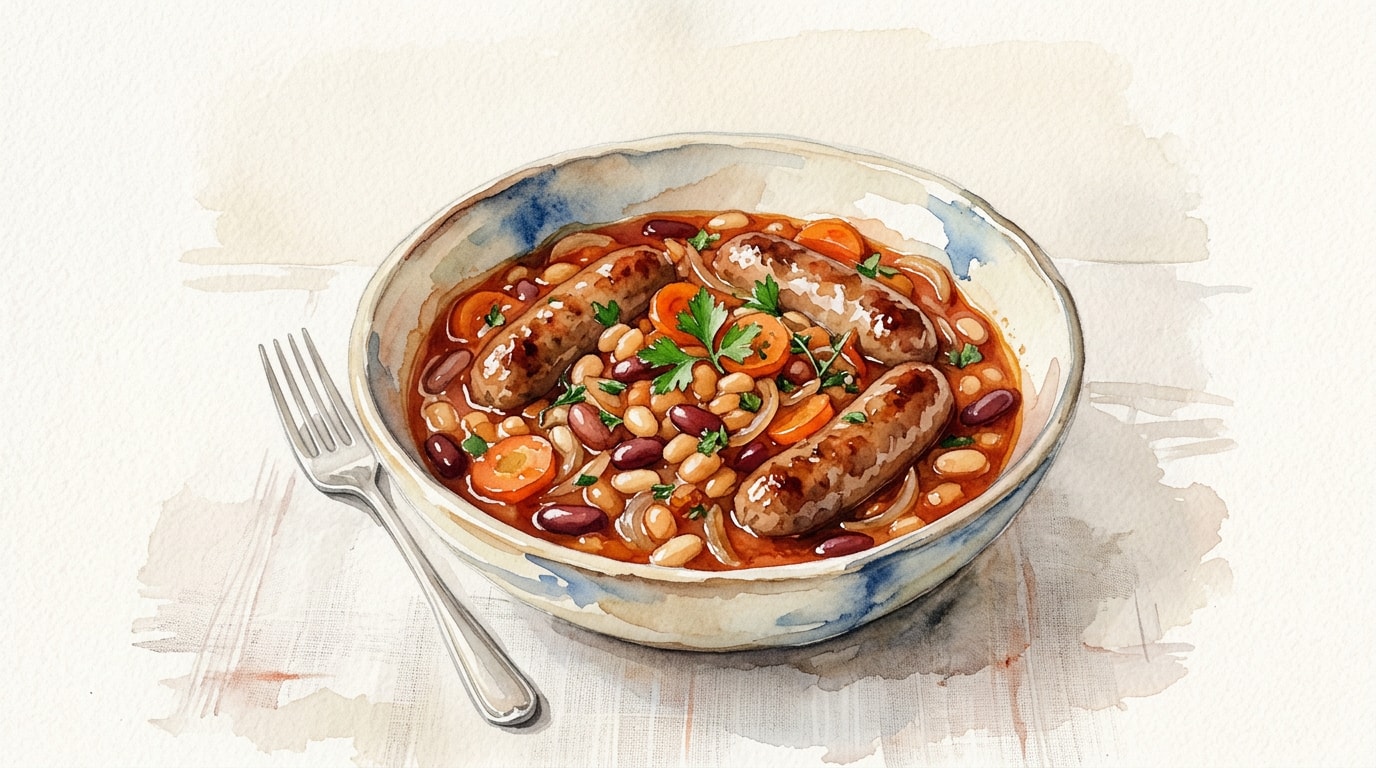
Sausage casserole is a quintessential British comfort food, heavily relied upon during the cold and damp autumn and winter months. Historically, it was a practical way for working-class families to stretch expensive meat by combining it with hearty root vegetables, inexpensive beans, and rich gravies. Today, it remains a beloved family weeknight staple, traditionally served alongside creamy mashed potatoes or crusty bread to mop up the savory tomato sauce.