Equipment
Ingredients
Day 1 (The Capture)
- 60 g whole rye flour, room temperature
- 60 ml filtered water, lukewarm (26°C/78°F)
Days 2-7 (The Feedings)
- 500 g unbleached all-purpose flour
- 500 ml filtered water, lukewarm
Nutrition (per serving)
Nutrition is estimated per serving. Nutrients without complete source data are omitted.
Full nutrition
- Calories
- 506 kcal
- Protein
- 15 g
- Carbohydrates
- 106 g
- Fat
- 2 g
- Fiber
- 5 g
- Sugar
- 0 g
- Sodium
- 8 mg
- Saturated Fat
- 0 g
- Monounsaturated Fat
- 0 g
- Polyunsaturated Fat
- 1 g
- Potassium
- 188 mg
- Calcium
- 28 mg
- Iron
- 6.3 mg
- Magnesium
- 49 mg
- Phosphorus
- 189 mg
- Zinc
- 1.3 mg
- Vitamin E
- 0.2 mg
- Vitamin K
- 1 mcg
- Vitamin B6
- 0.1 mg
- Thiamin
- 1.06 mg
- Riboflavin
- 0.64 mg
- Niacin
- 8.1 mg
- Folate
- 235 mcg
- Water
- 156 g
Sources: USDA FoodData Central
Method
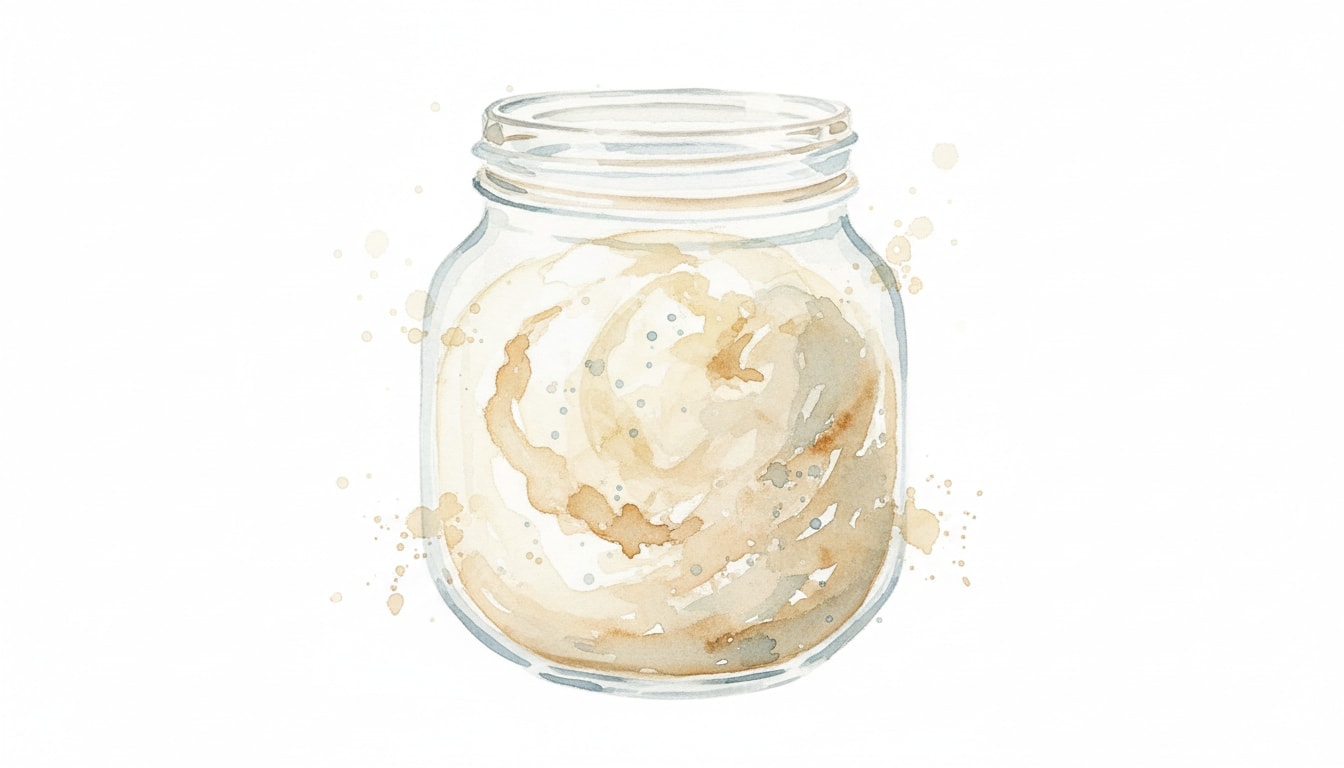
Day 1: In a clean glass jar, combine 60g of whole rye flour and 60ml of lukewarm water (26°C/79°F). Mix thoroughly until no dry flour remains.
Cover the jar loosely with a breathable material (like a paper towel or loose lid) to allow airflow but prevent debris entry. Place in a warm spot (24-26°C / 75-79°F) for 24 hours.
Day 2: Check for bubbles. You may see no activity yet, which is normal. Discard half of the mixture (about 60g). Add 60g of unbleached all-purpose flour and 60ml of lukewarm water to the remaining starter. Mix well, cover, and rest for another 24 hours.
Day 3: You should start to see bubbling and a fresh, yeasty aroma. If a dark liquid (hooch) forms on top, it is hungry. Discard all but 60g of the starter. Feed with 60g all-purpose flour and 60ml water. Mix and rest for 24 hours.
Days 4-6: Repeat the process daily: discard all but 60g of starter, then feed with 60g flour and 60ml water. The starter will begin to rise and fall predictably. Mark the level on the jar with a rubber band to track growth.
Day 7: The starter is ready when it doubles or triples in volume within 4-6 hours of feeding, has a pleasant sour-fruity smell, and passes the 'float test' (a teaspoon dropped in water floats).
Chef's Notes
- Identifying Peak: The starter is at its strongest when it has reached its highest point in the jar and the top surface just begins to flatten (doming).
- Water Quality: If your tap water is heavily chlorinated, let it sit out open for 24 hours or use bottled spring water, as chlorine can inhibit yeast growth.
- Maintenance Mode: Once established, store in the fridge and feed once a week. Let it come to room temperature for 1 hour before feeding.
Storage
Refrigerator: 3 months — Feed once weekly to maintain health. Store in an airtight jar.
Freezer: 12 months — Spread thin on parchment, dry until brittle, then freeze flakes.
Troubleshooting
Dark liquid accumulates on top
Cause: The starter is hungry/starving (This liquid is 'hooch')
Fix: Pour off the liquid and perform a normal feeding immediately
Prevention: Feed more frequently or increase the feeding ratio (less starter, more flour/water)
Pink or orange streaks appear
Cause: Harmful bacteria (Serratia marcescens) contamination
Fix: Cannot be fixed. Discard entire batch and sanitize equipment.
Prevention: Sterilize jars and wash hands thoroughly before feeding
Smells like acetone or nail polish remover
Cause: Starter is extremely hungry and acidic
Fix: Discard 90% of the starter and feed with a high ratio (1:5:5) to refresh
Prevention: Feed more frequently (every 12 hours)
Cultural Context
Sourdough starter is a living testament to ancient baking techniques, predating commercial yeast by millennia. Its origins are deeply intertwined with the earliest forms of leavened bread, likely discovered accidentally when wild yeasts and bacteria from flour and the environment began fermenting dough left to rest. It's a cornerstone of artisanal bread making across many cultures, particularly in Europe and North America, where regional variations in flavor and leavening power are prized.