
Equipment
Ingredients
Vegetables
- 300 g zucchini, medium dice (1cm cubes)
- 300 g yellow squash, medium dice (1cm cubes)
- 150 g yellow onion, finely diced
- 100 g celery, finely diced
Aromatics & Sauce
- 80 g green olives, pitted and roughly chopped
- 30 g capers, rinsed
- 150 ml tomato purée, passata
- 60 ml extra virgin olive oil
- 45 ml red wine vinegar
- 25 g granulated sugar
- salt
Garnish (Optional)
- 5 g fresh mint, torn
- 20 g pine nuts, toasted
Nutrition (per serving)
Nutrition is estimated per serving. Nutrients without complete source data are omitted.
Full nutrition
- Calories
- 92 kcal
- Protein
- 1 g
- Carbohydrates
- 6 g
- Fat
- 7 g
- Fiber
- 2 g
- Sugar
- 4 g
- Sodium
- 303 mg
- Saturated Fat
- 1 g
- Monounsaturated Fat
- 4 g
- Polyunsaturated Fat
- 1 g
- Potassium
- 161 mg
- Calcium
- 13 mg
- Iron
- 0.5 mg
- Magnesium
- 19 mg
- Phosphorus
- 35 mg
- Zinc
- 0.2 mg
- Vitamin A
- 8 mcg
- Vitamin C
- 8 mg
- Vitamin E
- 1.0 mg
- Vitamin K
- 6 mcg
- Vitamin B6
- 0.0 mg
- Thiamin
- 0.01 mg
- Riboflavin
- 0.02 mg
- Niacin
- 0.1 mg
- Folate
- 7 mcg
- Water
- 30 g
Sources: Aggregated Public Data, USDA FoodData Central
Method
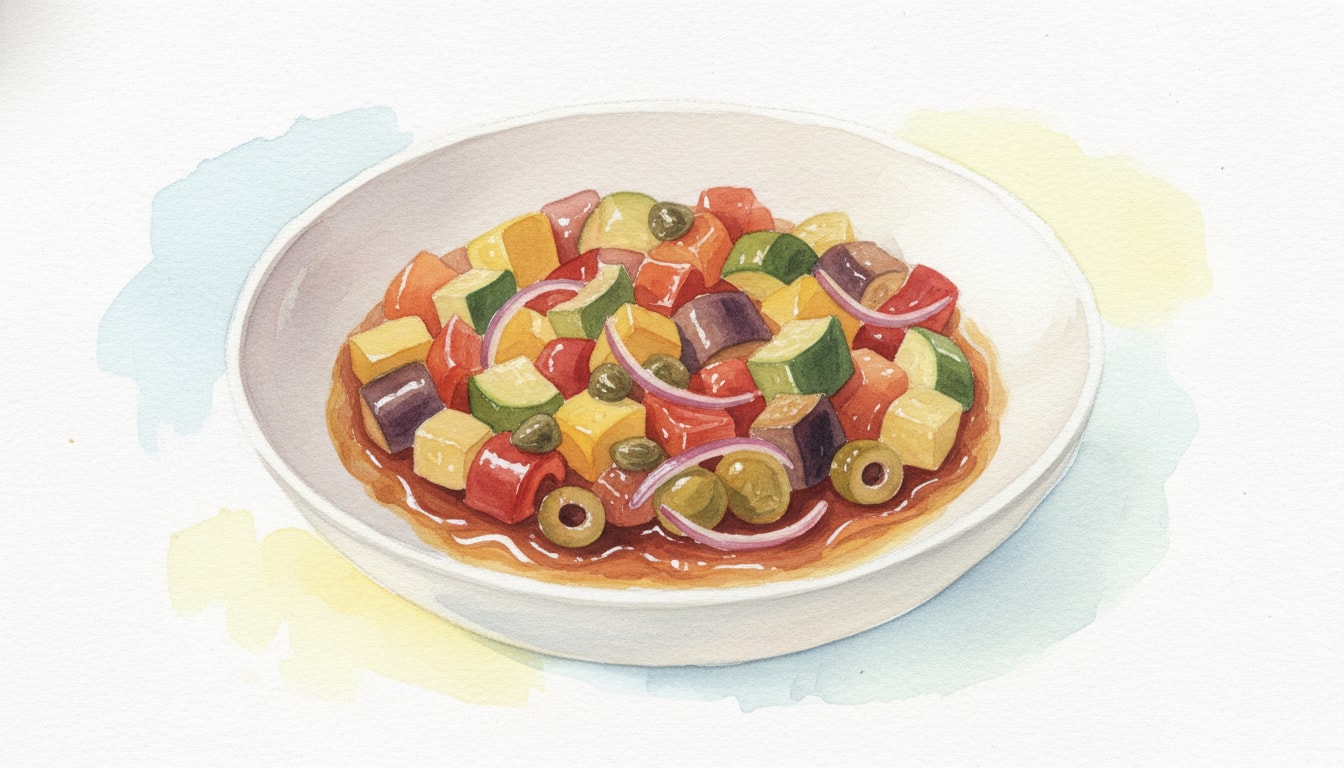
Wash and dice the zucchini and yellow squash into uniform 1cm cubes. Dice the onion and celery to a slightly smaller size.
Heat 40ml of olive oil in a large skillet over medium-high heat (approx 190°C/375°F). Add the zucchini and yellow squash in a single layer (do this in batches if necessary to avoid steaming).
Fry the squash for 6-8 minutes until golden brown and tender but not mushy. Remove with a slotted spoon and set aside in a bowl.
In the same pan, add the remaining 20ml olive oil. Add the onion and celery. Sauté over medium heat (160°C/320°F) until softened and translucent.
Stir in the tomato purée, chopped olives, and capers. Simmer gently for 5 minutes to meld the flavors.
Pour in the red wine vinegar and sprinkle the sugar over the mixture. Stir well and cook for 2-3 minutes until the vinegar pungency evaporates and the sauce thickens slightly.
Return the fried zucchini and squash to the pan. Fold gently to coat the vegetables in the sauce without crushing them. Cook for 1 minute to warm through.
Remove from heat and transfer to a serving dish. Let the caponata cool completely to room temperature (at least 1 hour) to allow the sweet and sour flavors to penetrate the vegetables. Garnish with torn mint and toasted pine nuts before serving.
Chef's Notes
- The secret to a great caponata is the 'agrodolce' balance. Taste the sauce before adding the vegetables back in; it should trigger both salivation (sour) and satisfaction (sweet). Adjust vinegar or sugar by 5g increments if needed.
- Do not skip the cooling step. Hot caponata tastes disjointed; room temperature caponata is harmonious.
- For a true finger food experience, serve spoonfuls of this mixture atop toasted baguette slices rubbed with a raw garlic clove.
- If using salted capers, soak them in water for 10 minutes and rinse thoroughly to control the sodium level.
Storage
Refrigerator: 5 days — Flavors improve significantly after 24 hours.
Reheating: Serve at room temperature. Do not reheat.
Troubleshooting
Vegetables are mushy or disintegrating
Cause: Overcrowded pan during the initial frying step caused steaming instead of searing
Fix: Cannot be fixed structurally, but serve as a spread or dip for crusty bread rather than a fork dish
Prevention: Fry the squash in batches so they have space to brown quickly
Cultural Context
Originating from Sicily, Caponata is a testament to the island's complex history, blending Italian vegetables with Arab influences like sugar, citrus, and sour notes. While eggplant is the traditional star, summer squash versions ('Caponata di Zucchine') are a common seasonal variation in Italian households when gardens are overflowing with zucchini.


