Equipment
Ingredients
Vanilla Sponge
- 200 g plain flour
- 150 g caster sugar
- 8 g baking powder
- 1 g fine sea salt
- 180 ml oat milk
- 120 ml aquafaba, at room temperature
- 60 ml sunflower oil
- 10 ml vanilla extract
- 10 ml apple cider vinegar
Raspberry Jelly
- 300 g raspberries, fresh or frozen
- 80 g caster sugar
- 250 ml water
- 7 g agar agar powder
- 15 ml lemon juice
Vegan Custard
- 500 ml oat milk
- 40 g cornstarch
- 80 g caster sugar
- 1 g fine sea salt
- 60 ml coconut cream, full fat, stirred
- 10 ml vanilla extract
- 1 g ground turmeric
Coconut Whipped Cream
- 400 ml coconut cream, full fat, chilled at least 24 hours, solid portion only
- 30 g powdered sugar
- 5 ml vanilla extract
Assembly
- 250 g fresh raspberries
- 10 g powdered sugar
Nutrition (per serving)
Nutrition is estimated per serving. Nutrients without complete source data are omitted.
Full nutrition
- Calories
- 705 kcal
- Protein
- 10 g
- Carbohydrates
- 99 g
- Fat
- 31 g
- Fiber
- 9 g
- Saturated Fat
- 19 g
Sources: Aggregated Public Data, USDA FoodData Central
Method
Preheat the oven to 180°C (350°F). Grease a 23cm round cake tin and line the base with baking parchment.
Drain one 240g can of chickpeas over a measuring jug, reserving exactly 120ml of the clear aquafaba liquid. Discard the chickpeas or reserve for another dish. Set the aquafaba aside at room temperature.
Into a large mixing bowl, sift together 200g plain flour, 8g baking powder, and 1g fine sea salt. Whisk briefly to combine.
In a separate medium bowl, combine 180ml oat milk, 60ml sunflower oil, 10ml vanilla extract, and 10ml apple cider vinegar. Whisk until smooth.
Pour the wet mixture into the dry ingredients and whisk gently until you have a smooth, lump-free batter. Do not overmix.
In a scrupulously clean, grease-free mixing bowl, whip the 120ml aquafaba with an electric mixer on high speed for 3 to 4 minutes until stiff, glossy peaks form that hold their shape when the whisk is lifted.
Using a rubber spatula, fold the whipped aquafaba into the batter in three additions, cutting through the centre and sweeping along the base of the bowl each time. Preserve as much air as possible; the finished batter should look pillowy and pale.
Pour the batter into the prepared cake tin, gently spreading it into an even layer with the spatula.
Bake on the middle rack for 25 to 30 minutes, until the top is golden brown, springs back when lightly pressed, and a skewer inserted into the centre comes out clean. The internal temperature should reach 95°C (203°F).
Cool the sponge in the tin for 10 minutes, then turn it out onto a wire rack and leave to cool completely, at least 30 minutes.
While the sponge cools, prepare the jelly. Combine 300g raspberries, 80g caster sugar, and 250ml water in a medium saucepan. Crush the berries gently with the back of a spoon and bring to a gentle simmer over medium heat.
Simmer for 5 minutes, then pour the mixture through a fine sieve into a small saucepan, pressing the berries firmly with a spoon to extract all the juice. Discard the seeds and pulp.
Whisk 7g agar agar powder and 15ml lemon juice into the strained juice. Bring to a rolling boil over high heat and cook for a full 2 minutes, whisking constantly, to fully activate the agar agar.
Pour the hot jelly into the shallow rectangular dish and refrigerate for 1.5 to 2 hours, until firmly set and sliceable.
For the custard, whisk together 40g cornstarch, 80g caster sugar, and 1g fine sea salt in a medium saucepan.
Gradually whisk in 500ml oat milk, a little at a time, until completely smooth with no visible lumps of cornstarch.
Place the saucepan over medium-low heat and cook, whisking constantly, for 8 to 10 minutes, until the custard thickens enough to coat the back of a spoon and a line drawn with your finger holds clearly.
Remove the pan from the heat and whisk in 60ml coconut cream, 10ml vanilla extract, and 1g ground turmeric (if using) until silky and uniformly pale yellow.
Pour the custard into a bowl, press a sheet of cling film directly onto the surface to prevent a skin from forming, and refrigerate until completely cool, about 45 minutes.
For the whipped cream, place a mixing bowl and the electric mixer beaters in the freezer for 10 minutes. Open the two chilled cans of coconut cream and scoop out only the thick, solid cream from the tops, leaving the watery liquid behind (reserve it for smoothies or curries).
Whip the chilled coconut cream with the electric mixer on medium speed for 2 to 3 minutes, until soft peaks begin to form.
Add 30g powdered sugar and 5ml vanilla extract, then continue whipping for another minute until the cream holds stiff, billowy peaks. Cover and refrigerate until needed.
Slice the cooled sponge horizontally into 2cm thick slices, then cut each slice into bite-sized pieces roughly 4cm square.
Arrange a single layer of sponge pieces in the base of the trifle dish, fitting them snugly and covering the bottom completely.
Scatter 100g of the fresh raspberries evenly over the sponge layer, tucking some against the glass so they show through.
Turn the set jelly out onto a board and cut into 1.5cm cubes. Scatter half of the cubes evenly over the raspberries.
Spoon half of the cooled custard over the jelly and spread it gently with the spatula, taking care not to disturb the layers beneath.
Top with half of the whipped coconut cream and smooth it into an even layer with the back of a spoon.
Repeat the layers in the same order: remaining sponge pieces, the remaining 150g fresh raspberries, the remaining jelly cubes, and the remaining custard.
Finish with the remaining whipped coconut cream, creating soft swirls and peaks with the back of a spoon.
Garnish the top with a few whole fresh raspberries and a light dusting of powdered sugar, if using.
Cover the trifle loosely with cling film and refrigerate for at least 2 hours, ideally overnight, to allow the sponge to absorb the surrounding moisture and the flavours to meld.
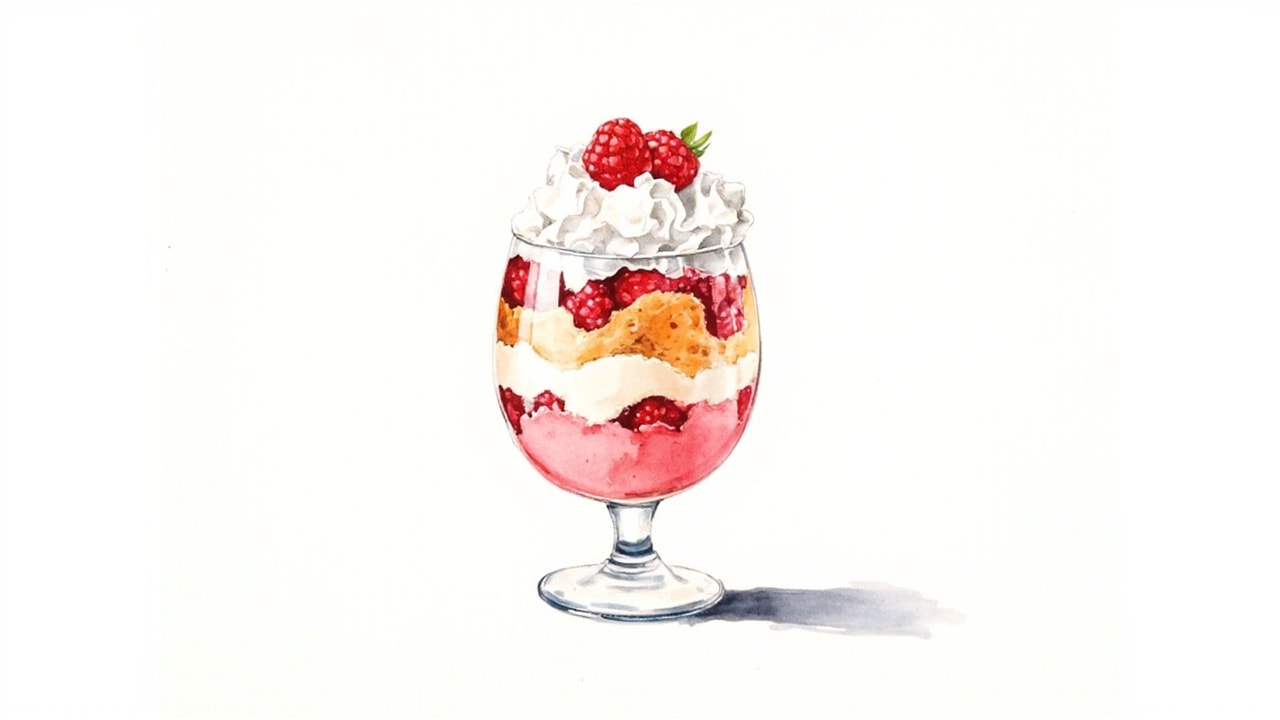
Serve chilled in individual glass bowls or tumblers, scooping down through all the layers to showcase the colourful strata. Consume within 3 days.
Chef's Notes
- Aquafaba works as an egg replacer because its soluble proteins mimic egg whites when whipped. A scrupulously clean bowl is non-negotiable, as even a trace of fat will prevent the aquafaba from reaching stiff peaks and leave you with a flat, dense sponge.
- Coconut cream must be thoroughly chilled, at least 24 hours in the refrigerator, before the solid cream will separate cleanly from the watery liquid. Only whip the thick, fatty portion; the reserved liquid is excellent in curries, soups, or smoothies.
- Agar agar sets firmly at room temperature and holds its shape far better than animal gelatin, but it must be boiled for a full 2 minutes to activate. Under-boiling is the single most common reason vegan trifles end up with a soft, weeping jelly layer.
- For the cleanest visible layers, every component must be thoroughly chilled before assembly. Warm custard or cream will melt the jelly and cause the colours to bleed into one another.
- The trifle improves significantly with overnight resting. The sponge absorbs some of the surrounding moisture, the raspberries perfume the custard, and the layers settle into a cohesive, sliceable whole, which is why trifles have traditionally been made the day before serving.
Storage
Refrigerator: 3 days — Cover loosely with cling film; consume within 3 days for best texture.
Troubleshooting
Sponge cake is dense, heavy, or gummy
Cause: The aquafaba was either under-whipped, or deflated during folding, or the batter was overmixed once the aquafaba was added.
Fix: Cannot be fixed once baked; serve the dense sponge crumbled over ice cream or as a parfait base instead.
Prevention: Whip the aquafaba to genuinely stiff peaks and fold it in gently in three additions, stopping the moment the batter looks uniform.
Custard is lumpy or grainy
Cause: The cornstarch was added to the milk without being properly dispersed, or the custard was not whisked continuously during cooking.
Fix: Press the warm custard through a fine sieve, or blend briefly with an immersion blender until smooth.
Prevention: Whisk the cornstarch with the sugar first, then add the milk gradually while whisking, and never stop stirring once the pan is on the heat.
Coconut cream refuses to whip or stays liquid
Cause: The cream was not cold enough, or the solid and watery portions were whipped together instead of separated.
Fix: Return the mixture to the refrigerator for 30 minutes, then re-whip. If it still will not hold peaks, fold in 2 tablespoons of melted and cooled coconut butter.
Prevention: Chill the cans for at least 24 hours and chill the bowl and beaters in the freezer for 10 minutes; scoop only the thick, solid cream.
Jelly is soft, runny, or weepy and sinks through the other layers
Cause: The agar agar was not boiled long enough to activate, or the jelly was not fully set before being cut and layered.
Fix: Return the cubes to a clean dish and refrigerate for another 30 minutes; if still soft, dissolve an additional 1g agar agar in a little boiling water and stir it into a new batch.
Prevention: Boil the agar mixture vigorously for the full 2 minutes and allow at least 1.5 hours of chilling before cubing.
Layers bleed into one another and the sponge becomes soggy
Cause: The custard and whipped cream were not chilled thoroughly before assembly, or the assembled trifle was not given enough resting time.
Fix: Cannot be reversed once assembled; serve in tall glasses as a deconstructed trifle and call it a parfait.
Prevention: Ensure every component is cold before layering and refrigerate the finished trifle for at least 2 hours, preferably overnight.
Cultural Context
Trifle is a quintessentially British dessert with origins tracing back to the late 16th century, when it began as a thick cream flavoured with sugar, rosewater, and ginger, layered with sponge biscuits. By the Victorian era it had evolved into the elaborate, architecturally layered showpiece of sponge, fruit jelly, custard, and cream served in cut-glass bowls that became a centrepiece of celebratory British dining. This plant-based interpretation honours the original's signature contrasts of airy sponge, jiggly jelly, silken custard, and billowy cream while replacing eggs, dairy, and animal gelatin with aquafaba, oat milk, coconut cream, and agar agar.