
Equipment
* optional
Ingredients
Angel Cake
- 120 g cake flour, sifted
- 300 g granulated sugar
- 12 egg white, room temperature
- 5 g cream of tartar
- 2 g fine salt
- 10 ml vanilla extract
Rum-Vanilla Whipped Cream Frosting
- 480 ml heavy cream, very cold
- 60 g powdered sugar, sifted
- 45 ml dark rum
- 5 ml vanilla extract
Garnish
- 30 g toasted sliced almonds, lightly toasted and cooled
Nutrition (per serving)
Nutrition is estimated per serving. Nutrients without complete source data are omitted.
Full nutrition
- Calories
- 399 kcal
- Protein
- 7 g
- Carbohydrates
- 48 g
- Fat
- 19 g
- Fiber
- 1 g
- Sugar
- 38 g
- Sodium
- 152 mg
- Saturated Fat
- 11 g
- Trans Fat
- 1 g
- Monounsaturated Fat
- 5 g
- Polyunsaturated Fat
- 1 g
- Cholesterol
- 55 mg
- Potassium
- 224 mg
- Calcium
- 45 mg
- Iron
- 1.1 mg
- Magnesium
- 18 mg
- Phosphorus
- 58 mg
- Zinc
- 0.3 mg
- Vitamin A
- 199 mcg
- Vitamin C
- 0 mg
- Vitamin D
- 0.8 mcg
- Vitamin E
- 1.2 mg
- Vitamin K
- 2 mcg
- Vitamin B6
- 0.0 mg
- Vitamin B12
- 0.1 mcg
- Thiamin
- 0.12 mg
- Riboflavin
- 0.35 mg
- Niacin
- 1.0 mg
- Folate
- 27 mcg
- Water
- 65 g
- Alcohol
- 2 g
- Caffeine
- 0 mg
Sources: Aggregated Public Data, USDA FoodData Central
Method
Position a rack in the lower third of the oven and preheat to 175°C (350°F). Do not grease the tube pan.
Sift the cake flour with 150 g of the granulated sugar twice into a bowl and set aside.
In the spotlessly clean mixer bowl, whip the egg whites with the cream of tartar and salt on medium speed until foamy and opaque, about 2 minutes, then increase to medium-high and whip to soft peaks that droop gently, about 3 minutes more.
With the mixer running on medium-high, add the remaining 150 g sugar one spoonful at a time, then beat until the meringue holds firm glossy peaks that stand nearly straight, about 3 minutes. Beat in the vanilla extract just until combined.
Sift one third of the flour mixture over the meringue and fold gently with a rubber spatula, cutting down through the center and sweeping up the sides. Repeat with the remaining flour in two additions until no dry streaks remain.
Spoon the batter into the ungreased tube pan, smooth the top, and run a thin knife through the batter once to release large air pockets.
Bake at 175°C (350°F) until the top is deep golden, springs back when lightly pressed, and a skewer inserted in the center comes out clean, about 40 minutes. For assurance, the center of this egg-based cake should register at least 71°C (160°F) on an instant-read thermometer; do not rely on carryover heat to reach that point.
Immediately invert the pan onto its feet or over the neck of a heatproof bottle and let the cake cool completely upside down, about 90 minutes, so the delicate crumb does not collapse under its own weight.
Chill the mixer bowl and whisk attachment in the refrigerator for 15 minutes so the cream whips quickly and holds its shape.
Run a thin knife around the outer and inner edges of the cooled pan, release the cake, and transfer it to a serving plate. Slice off any overly browned top crust if desired for a clean white finish.
In the chilled bowl, whip the cold heavy cream with the powdered sugar and vanilla on medium-high speed until it begins to thicken, then drizzle in the dark rum and continue whipping to soft billowy peaks that hold their shape, about 5 minutes total. Stop before the cream looks grainy.
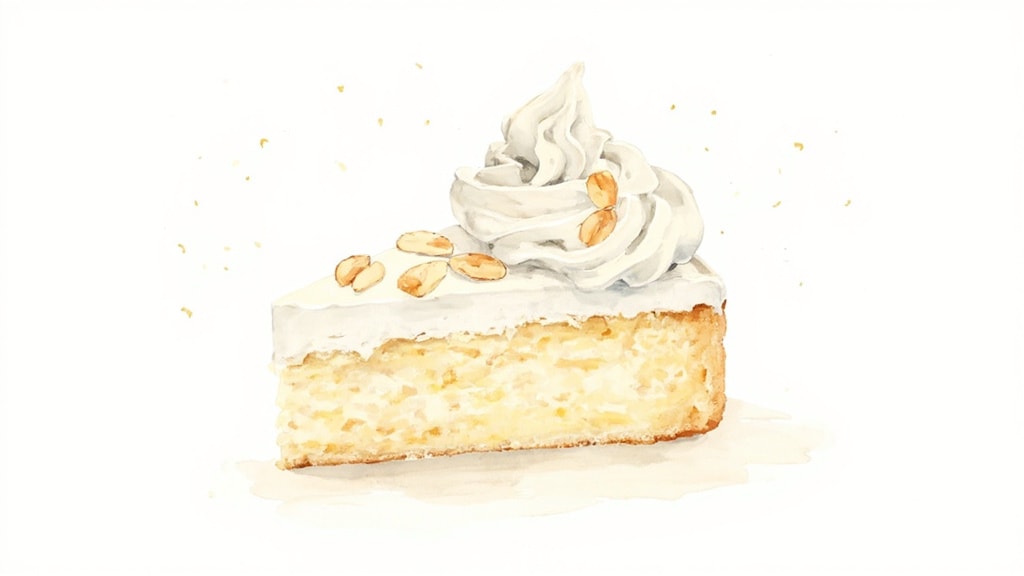
Spread the rum-vanilla whipped cream generously over the top and sides of the cake with an offset spatula, creating soft swirls.
Shower with toasted sliced almonds and serve immediately, or refrigerate promptly and serve within 4 hours for the freshest cream texture.
Chef's Notes
- Room-temperature egg whites whip to greater volume than cold ones; separate the eggs while cold for clean yolks, then let the whites sit for 30 minutes.
- Sifting the flour twice and again over the meringue keeps the batter light; never dump the flour in all at once.
- Adding the rum after the cream begins to thicken protects the foam structure and keeps the frosting stable for hours in the refrigerator.
- For clean slices, use a serrated knife and a gentle sawing motion; pressing straight down compresses the airy crumb.
- For an alcohol-free version, replace the rum with 45 ml additional cold cream and 5 ml extra vanilla extract; the frosting will be vanilla-forward rather than spirit-scented.
Storage
Refrigerator: 2 days — Refrigerate frosted cake promptly, covered, because of the whipped cream frosting. Let slices stand at cool room temperature for 15 minutes before serving for best texture.
Freezer: 3 months — Freeze the unfrosted cake only, wrapped tightly in plastic wrap and foil. Thaw overnight in the refrigerator, then frost before serving; whipped cream frosting does not freeze well.
Troubleshooting
Cake rose poorly or collapsed after baking
Cause: Whites were under-whipped, the bowl had traces of grease or yolk, or the pan was greased so the batter could not climb the sides
Fix: Cannot be fixed once baked; serve collapsed cake cubed as a trifle layer with the whipped cream and fruit
Prevention: Use a scrupulously clean metal or glass bowl, whip to firm glossy peaks, and never grease an angel food pan
Whipped cream frosting is runny and slides off the cake
Cause: Cream was not cold enough or was under-whipped before the rum was added
Fix: Chill the mixture for 20 minutes, then whip briefly again until it thickens; if it has been over-whipped into butter, it cannot be rescued
Prevention: Chill the bowl and whisk, use cream straight from the refrigerator, and whip to soft peaks that hold their shape
Cake tears or sticks when unmolding
Cause: Cake was still warm when unmolded or the knife was not run fully around the center tube
Fix: Patch torn areas with extra frosting; the swirled cream hides most imperfections
Prevention: Cool the cake completely inverted for the full 90 minutes and loosen both the outer wall and the tube
Crumb is dense and rubbery
Cause: Flour was folded too aggressively, deflating the meringue
Fix: Cannot be fixed; slice thin and serve with extra cream and berries to lighten each bite
Prevention: Sift the flour over the surface in thirds and fold with light deliberate strokes only until no streaks remain
Cultural Context
Angel food cake emerged in the United States in the late nineteenth century, prized for its snowy fat-free crumb made possible by hand-crank egg beaters and cream of tartar. Pairing it with spirit-scented whipped cream borrows from European torte traditions, where rum and other spirits have long flavored cream fillings. The combination turns a humble pantry cake into a celebration dessert.


