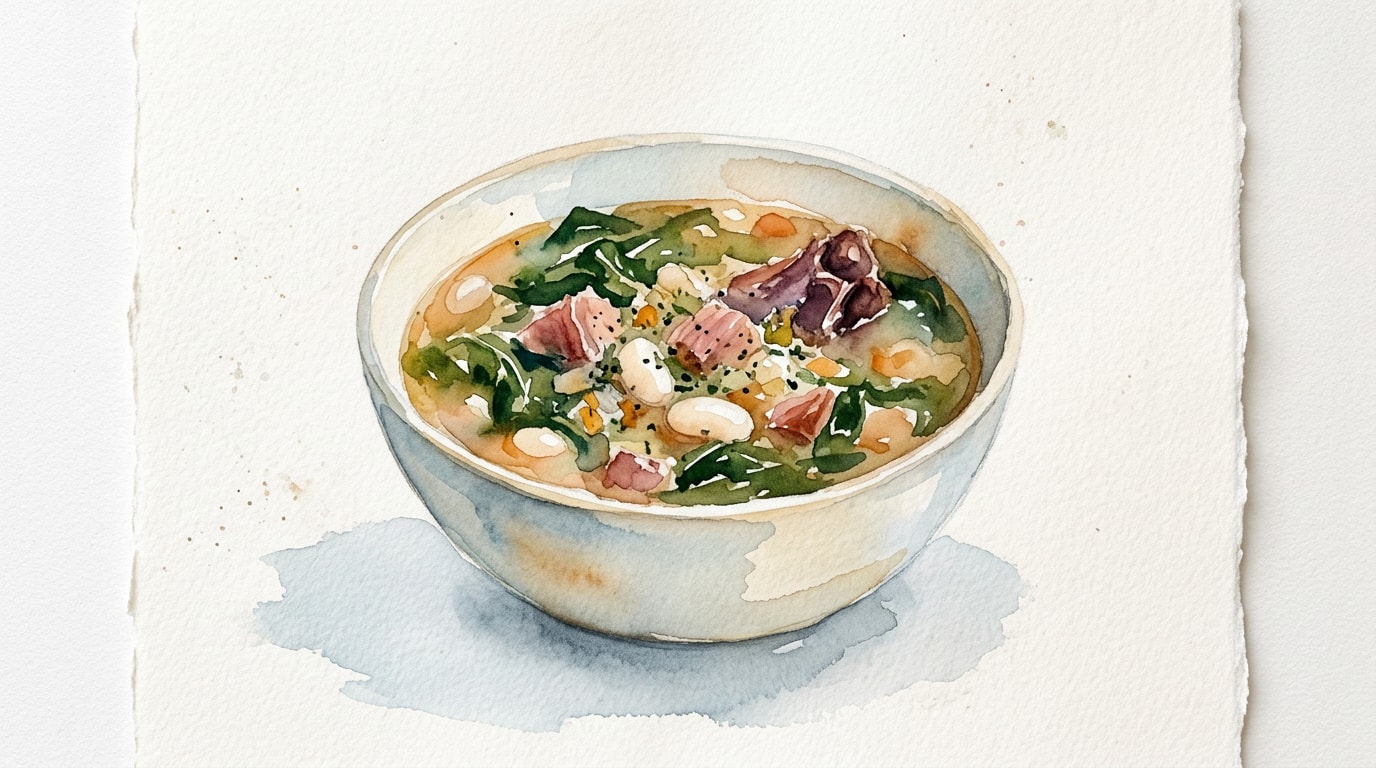
Equipment
Ingredients
Pantry & Base
- 450 g dried great northern beans
- 15 ml olive oil, room temperature
- 1000 ml low-sodium chicken broth
- 1000 ml water
Meat & Produce
- 1 leftover meaty ham bone
- 150 g yellow onion, diced
- 150 g carrots, peeled and diced
- 100 g celery, diced
- 4 garlic, minced
- 300 g collard greens, stems removed, leaves roughly chopped
Seasonings & Finishings
- 2 bay leaves, whole dried
- 2 g dried thyme, crumbled
- 2 g black pepper, freshly ground
- 15 ml apple cider vinegar
Nutrition (per serving)
Nutrition is estimated per serving. Nutrients without complete source data are omitted.
Full nutrition
- Calories
- 464 kcal
- Protein
- 37 g
- Carbohydrates
- 58 g
- Fat
- 11 g
- Fiber
- 19 g
- Sugar
- 5 g
- Sodium
- 587 mg
- Saturated Fat
- 3 g
- Trans Fat
- 0 g
- Monounsaturated Fat
- 5 g
- Polyunsaturated Fat
- 2 g
- Cholesterol
- 41 mg
- Potassium
- 1709 mg
- Calcium
- 294 mg
- Iron
- 6.0 mg
- Magnesium
- 183 mg
- Phosphorus
- 590 mg
- Zinc
- 3.8 mg
- Vitamin A
- 340 mcg
- Vitamin C
- 26 mg
- Vitamin E
- 2.1 mg
- Vitamin K
- 239 mcg
- Vitamin B6
- 0.9 mg
- Vitamin B12
- 0.5 mcg
- Thiamin
- 0.87 mg
- Riboflavin
- 0.47 mg
- Niacin
- 8.8 mg
- Folate
- 443 mcg
- Water
- 487 g
Sources: Aggregated Public Data, USDA FoodData Central
Method
Place the dried beans in a large bowl and cover with 5 centimeters of cold water. Allow them to soak overnight at room temperature. Drain and rinse thoroughly before cooking.
Heat the olive oil in a large heavy-bottomed pot over medium heat. Add the diced yellow onion, carrots, and celery. Sauté until the vegetables are softened and the onions are translucent, about 8 to 10 minutes.
Stir in the minced garlic and dried thyme. Cook until highly fragrant, taking care not to let the garlic brown, about 1 minute.
Add the drained beans, leftover ham bone, low-sodium chicken broth, water, and bay leaves to the pot. Increase the heat to high and bring the liquid to a rolling boil at 100°C/212°F.
Reduce the heat to low, cover the pot partially with a lid, and simmer gently. Cook until the beans are completely tender and creamy, which will take roughly 1.5 to 2 hours. Skim off any excess foam that rises to the surface during the first 20 minutes.
Using tongs, carefully remove the ham bone from the pot and transfer it to a cutting board. Once it is cool enough to handle safely, pull or shred all the meat from the bone. Discard the bone, fat, and gristle. Return the shredded ham to the simmering soup.
Stir the chopped collard greens into the pot. Continue to simmer uncovered until the greens are tender and dark green, about 30 minutes.
Remove the pot from the heat. Retrieve and discard the bay leaves. Stir in the apple cider vinegar and black pepper. Taste the broth cautiously; the ham bone usually provides enough salt, but you may add a pinch if necessary. Serve hot.
Chef's Notes
- Acid balance: The finishing splash of apple cider vinegar is crucial. It cuts through the heavy richness of the pork broth and brightens the earthy beans and greens without making the soup taste sour.
- Meat supplementation: If your leftover holiday ham bone was picked completely clean, you can easily supplement the soup by searing 200 grams of diced ham steak and adding it during the final 30 minutes of cooking.
- Collard preparation: The stems of mature collard greens can be exceptionally tough and fibrous. It is best to strip the leaves from the central rib completely. If you prefer zero waste, dice the stems very finely and sauté them alongside your carrots and celery.
- Creamy consistency: For a thicker, more stew-like texture, use the back of a wooden spoon to mash a portion of the beans against the side of the pot during the final 15 minutes of simmering. Their natural starches will emulsify the broth.
Storage
Refrigerator: 4 days — Flavors deepen and improve after a day in the refrigerator. Store in an airtight container.
Freezer: 3 months — Freeze in individual portions leaving 2cm of headspace for expansion. Thaw overnight in the refrigerator before reheating.
Reheating: Warm gently in a saucepan over medium-low heat until simmering. Add a splash of water or broth if the soup has thickened too much.
Troubleshooting
Beans are tough and refuse to soften even after hours of simmering.
Cause: The dried beans were very old, or acidic ingredients were introduced too early in the cooking process.
Fix: Add a quarter teaspoon of baking soda to the pot to raise the pH slightly, and continue simmering for another 45 minutes.
Prevention: Ensure dried beans are purchased from a store with high turnover. Never add tomatoes, vinegar, or salt until the beans are fully tender.
The soup broth is overwhelmingly salty.
Cause: The ham bone and residual meat contained a very high salt concentration, compounded by evaporation during simmering.
Fix: Add a peeled, quartered raw potato and simmer for 15 minutes to absorb some salt, then discard the potato. Alternatively, dilute with a splash of unsalted broth or water.
Prevention: Always use low-sodium or unsalted broth when cooking with cured meats. Avoid adding any extra salt until the very end.
Cultural Context
This hearty soup is a cornerstone of American Southern culinary resourcefulness. Rooted in an agricultural zero-waste philosophy where every part of the pig was utilized, the slow simmering of a leftover holiday ham bone extracts deep, smoky flavors and rich gelatin. This creates a luxurious foundation for nutrient-dense winter greens and economical dried beans, resulting in a dish that has nourished generations through cold winter months.