
Equipment
Ingredients
Sweet Pastry (Pate Sucree)
- 200 g plain flour
- 50 g icing sugar
- 1 g salt
- 100 g unsalted butter, cold and cubed
- 1 egg, beaten
Seville Orange Curd
- 150 g caster sugar
- 15 g cornstarch
- 3 eggs
- 3 egg yolks
- 150 ml seville orange juice, freshly squeezed
- 10 g seville orange zest, finely grated
- 120 g unsalted butter, cubed and softened slightly
Swiss Meringue
- 3 egg whites
- 180 g caster sugar
- 5 ml vanilla extract
Nutrition (per serving)
Nutrition is estimated per serving. Nutrients without complete source data are omitted.
Full nutrition
- Calories
- 552 kcal
- Protein
- 8 g
- Carbohydrates
- 71 g
- Fat
- 27 g
- Fiber
- 1 g
- Sugar
- 49 g
- Sodium
- 110 mg
- Saturated Fat
- 15 g
- Trans Fat
- 0 g
- Monounsaturated Fat
- 8 g
- Polyunsaturated Fat
- 2 g
- Cholesterol
- 220 mg
- Potassium
- 135 mg
- Calcium
- 38 mg
- Iron
- 1.0 mg
- Magnesium
- 13 mg
- Phosphorus
- 113 mg
- Zinc
- 0.7 mg
- Vitamin A
- 254 mcg
- Vitamin C
- 11 mg
- Vitamin D
- 0.8 mcg
- Vitamin E
- 1.1 mg
- Vitamin K
- 2 mcg
- Vitamin B6
- 0.1 mg
- Vitamin B12
- 0.4 mcg
- Thiamin
- 0.07 mg
- Riboflavin
- 0.24 mg
- Niacin
- 0.4 mg
- Folate
- 35 mcg
- Water
- 58 g
- Alcohol
- 0 g
Sources: USDA FoodData Central
Method
In a large mixing bowl, combine the plain flour, icing sugar, and salt.
Add the cold, cubed unsalted butter and use your fingertips to quickly rub the butter into the dry ingredients until the mixture resembles coarse sand.
Add the beaten egg and mix gently until the dough just comes together into a cohesive mass. Avoid overworking the gluten.
Shape the dough into a flat disc, wrap tightly in baking parchment or plastic wrap, and chill in the refrigerator for 1 hour.
Roll out the chilled dough with a rolling pin on a lightly floured surface to a 3mm thickness. Carefully transfer the pastry to line the 23cm fluted tart tin, pressing gently into the corners. Trim any excess overhang.
Prick the base gently with a fork and chill the lined tart tin in the refrigerator for 30 minutes to relax the pastry.
Preheat the oven to 180°C/350°F.
Line the pastry case with baking parchment and fill evenly with baking beans. Bake blind for 15 minutes.
Remove the parchment and baking beans, then return the tart shell to the oven for a further 10 minutes until the base is golden brown and fully cooked. Set aside to cool.
In a medium saucepan, whisk together the caster sugar and cornstarch to remove any lumps. Add the whole eggs, egg yolks, Seville orange juice, and Seville orange zest, whisking until smooth.
Place the saucepan over medium-low heat and cook, whisking continuously, until the mixture thickens heavily and begins to gently bubble, reaching approximately 75°C/167°F. This will take about 8 minutes.
Remove the saucepan from the heat immediately. Whisk in the softened butter, a few pieces at a time, until completely melted and the curd is smooth and glossy.
Pour the warm orange curd into the cooled baked tart shell, using a silicone spatula to smooth the surface into an even layer.
Transfer the filled tart to the refrigerator and chill for 2 hours until the curd is firmly set.
To prepare the Swiss meringue, combine the egg whites and caster sugar in a heatproof bowl set over a medium saucepan of gently simmering water, ensuring the water does not touch the bottom of the bowl.
Whisk the egg whites and sugar continuously over the heat until the sugar completely dissolves and the mixture reaches 71°C/160°F on a digital thermometer. This will take about 5 minutes.
Transfer the hot mixture to the bowl of a stand mixer fitted with a whisk attachment. Whip on high speed until stiff, glossy peaks form and the bowl feels cool to the touch. Whisk in the vanilla extract at the end.
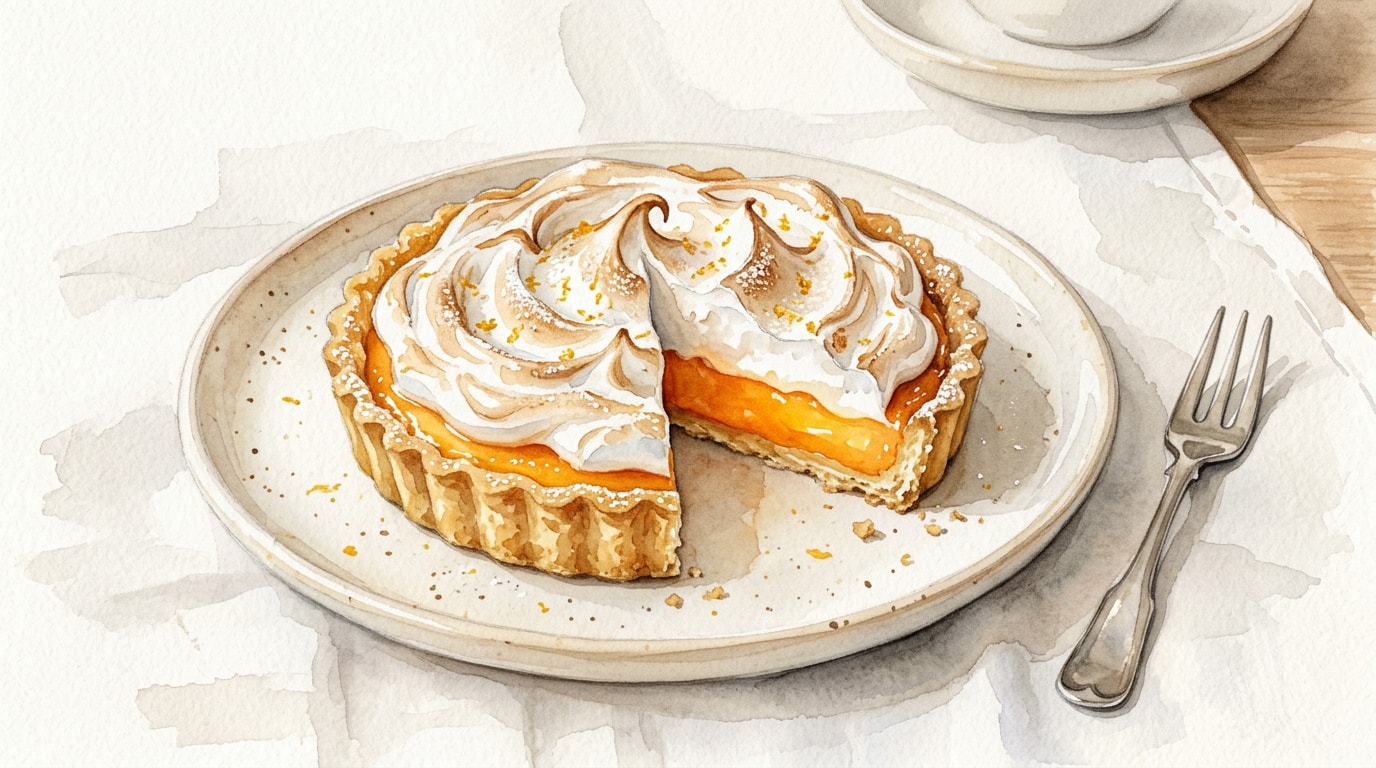
Spoon or pipe the meringue directly over the cold, set orange curd. Ensure you spread the meringue all the way to the pastry crust to create a complete seal, preventing shrinkage.
Use a culinary blowtorch to toast the peaks of the meringue until lightly caramelized and golden brown. Serve immediately or hold in the refrigerator.
Chef's Notes
- If Seville oranges are out of season, you can replicate their signature bitter profile by mixing 100ml of standard navel orange juice with 50ml of fresh lemon or grapefruit juice.
- A Swiss meringue provides much better stability than a standard French meringue, preventing the dreaded weeping layer between the citrus curd and the topping.
- When smoothing the meringue over the tart, push it firmly against the interior wall of the pastry crust. This anchors the meringue and prevents it from shrinking back to reveal the curd underneath.
- Cornstarch is added to the curd to ensure a cleanly sliceable tart. Without it, the high acidity of the oranges can sometimes interfere with the setting power of the eggs alone.
Storage
Refrigerator: 2 days — Meringue may begin to weep slightly after the first 24 hours, but remains safe to eat.
Troubleshooting
Meringue is weeping or forming sugar syrup droplets
Cause: Sugar was not fully dissolved during the water bath phase, or the whites were undercooked
Fix: Cannot be fixed once piped, but is entirely safe to eat. Serve quickly.
Prevention: Ensure the mixture reaches 71C/160F and feels entirely smooth between your fingers before whipping
Curd does not set firmly enough to slice
Cause: Insufficient cooking of the cornstarch and egg mixture, or not chilled for long enough
Fix: Chill the tart for an additional 2 to 3 hours or freeze briefly before slicing
Prevention: Allow the curd to gently bubble while whisking to activate the cornstarch fully
Pastry shrinks down the sides of the tin during baking
Cause: The dough was overworked, developing too much gluten, or it was not chilled sufficiently before baking
Fix: Cannot be fixed. If shrinkage is minor, fill with slightly less curd.
Prevention: Handle the dough minimally and ensure the full resting times in the refrigerator are adhered to
Cultural Context
Seville oranges are incredibly tart and bitter citrus fruits primarily grown in Spain, but highly prized in classic British and French preserving and pastry arts. Their short winter season makes them a highly sought-after ingredient. In this tart, their sharp, complex bitterness provides an elegant and necessary counterpoint to the intensely sweet, marshmallow-like Swiss meringue.


