Equipment
* optional
Ingredients
Turkey
- 1500 g boneless butterflied turkey breast, butterflied open, evened to about 2 cm thickness
Stuffing
- 400 g italian sausage meat, removed from casing if linked
- 250 g stale country bread, cut into 1 cm cubes and lightly toasted
- 75 g pancetta, finely diced
- 2 large eggs, lightly beaten, room temperature
- 50 g parmesan cheese, finely grated
Aromatics and herbs
- 1 yellow onion, finely diced
- 3 celery stalks, finely diced
- 4 garlic cloves, minced
- 5 g fresh sage, leaves chopped
- 3 g fresh rosemary, leaves minced
- 3 g fresh thyme, leaves stripped
Braising liquid
- 500 ml tomato juice, plain, unsweetened
- 250 ml dry white wine, at room temperature
- 250 ml turkey or chicken stock, low-sodium preferred
- 2 bay leaves, dried or fresh
For cooking and seasoning
- 45 ml olive oil, extra-virgin, divided use
- 15 g unsalted butter, for richer browning and sauce finish
- 12 g kosher salt, divided use, plus more to taste
- 3 g black pepper, freshly ground
Nutrition (per serving)
Nutrition is estimated per serving. Nutrients without complete source data are omitted.
Full nutrition
- Calories
- 1080 kcal
- Protein
- 93 g
- Carbohydrates
- 47 g
- Fat
- 46 g
- Fiber
- 3 g
- Sodium
- 2902 mg
- Saturated Fat
- 13 g
- Potassium
- 1795 mg
- Calcium
- 340 mg
- Iron
- 8.3 mg
- Magnesium
- 111 mg
- Phosphorus
- 823 mg
- Zinc
- 6.5 mg
- Vitamin A
- 94 mcg
- Vitamin C
- 65 mg
- Water
- 402 g
Sources: Aggregated Public Data, USDA FoodData Central
Method
Preheat the oven to 175°C/350°F for toasting. Spread the bread cubes on a rimmed baking sheet and toast, stirring once, until pale gold and dry to the touch, about 8 minutes. Transfer to a large mixing bowl and reduce the oven to 160°C/325°F for braising later.
Heat the Dutch oven over medium heat. Add the pancetta and cook, stirring occasionally, until crisp and the fat has rendered, about 5 minutes. Lift out the pancetta with a slotted spoon and reserve, leaving about 30 ml of fat in the pot. Add the Italian sausage meat, breaking it into roughly 2 cm pieces with a wooden spoon. Cook undisturbed for 3 minutes to form a crust, then stir and continue cooking until deeply browned with no pink remaining, 5 to 7 minutes more. Transfer the sausage and any pan drippings to the bowl of toasted bread.
Pour off all but 30 ml of fat from the Dutch oven. Return it to medium heat and add 15 ml of olive oil along with the butter. When the butter foams, add the onion, celery, garlic, sage, rosemary, and thyme. Cook, stirring occasionally, until the vegetables are translucent and beginning to caramelize at the edges, about 8 minutes. Season with 2 g of salt.
Add the cooked aromatics, reserved pancetta, beaten eggs, and grated Parmesan to the bowl of bread and sausage. Season with 6 g of salt and half the pepper. Toss gently with a large spoon until the bread is evenly moistened but not soggy. The stuffing should clump together when pressed firmly in your hand; if it feels dry, add 1 to 2 tablespoons of stock.
Lay the butterflied turkey breast skin-side down on a clean cutting board, patting the surface dry with paper towels. Cover with plastic wrap and gently pound the thicker portions with a meat mallet or rolling pin until the breast is an even 2 cm thickness throughout, about 5 minutes. Discard the plastic wrap, then season the exposed interior generously with the remaining 4 g of salt and the remaining pepper.
Spoon the stuffing evenly over the seasoned turkey, leaving a 2 cm border along the long sides and a 4 cm border along one short end. Press the stuffing down gently with the back of a spoon so it forms a compact layer. Starting from the short end opposite the bare border, roll the turkey away from you into a tight cylinder, lifting the bottom edge to tuck stuffing back in as you go. Place the roulade seam-side down and tie at 4 cm intervals with kitchen twine, finishing with a knot at each end.
Heat 30 ml of olive oil in the Dutch oven over medium-high heat until shimmering. Add the roulade and sear, turning every 2 minutes with tongs, until a deep golden crust forms on all sides, about 8 minutes total. Lift the roulade onto a plate and pour off all but 30 ml of fat from the pot.
With the pot off heat briefly, pour in the white wine and return to medium heat. Scrape the bottom with a wooden spoon to release the browned fond, stirring until the wine reduces by half and looks slightly syrupy, about 3 minutes.
Add the tomato juice, stock, and bay leaves, stirring to combine. Return the roulade seam-side down to the pot. The liquid should reach about one-third of the way up the side of the roll; top up with water if necessary. Bring to a gentle simmer, skimming any foam from the surface.
Cover the Dutch oven and transfer to the preheated 160°C/325°F oven. Braise for 1 hour 30 minutes to 2 hours, turning the roulade every 30 minutes to brown evenly on all sides. The roulade is ready when a probe thermometer inserted into the thickest part reads 74°C/165°F and juices run clear when pierced.
Lift the roulade onto a cutting board, cover loosely with foil, and rest for 15 minutes. Meanwhile, strain the braising liquid through a fine-mesh strainer into a clean saucepan, pressing gently on the solids to extract flavor. Skim off excess fat from the surface and bring the sauce to a gentle simmer.
Simmer the strained sauce until it lightly coats the back of a spoon and leaves a clean trail when a finger swipes across, 6 to 8 minutes. Taste and adjust with salt and pepper. For a glossy finish, whisk in 5 g of cold butter at the end off the heat.
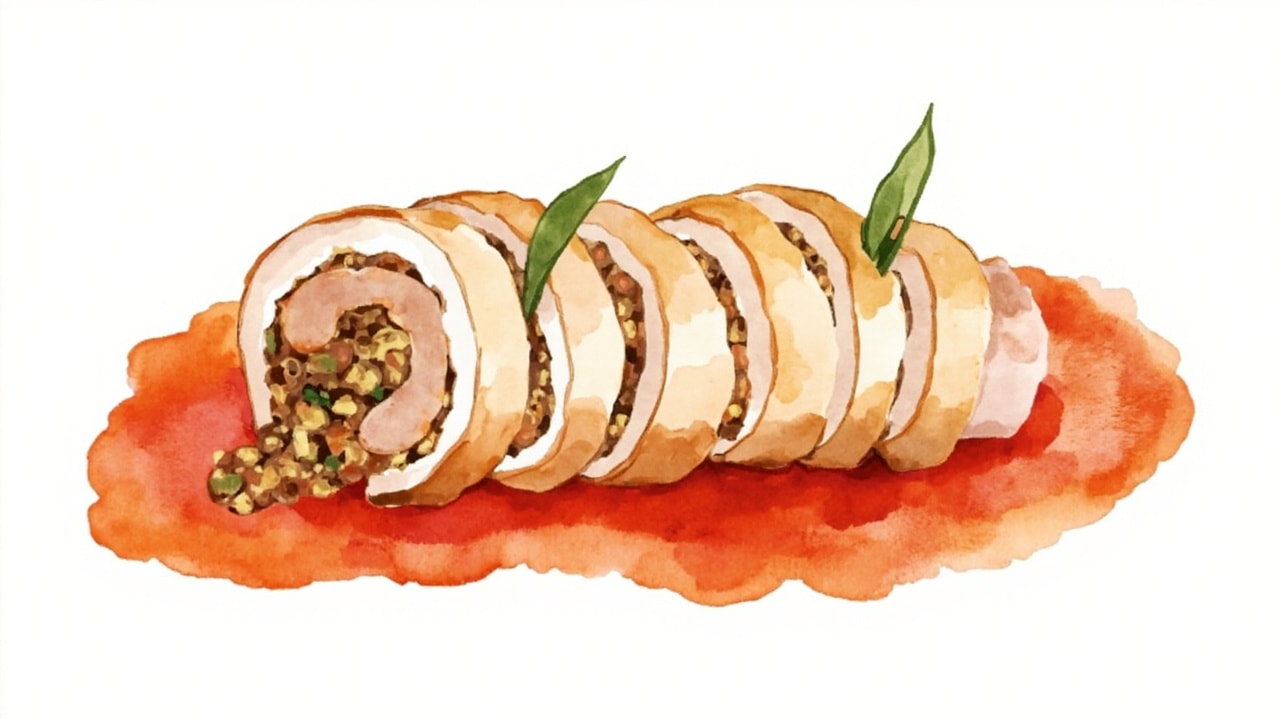
Snip and remove the kitchen twine from the rested roulade. Slice into 2 cm rounds with a sharp chef's knife using a gentle sawing motion. Arrange the slices overlapping on a warm platter.
Spoon the glossy sauce around and over the slices, finish with a final grind of pepper and a few torn basil leaves if desired, and serve immediately with crusty bread, soft polenta, or buttered egg noodles to catch the juices.
Chef's Notes
- For the most tender result, brine the turkey breast for 2 to 4 hours in a simple solution of 30 g salt and 15 g sugar dissolved in 1 liter of water, then pat dry before butterflying.
- Day-old country bread is essential for texture; fresh bread turns pasty. If your bread is fresh, leave the cubes uncovered at room temperature overnight or extend the toasting time.
- Probe the thickest portion of the roll at multiple angles; the stuffing interior can hide cool spots, and a single reading at the meat's geometric center does not always represent the worst case.
- If you have leftover braising solids after straining, do not discard them. Pulse with a splash of stock and a knob of butter for a rustic pasta sauce the next day.
- For holiday cooking, prepare the roulade through step 6 earlier in the day and refrigerate covered. Sear, deglaze, and braise just before serving so the kitchen stays calm and the meat is at peak doneness.
Storage
Refrigerator: 3 days — Cool to room temperature within 90 minutes of cooking, then refrigerate in a covered container. Reheat to 74°C/165°F before serving.
Freezer: 2 months — Slice and freeze on a parchment-lined tray until firm, then transfer to an airtight container. Thaw overnight in the refrigerator before reheating.
Reheating: Reheat slices gently in a covered oven at 160°C/325°F with a splash of sauce or stock until the internal temperature reaches 74°C/165°F, about 12 to 15 minutes.
Troubleshooting
Stuffing leaks out of the roulade during braising
Cause: The stuffing layer was spread too thick, borders were insufficient, or the roll was tied too loosely
Fix: Spoon any escaped stuffing back onto the slices when plating; the leak is purely cosmetic and the dish remains safe to eat
Prevention: Compact the stuffing to a 1 cm layer with even 2 cm borders along the long sides, roll tightly, and tie snugly at 4 cm intervals
The turkey breast is dry after slicing
Cause: The breast was pounded too thin, overcooked, or sliced before the rest period
Fix: Cannot reverse dryness once cooked; serve with extra sauce and a wedge of lemon to lift perceived moisture
Prevention: Keep the breast at 2 cm thickness, pull from the oven exactly at 74°C/165°F, and rest a full 15 minutes before slicing
The braising sauce tastes thin, sharp, or watery
Cause: Insufficient reduction, or sweetened tomato juice was used instead of plain
Fix: Simmer the sauce longer to concentrate flavor; a small pinch of sugar and a finishing butter will round out sharp acidity
Prevention: Reduce the strained sauce until it coats the back of a spoon, and always use unsweetened plain tomato juice
The interior stuffing feels gummy or undercooked in places
Cause: Stuffing was packed too densely or the breast was not pounded to an even thickness
Fix: Cannot be fully fixed after the fact; transfer slices to a hot pan with a splash of sauce, cover, and warm through for 5 minutes to bring any cool spots above 74°C/165°F
Prevention: Spread stuffing in an even, lightly compacted layer, and ensure the breast is a uniform 2 cm thickness before rolling
Cultural Context
This preparation draws on Italian techniques for stuffed rolled meats known as rollatini or involtini, pairing a rustic northern Italian bread-and-sausage stuffing with a braising liquid that nods to southern Italian tomato cooking. In cucina povera traditions, day-old bread was transformed into hearty stuffings bound with pork or poultry offal, and the autumnal dimension of turkey makes this a natural centerpiece for harvest celebrations in Italian-American households. The tomato-and-wine braise echoes the slow-cooked sauces of family trattorias, where simple ingredients develop remarkable depth through patient heat.