
Equipment
Ingredients
Cheese & Aromatics
- 250 g camembert cheese, whole wheel, cold or room temperature
- 1 garlic, cut into thin slivers
- 2 fresh rosemary, broken into small sprigs
- 15 ml olive oil, extra virgin
- 2 g flaky sea salt
- 1 g black pepper, freshly cracked
Accompaniments
- 150 g rustic baguette, sliced thickly
Nutrition (per serving)
Nutrition is estimated per serving. Nutrients without complete source data are omitted.
Full nutrition
- Calories
- 324 kcal
- Protein
- 16 g
- Carbohydrates
- 21 g
- Fat
- 20 g
- Fiber
- 1 g
- Sugar
- 0 g
- Sodium
- 959 mg
- Saturated Fat
- 10 g
- Monounsaturated Fat
- 7 g
- Polyunsaturated Fat
- 1 g
- Cholesterol
- 45 mg
- Potassium
- 232 mg
- Calcium
- 256 mg
- Iron
- 1.4 mg
- Magnesium
- 14 mg
- Phosphorus
- 313 mg
- Zinc
- 2.3 mg
- Vitamin A
- 151 mcg
- Vitamin C
- 0 mg
- Vitamin D
- 0.3 mcg
- Vitamin E
- 0.7 mg
- Vitamin K
- 4 mcg
- Vitamin B6
- 0.2 mg
- Vitamin B12
- 0.8 mcg
- Thiamin
- 0.02 mg
- Riboflavin
- 0.31 mg
- Niacin
- 0.4 mg
- Folate
- 39 mcg
- Water
- 33 g
Sources: Aggregated Public Data, USDA FoodData Central
Method
Preheat your oven to 180°C/350°F.
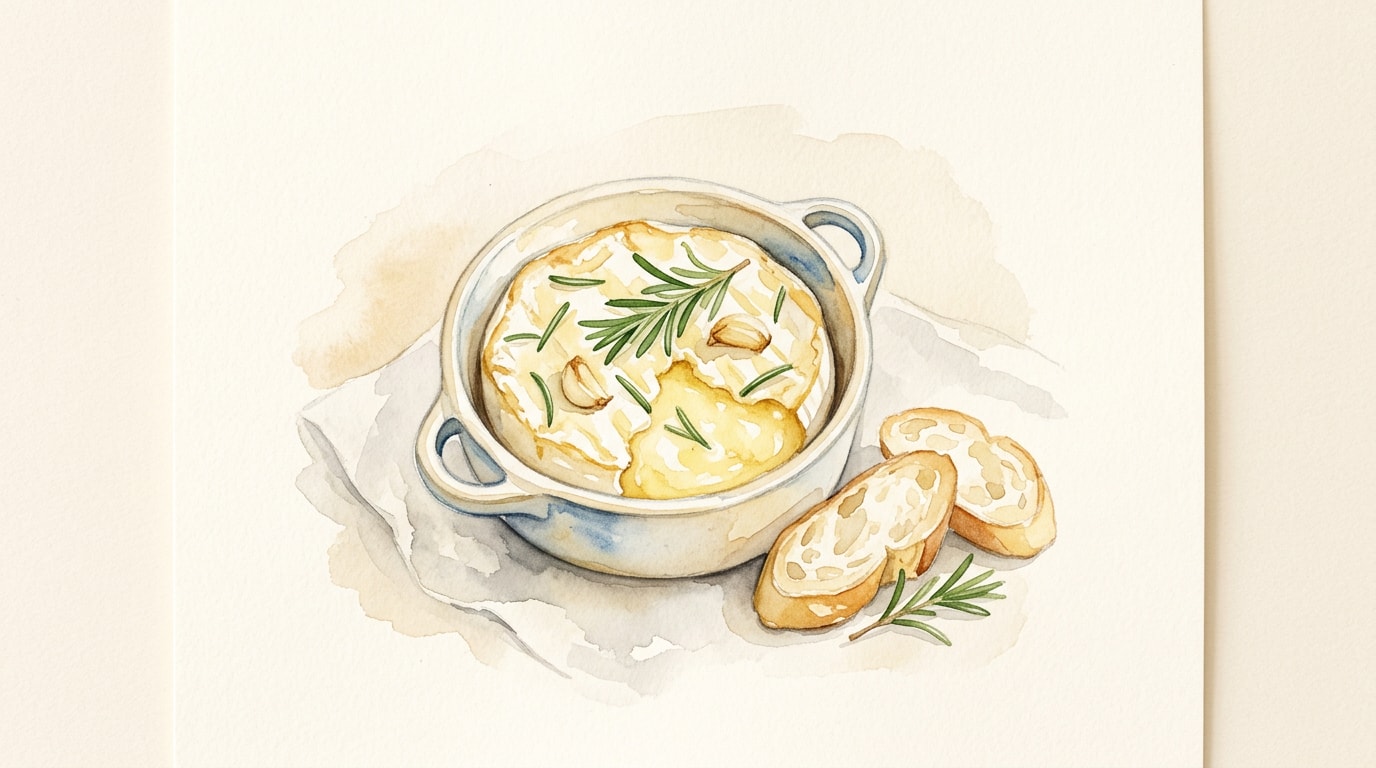
Unbox the camembert, completely remove and discard the plastic wrapping, and place the bare cheese back into its bottom wooden box half or a similarly sized ceramic baking dish.
Using a paring knife, score the top rind of the cheese in a crosshatch pattern, cutting about 5 millimeters deep.
Press the slivers of garlic and small sprigs of rosemary evenly into the scored cuts across the top of the cheese.
Drizzle the olive oil over the top of the studded cheese, then sprinkle evenly with the flaky sea salt and cracked black pepper.
Bake in the preheated oven for 15 minutes, or until the cheese feels very soft to the touch and is bubbling slightly under the rind.
Remove from the oven and serve immediately while the center is molten, alongside the sliced rustic baguette for dipping.
Chef's Notes
- Always remember to remove the plastic wrapper. Baking the cheese in plastic is a common mistake that ruins both the cheese and the dish.
- Select a camembert that yields slightly when pressed at the store. An overripe cheese might split or taste overly ammoniated when heated.
- For a sweeter variation, omit the garlic and instead add a drizzle of honey, a sprinkle of thyme, and a few crushed walnuts before baking.
- Do not score too deeply or pierce the bottom rind, otherwise the molten cheese will leak out entirely through the bottom.
- If your camembert comes in a cardboard box rather than wood, do not bake it in the box. Transfer it to a small oven-safe ramekin instead.
Storage
Refrigerator: 3 days — Store leftover cheese in an airtight container.
Reheating: Microwave in 15-second bursts until warm, or re-bake at 180C for 5-7 minutes.
Troubleshooting
Cheese is not melting in the center
Cause: The cheese was too firm or cold before baking, or the oven was not fully preheated
Fix: Return to the oven for an additional 5 minutes. If the top is getting too dark, tent loosely with aluminum foil.
Prevention: Allow the camembert to sit at room temperature for 30 minutes prior to baking
Cheese completely collapsed and spilled everywhere
Cause: Baked without a confining dish or the bottom rind was pierced during scoring
Fix: Scoop the escaped cheese up with the bread; it cannot be re-formed.
Prevention: Always bake in a tight-fitting ceramic dish or the original wooden box, and score gently
Cultural Context
Baked Camembert, or Camembert Rôti, is a beloved French classic originating from the Normandy region where the cheese is traditionally produced. It transforms a staple dairy product into a communal, interactive appetizer often enjoyed during the colder winter months. The addition of local herbs and garlic highlights the rustic simplicity and elegance of French country cooking.


