
Equipment
* optional
Ingredients
Laminated Pastry
- 250 g all-purpose flour
- 3 g fine sea salt
- 125 ml water, room temperature
- 115 g unsalted butter, very soft, mayonnaise consistency
Sugar Syrup
- 125 g granulated sugar
- 60 ml water
- 1 cinnamon stick
- 1 lemon, peeled into wide strips
Custard Base
- 175 ml whole milk
- 15 g all-purpose flour
- 3 egg yolks
Nutrition (per serving)
Nutrition is estimated per serving. Nutrients without complete source data are omitted.
Full nutrition
- Calories
- 214 kcal
- Protein
- 4 g
- Carbohydrates
- 28 g
- Fat
- 10 g
- Fiber
- 1 g
- Sugar
- 11 g
- Sodium
- 108 mg
- Saturated Fat
- 6 g
- Monounsaturated Fat
- 3 g
- Polyunsaturated Fat
- 1 g
- Cholesterol
- 72 mg
- Potassium
- 53 mg
- Calcium
- 32 mg
- Iron
- 0.4 mg
- Magnesium
- 7 mg
- Phosphorus
- 57 mg
- Zinc
- 0.3 mg
- Vitamin A
- 90 mcg
- Vitamin C
- 0 mg
- Vitamin D
- 0.4 mcg
- Vitamin E
- 0.4 mg
- Vitamin K
- 1 mcg
- Vitamin B6
- 0.0 mg
- Vitamin B12
- 0.2 mcg
- Thiamin
- 0.04 mg
- Riboflavin
- 0.06 mg
- Niacin
- 0.3 mg
- Folate
- 14 mcg
- Water
- 36 g
Sources: Aggregated Public Data, USDA FoodData Central
Method
Combine 250g all-purpose flour, 3g fine sea salt, and 125ml water in a mixing bowl until a shaggy dough forms.
Turn the dough out and knead for 3 minutes until smooth and slightly tacky.
Cover the dough with a damp cloth and let it rest at room temperature for 15 minutes to relax the gluten.
On a floured surface, roll the dough into a 30 by 30 centimeter square. Spread half of the softened butter evenly over the left two-thirds. Fold the unbuttered right third over the middle, then fold the left third over the top.
Turn the dough 90 degrees and roll into a 30 by 40 centimeter rectangle. Spread the remaining butter evenly across the entire surface.
Starting from the short edge, roll the dough tightly into a solid log shape.
Wrap the dough log tightly in plastic wrap and chill in the refrigerator for at least 2 hours.
In a saucepan, combine 125g granulated sugar, 60ml water, the cinnamon stick, and lemon peel strips. Bring to a boil without stirring until the syrup reaches 105°C (221°F), then immediately remove from heat.
In a pouring jug, whisk 15g all-purpose flour with 25ml of the milk until a completely smooth paste forms.
Heat the remaining 150ml of milk in a heavy-bottomed saucepan over medium heat until it reaches a gentle simmer.
Pour the simmering milk into the flour paste while whisking vigorously to prevent any lumps from forming.
Remove the aromatics from the hot sugar syrup, then pour the syrup in a thin, steady stream into the milk mixture while continuously mixing.
Allow the liquid custard base to cool at room temperature for 10 minutes until it is warm but no longer scalding.
Briskly whisk the 3 egg yolks into the warm custard base until thoroughly incorporated.
Pass the entire custard mixture through a fine mesh strainer to ensure a perfectly smooth, lump-free texture.
Preheat the oven to 260°C (500°F) or your oven's absolute maximum setting, and place a baking stone on the top rack to heat thoroughly.
Cut the chilled dough log into 12 equal disks. Place each disk cut-side down into a mold and press outward with wet thumbs to push the dough up the sides, creating a nearly translucent base and a slightly thicker rim.
Pour the strained custard into the shaped pastry shells, filling them exactly three-quarters full to allow room for the custard to expand without overflowing.
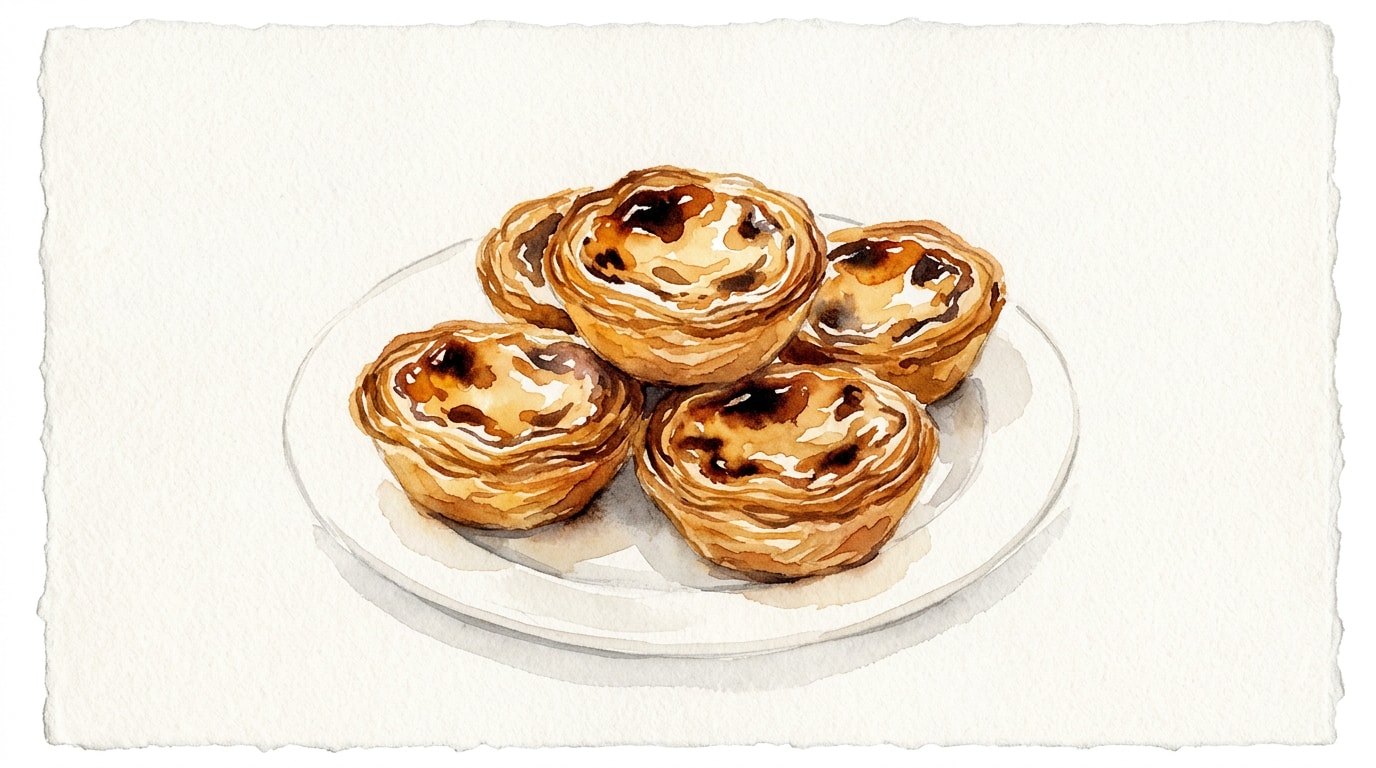
Place the molds on the hot baking stone. Bake for 10 to 14 minutes until the pastry is deeply golden and the custard reaches at least 74°C (165°F) internally, developing signature dark blistered spots on top.
Remove from the oven and let the tarts cool in their molds for 5 minutes before carefully transferring them to a wire rack to finish cooling.
Chef's Notes
- The secret to the signature blistering without overcooking the custard is extreme heat. Use a pizza stone or heavy baking steel to deliver intense bottom heat, and bake at your oven's absolute maximum temperature.
- When laminating the dough, the butter must be the exact consistency of mayonnaise. If it is too cold, it will tear the dough; if it is melted, it will leak out and destroy the flaky layers.
- Pushing the dough up the sides of the mold with a wet thumb is crucial. The bottom should be nearly translucent so it crisps fully, while a thicker rim allows the pastry to puff and create a protective barrier for the custard.
- To ensure perfect spirals on the bottom of your tarts, always place the cut side of the dough disk facing straight down into the mold before pressing.
Storage
Refrigerator: 3 days — Store in an airtight container. Pastry will soften significantly.
Reheating: Reheat in a 180°C (350°F) oven for 5 to 8 minutes to successfully restore the pastry's crispness.
Troubleshooting
Pastry shrinks down the sides of the tin during baking
Cause: Dough was not rested sufficiently after shaping or was pressed too thickly at the bottom
Fix: Cannot be fixed once baked
Prevention: Ensure the dough rests in the molds in the refrigerator for at least 15 minutes before filling, and press the bottom very thin
Custard boils over and spills out of the pastry shell
Cause: Molds were overfilled or the oven temperature was too low requiring a longer bake time
Fix: Wipe excess off the tin immediately after baking to prevent sticking
Prevention: Fill molds strictly three-quarters full and bake at the highest possible oven temperature
Custard splits or curdles with a grainy texture
Cause: Egg yolks were added when the base was too hot, or the tarts were baked too long at a lower temperature
Fix: Cannot be fixed once curdled
Prevention: Allow the milk and syrup base to cool for a full 10 minutes before whisking in the yolks
Cultural Context
Pastéis de Nata were originally created in the 18th century by Catholic monks at the Jerónimos Monastery in the civil parish of Santa Maria de Belém, Lisbon. The monks used large quantities of egg whites for starching clothes, leading to a surplus of egg yolks which they brilliantly repurposed into these iconic custard tarts. Today, they remain Portugal's most celebrated culinary export, traditionally enjoyed warm with a light dusting of powdered sugar and cinnamon.


