
Equipment
Ingredients
Saffron Base
- ⅛ g saffron threads
- 15 ml warm water, warm
Soup Aromatics
- 30 ml extra virgin olive oil
- 15 g anchovy fillets, finely chopped
- 150 g leeks, white and light green parts only, sliced and thoroughly washed
- 15 g garlic, thinly sliced
- 2 g red chili flakes
Broth and Seafood
- 200 ml dry white wine
- 400 g canned crushed tomatoes
- 250 ml fish stock
- 1000 g fresh mussels, scrubbed and debearded
- 15 g fresh parsley, roughly chopped
Garlic Bread
- 200 g rustic sourdough bread, cut into 4 thick slices
- 5 g garlic, cut in half crosswise, for rubbing
- 30 ml extra virgin olive oil, for drizzling
Nutrition (per serving)
Nutrition is estimated per serving. Nutrients without complete source data are omitted.
Full nutrition
- Calories
- 612 kcal
- Protein
- 40 g
- Carbohydrates
- 50 g
- Fat
- 23 g
- Fiber
- 5 g
- Sugar
- 7 g
- Sodium
- 1717 mg
- Saturated Fat
- 3 g
- Monounsaturated Fat
- 12 g
- Polyunsaturated Fat
- 3 g
- Cholesterol
- 73 mg
- Potassium
- 1437 mg
- Calcium
- 152 mg
- Iron
- 13.3 mg
- Magnesium
- 126 mg
- Phosphorus
- 565 mg
- Zinc
- 4.6 mg
- Vitamin A
- 189 mcg
- Vitamin C
- 41 mg
- Vitamin D
- 0.1 mcg
- Vitamin E
- 4.0 mg
- Vitamin K
- 89 mcg
- Vitamin B6
- 0.3 mg
- Vitamin B12
- 30.0 mcg
- Thiamin
- 0.44 mg
- Riboflavin
- 0.57 mg
- Niacin
- 5.0 mg
- Folate
- 136 mcg
- Water
- 288 g
- Alcohol
- 5 g
Sources: Aggregated Public Data, USDA FoodData Central
Method
Place the saffron threads in a small bowl and pour the warm water over them. Set aside to bloom and release their color and flavor.
Heat the extra virgin olive oil in a large heavy-bottomed pot over medium heat. Add the chopped anchovy fillets and stir constantly until they dissolve into the oil. Add the sliced leeks, sliced garlic, and chili flakes. Cook until the leeks are very soft but not browned.
Increase the heat to medium-high and pour in the dry white wine. Scrape up any fond from the bottom of the pot and allow the wine to reduce by half to cook off the raw alcohol flavor.
Stir in the crushed tomatoes, fish stock, and the bloomed saffron along with its soaking water. Bring the liquid to a gentle simmer around 90C/195F. Let the broth cook to marry the flavors.
Add the scrubbed mussels to the simmering broth. Immediately cover the pot with a tight-fitting lid. Steam the mussels until they have wide-opened their shells. Shake the pot once or twice during cooking to distribute the heat evenly. Discard any mussels that remain completely closed after this time.
While the mussels are steaming, toast the sourdough slices in a grill pan or toaster until golden and crisp. Immediately rub the cut side of the halved garlic clove over the hot, abrasive surface of the bread, then drizzle generously with olive oil.
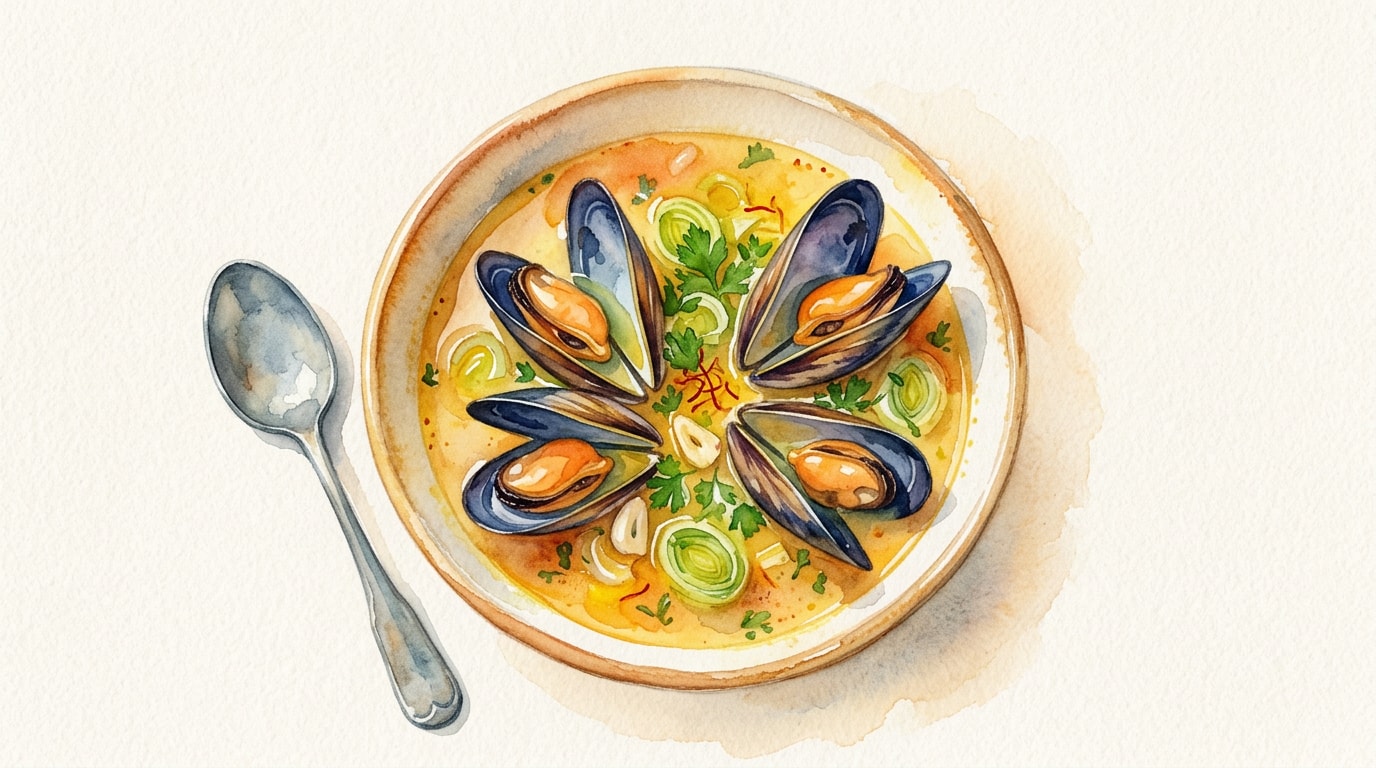
Ladle the mussels and the rich tomato saffron broth into wide serving bowls. Garnish with chopped fresh parsley and serve immediately alongside the warm garlic bread for dipping.
Chef's Notes
- Melting anchovies into the base fat is a classic Italian and Mediterranean technique. It does not make the dish taste fishy, but rather adds a profound, savory depth that elevates the tomatoes.
- When selecting wine for this broth, use a crisp, dry white that you would actually enjoy drinking. Avoid sweet wines or heavily oaked Chardonnays, which can turn the broth cloying or bitter.
- Saffron needs warmth and time to release its complex flavor and vibrant color. Always bloom it in warm liquid before adding it to a large volume of soup or stew.
- Discard any raw mussels that are open and do not close when tapped firmly on the counter. This indicates they are dead and unsafe to consume.
Storage
Refrigerator: 1 day — Store broth and mussels separately if possible. Seafood degrades quickly in quality.
Reheating: Reheat the broth on the stovetop until simmering, then gently add mussels just until warmed through to prevent overcooking.
Troubleshooting
Broth is gritty or sandy
Cause: Mussels were not purged or leeks were not washed properly
Fix: Cannot be fixed completely. You can remove the mussels and carefully decant the broth into a clean pot, leaving the sandy bottom sediment behind.
Prevention: Soak mussels in cold salted water for 20 minutes before cooking, and wash sliced leeks thoroughly in a bowl of cold water, lifting them out so sand stays at the bottom
Several mussels did not open
Cause: The mussels were dead before cooking, or the heat was not trapped efficiently
Fix: Discard any unopened mussels. Do not force them open as they may be unsafe to eat.
Prevention: Ensure the pot has a tight-fitting lid and is boiling rapidly to generate sufficient steam. Always buy fresh, tightly closed mussels.
Mussel meat is tiny and rubbery
Cause: Overcooked mussels
Fix: Cannot be fixed
Prevention: Remove from heat the exact moment the shells pop wide open. Do not leave them boiling in the liquid.
Cultural Context
Mediterranean coastal cooking relies heavily on the marriage of fresh, abundant seafood, local wine, and aromatic bases like garlic and tomatoes. Dishes similar to this can be found sweeping from the shores of Southern France to the Italian coast, where fishermen would stew their daily catch in a quick, aromatic broth and serve it over day-old bread to stretch the meal.


