
Equipment
Ingredients
Yogurt Ice Cream
- 450 g whole milk greek yogurt, cold
- 240 ml heavy cream, cold
- 100 g granulated sugar
- 15 ml lemon juice, freshly squeezed
- 5 ml vanilla extract
- 1 g fine sea salt
Honey-Thyme Roasted Grapes
- 500 g seedless red grapes, washed and removed from stems
- 80 g honey
- 15 ml extra virgin olive oil
- 5 g fresh thyme, whole sprigs
- 2 g flaky sea salt
Nutrition (per serving)
Nutrition is estimated per serving. Nutrients without complete source data are omitted.
Full nutrition
- Calories
- 397 kcal
- Protein
- 9 g
- Carbohydrates
- 47 g
- Fat
- 21 g
- Fiber
- 1 g
- Sugar
- 45 g
- Sodium
- 234 mg
- Saturated Fat
- 11 g
- Trans Fat
- 1 g
- Monounsaturated Fat
- 7 g
- Polyunsaturated Fat
- 1 g
- Cholesterol
- 55 mg
- Potassium
- 319 mg
- Calcium
- 114 mg
- Iron
- 0.6 mg
- Magnesium
- 19 mg
- Phosphorus
- 143 mg
- Zinc
- 0.6 mg
- Vitamin A
- 170 mcg
- Vitamin C
- 5 mg
- Vitamin D
- 0.6 mcg
- Vitamin E
- 0.9 mg
- Vitamin K
- 15 mcg
- Vitamin B6
- 0.1 mg
- Vitamin B12
- 0.6 mcg
- Thiamin
- 0.08 mg
- Riboflavin
- 0.36 mg
- Niacin
- 0.4 mg
- Folate
- 8 mcg
- Water
- 157 g
- Alcohol
- 0 g
Sources: USDA FoodData Central
Method
In a mixing bowl, use a whisk to combine the Greek yogurt, heavy cream, granulated sugar, lemon juice, vanilla extract, and fine sea salt until the sugar is fully dissolved.
Transfer the yogurt mixture to the refrigerator to chill thoroughly for at least 2 hours.
Pour the chilled yogurt base into an ice cream maker and churn according to the manufacturer's instructions until it reaches a thick, soft-serve consistency.
Transfer the churned ice cream to a freezer-safe container, smooth the top, cover tightly, and freeze for at least 2 hours to firm up.
Preheat the oven to 200°C/400°F.
On a baking sheet, toss the seedless red grapes with honey, extra virgin olive oil, fresh thyme sprigs, and flaky sea salt until the grapes are evenly coated.
Roast the grapes in the preheated oven for 20 minutes, or until the grapes begin to blister and release their juices, mingling with the honey to create a caramelized syrup.
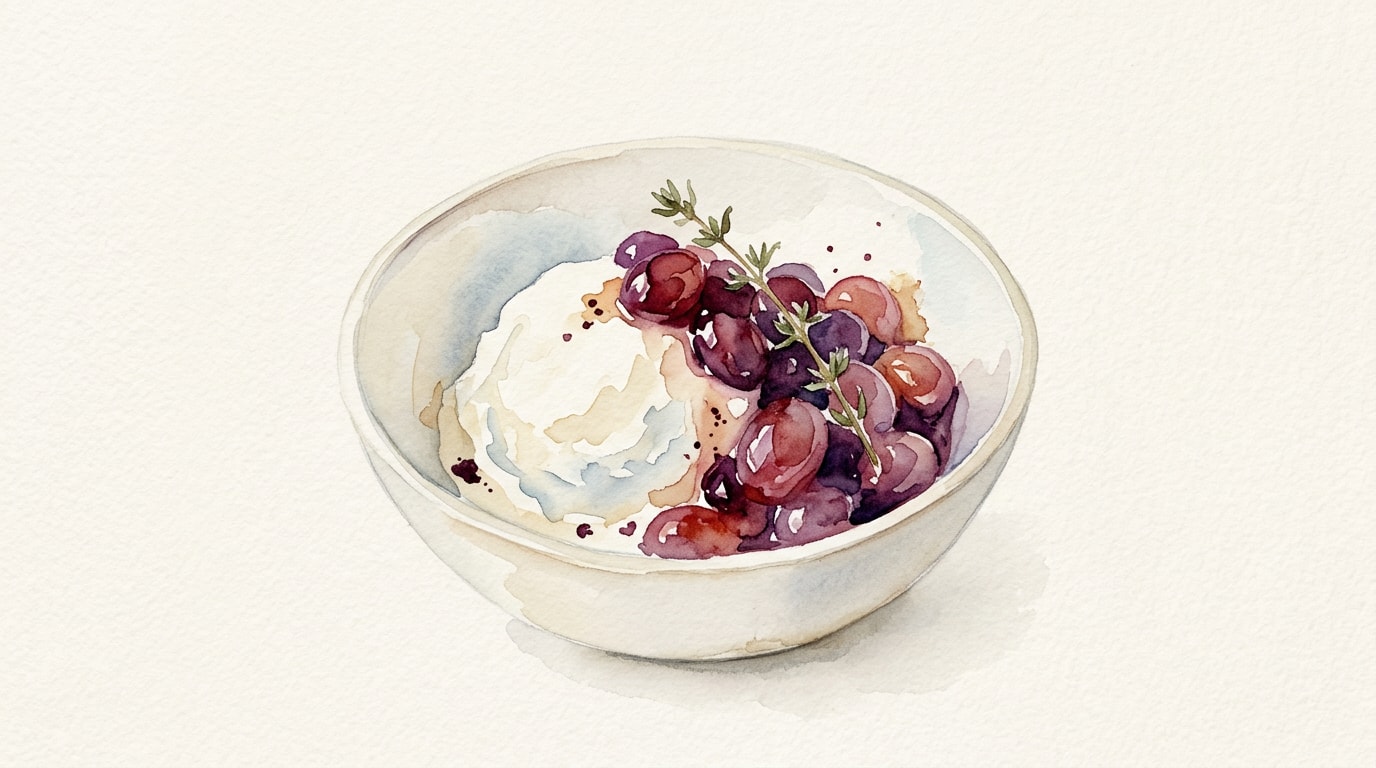
Scoop the firm yogurt ice cream into serving bowls and spoon the warm roasted grapes along with their thyme-infused honey syrup over the top.
Chef's Notes
- Roasting concentrates the natural sugars in the grapes, creating a jammy texture that contrasts beautifully with the cold, creamy, and slightly tart ice cream.
- Leave the thyme on the sprigs rather than picking the leaves; the essential oils will infuse the honey glaze gently during roasting, and the sprigs can be easily discarded before serving.
- For the absolute best texture, ensure your ice cream base is fully chilled before churning. This rapid cooling process encourages smaller ice crystals, yielding a smoother mouthfeel.
- A splash of white balsamic vinegar added to the grapes before roasting can provide a brilliant acidic counterpoint to the sweetness of the honey.
Storage
Refrigerator: 3 days — Store the roasted grapes in an airtight container. The ice cream must remain in the freezer.
Freezer: 1 month — Store the yogurt ice cream in a tightly sealed freezer-safe container to prevent ice crystal formation.
Reheating: Warm the refrigerated roasted grapes in a skillet over low heat or in the microwave for 30 seconds before serving.
Troubleshooting
Ice cream freezes into a solid, un-scoopable block
Cause: Domestic freezers are exceptionally cold, and homemade ice cream lacks commercial stabilizers.
Fix: Allow the container to sit at room temperature for 10 to 15 minutes before attempting to scoop.
Prevention: Use full-fat dairy, do not reduce the sugar content, and ensure the base is thoroughly chilled before churning to encourage small ice crystal formation.
Grapes burn instead of caramelizing
Cause: Oven temperature runs hot, or the honey pooled thinly on the edges of the pan.
Fix: Cannot be fixed if heavily burnt, but if only slightly dark, carefully lift the grapes away from the blackened syrup.
Prevention: Keep the grapes clustered slightly toward the center of the baking sheet so the honey does not spread too thin and scorch.
Cultural Context
Pairing fresh cheese or yogurt with seasonal fruit and honey is a quintessential Mediterranean tradition. The addition of savory herbs like thyme to sweet applications bridges the gap between sweet and savory, a hallmark of rustic Italian and Greek dessert philosophy.


