
Equipment
Ingredients
Potatoes
- 600 g baby potatoes, washed, left whole
- 15 g kosher salt
Finishing Ingredients
- 45 g unsalted butter
- 10 g fresh flat-leaf parsley, roughly chopped
- 5 g flaky sea salt
- 2 g black pepper, freshly cracked
Nutrition (per serving)
Nutrition is estimated per serving. Nutrients without complete source data are omitted.
Full nutrition
- Calories
- 170 kcal
- Protein
- 4 g
- Carbohydrates
- 19 g
- Fat
- 9 g
- Fiber
- 4 g
- Sugar
- 0 g
- Sodium
- 1958 mg
- Saturated Fat
- 6 g
- Monounsaturated Fat
- 3 g
- Polyunsaturated Fat
- 0 g
- Cholesterol
- 24 mg
- Potassium
- 643 mg
- Calcium
- 55 mg
- Iron
- 5.1 mg
- Magnesium
- 37 mg
- Phosphorus
- 62 mg
- Zinc
- 0.6 mg
- Vitamin A
- 88 mcg
- Vitamin C
- 20 mg
- Vitamin E
- 0.3 mg
- Vitamin K
- 43 mcg
- Vitamin B6
- 0.4 mg
- Vitamin B12
- 0.0 mcg
- Thiamin
- 0.03 mg
- Riboflavin
- 0.07 mg
- Niacin
- 1.6 mg
- Folate
- 30 mcg
- Water
- 129 g
Sources: USDA FoodData Central
Method
Place the washed baby potatoes in a medium saucepan and cover them completely with cold water by at least two centimeters. Stir in the kosher salt.
Bring the water to a boil over high heat, then reduce the heat to maintain a steady simmer. Cook the potatoes for 15 to 20 minutes until they are entirely tender but not splitting open.
Drain the potatoes into a colander and leave them undisturbed for 5 minutes. This resting period allows residual steam to evaporate, which is essential for achieving a crispy exterior later. If any potatoes are significantly larger than the rest, cut them in half on a cutting board.
Heat a large skillet over medium-high heat. Add the unsalted butter and allow it to melt completely.
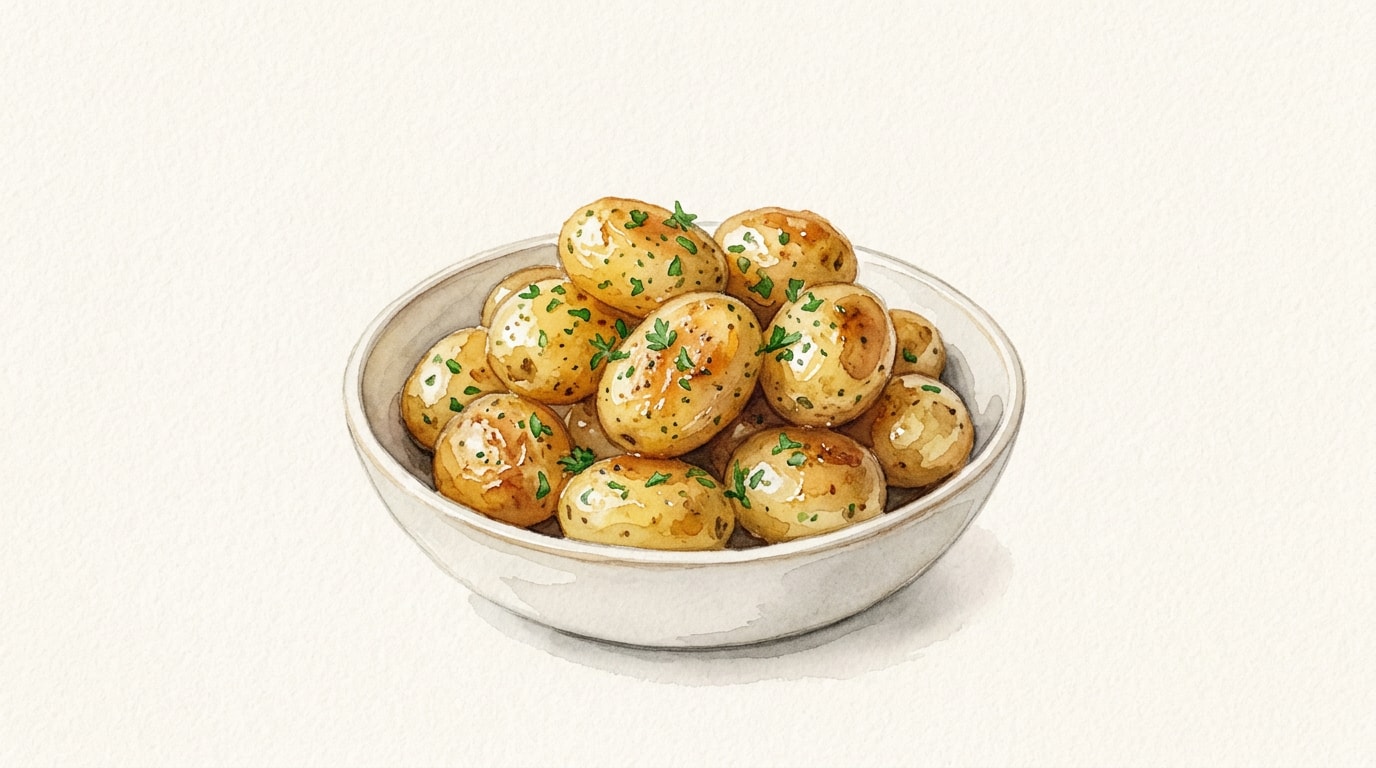
Carefully add the dry boiled potatoes to the skillet in a single layer. Let them fry undisturbed for 2 to 3 minutes to develop a crust, then toss occasionally. Continue cooking for 8 to 10 minutes total until the potato skins are deeply golden and crispy on all sides.
Remove the skillet from the heat immediately. Toss the hot, buttery potatoes with the freshly chopped parsley, a generous sprinkle of flaky sea salt, and freshly cracked black pepper. Serve right away while the crust is at its crispiest.
Chef's Notes
- Starting potatoes in cold water rather than dropping them into boiling water ensures they cook evenly from the outside in, preventing mushy exteriors and hard centers.
- Letting the potatoes steam dry in the colander is a critical and often overlooked step. Any residual surface moisture will cause the potatoes to steam in the skillet rather than fry, which directly inhibits the Maillard reaction needed for a golden crust.
- For an elevated textural experience, consider lightly crushing each boiled potato with the heel of your hand or a flat spatula right before they hit the skillet. This creates rugged edges and increases the surface area that makes contact with the hot butter, yielding incredibly crunchy results.
- If scaling this recipe, ensure you do not overcrowd the pan. If the potatoes are stacked or too close together, the trapped steam will prevent them from crisping. Cook in batches if necessary.
Storage
Refrigerator: 3 days — Store in an airtight container once completely cooled.
Reheating: Pan-fry over medium heat in a dry skillet until warmed through and crispy again, or roast in a 200C/400F oven for 10 minutes. Avoid microwaving as it ruins the crust.
Troubleshooting
Potatoes are browning too quickly and burning before getting evenly crisp
Cause: The skillet was too hot, or the butter began to burn before the potatoes could form a proper crust
Fix: Lower the heat immediately to medium-low and continue cooking slowly. If butter is actively smoking, carefully wipe out excess with a paper towel held by tongs and replace with fresh butter.
Prevention: Ensure the heat is kept at medium-high and adjust down if the butter milk solids darken too rapidly. Using clarified butter can also prevent burning.
Potatoes are greasy and not developing a crispy crust
Cause: The potatoes were not allowed to steam-dry properly after boiling, introducing water into the fat which lowers the frying temperature
Fix: Increase the heat slightly to cook off residual water and continue frying until the crust forms.
Prevention: Always let boiled potatoes sit in a colander for at least 5 minutes until their surfaces appear matte and dry.
Potatoes are crispy on the outside but hard and raw in the center
Cause: Potatoes were not boiled long enough in the first step
Fix: Lower the pan heat, cover the skillet with a tight-fitting lid, and allow the potatoes to steam in their own moisture for 5 to 8 minutes until tender inside.
Prevention: Always test the largest potato in the batch with a knife before draining; it must slide in with absolutely no resistance.
Cultural Context
In Spanish cuisine, simple preparations of the humble potato celebrate the ingredient by elevating its natural texture and flavor. Cooking in high-quality fat until a robust crust forms is a foundational technique in tapas culture, beautifully demonstrated in classics like patatas bravas. This five-ingredient approach relies heavily on technique rather than complex sauces, allowing the rich butter and earthy potato to shine, while parsley and sea salt add a vibrant, clean finish reminiscent of Mediterranean coastal dining.


