
Equipment
Ingredients
Infusion
- 500 ml whole milk
- 1 cinnamon stick
- 1 lemon, peeled in thick strips
Custard Base
- 4 egg yolks, room temperature
- 100 g granulated sugar
- 20 g cornstarch
Topping
- 40 g granulated sugar
Nutrition (per serving)
Nutrition is estimated per serving. Nutrients without complete source data are omitted.
Full nutrition
- Calories
- 292 kcal
- Protein
- 7 g
- Carbohydrates
- 47 g
- Fat
- 9 g
- Fiber
- 1 g
- Sugar
- 41 g
- Sodium
- 63 mg
- Saturated Fat
- 4 g
- Monounsaturated Fat
- 3 g
- Polyunsaturated Fat
- 1 g
- Cholesterol
- 207 mg
- Potassium
- 193 mg
- Calcium
- 178 mg
- Iron
- 0.7 mg
- Magnesium
- 14 mg
- Phosphorus
- 177 mg
- Zinc
- 0.9 mg
- Vitamin A
- 126 mcg
- Vitamin C
- 1 mg
- Vitamin D
- 2.6 mcg
- Vitamin E
- 0.6 mg
- Vitamin K
- 1 mcg
- Vitamin B6
- 0.1 mg
- Vitamin B12
- 0.9 mcg
- Thiamin
- 0.10 mg
- Riboflavin
- 0.32 mg
- Niacin
- 0.1 mg
- Folate
- 33 mcg
- Water
- 121 g
Sources: USDA FoodData Central
Method
In a medium saucepan, combine the whole milk, cinnamon stick, and lemon peel. Heat gently over medium heat until it just begins to simmer and steam vigorously, reaching approximately 85 degrees Celsius or 185 degrees Fahrenheit. Remove from heat, cover, and let steep for 15 minutes.
While the milk infuses, place the egg yolks and 100g of granulated sugar in a mixing bowl. Whisk vigorously until the mixture becomes pale yellow and thickens slightly. Sift in the cornstarch and whisk until completely smooth with no lumps remaining.
Remove the cinnamon stick and lemon peel from the steeped milk. Slowly pour the hot milk into the egg mixture in a thin, steady stream while whisking constantly. This tempers the yolks so they do not scramble.
Pour the tempered mixture back into the saucepan. Cook over medium-low heat, stirring continuously with a silicone spatula. Ensure you scrape the bottom and corners of the pan. Cook until the custard thickens significantly, registering 82 degrees Celsius or 180 degrees Fahrenheit on a thermometer.
Immediately pass the thickened custard through a fine mesh strainer into a large measuring jug to catch any stray coagulated egg bits. Divide the smooth custard evenly among 4 shallow clay dishes or ramekins.
Allow the ramekins to cool briefly at room temperature. Press a piece of plastic wrap directly onto the surface of each custard to prevent a skin from forming. Chill in the refrigerator for at least 4 hours, or until completely set.
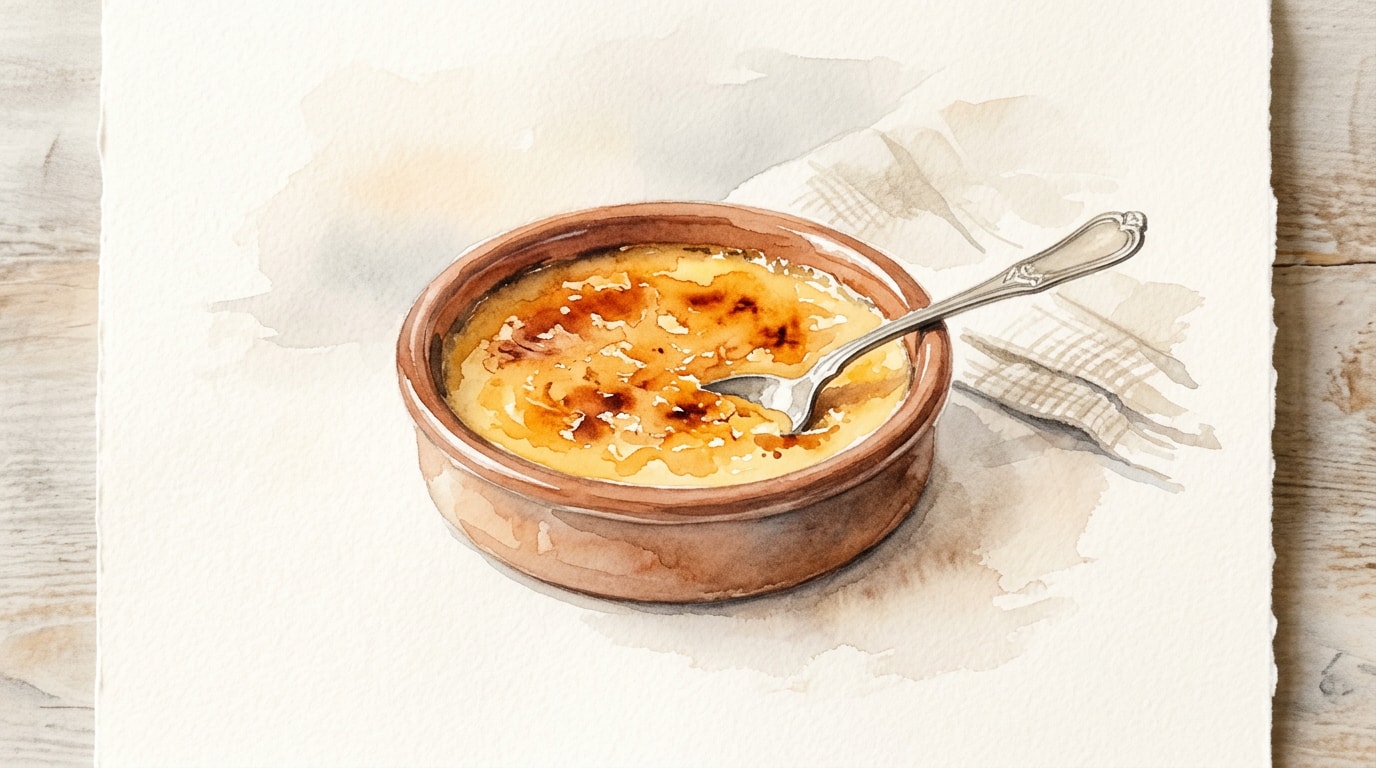
Just before serving, remove the plastic wrap. Sprinkle 10g of granulated sugar in a thin, even layer over the surface of each custard. Use a kitchen blowtorch in constant circular motions to melt and caramelize the sugar until it turns a deep amber color.
Chef's Notes
- Traditional Crema Catalana relies exclusively on cornstarch for thickening, allowing it to be cooked directly on the stovetop rather than baked in a water bath like its French counterpart, Creme Brulee.
- Be meticulous when peeling your lemon. The essential oils in the yellow skin provide a beautiful floral note, but the white pith underneath is intensely bitter and will ruin the delicate milk base.
- When tempering the eggs, place your mixing bowl on a damp kitchen towel. This prevents the bowl from spinning while you use one hand to pour the hot milk and the other to whisk.
- For the topping, white granulated sugar melts and caramelizes the most evenly. A darker caramel provides a vital bitter contrast to the sweet, rich custard below.
Storage
Refrigerator: 2 days — Store without the burnt sugar topping. Caramelize right before serving.
Troubleshooting
Custard is lumpy or grainy
Cause: Heat was too high or stirring was insufficient, causing the egg proteins to scramble.
Fix: Immediately pour through a fine mesh strainer, or pulse briefly with an immersion blender before chilling. Cannot be fixed if fully scrambled.
Prevention: Keep heat at medium-low and use a spatula to constantly scrape the bottom and sides of the pan.
Custard did not set in the fridge
Cause: The base was undercooked and the cornstarch was not activated.
Fix: Cannot be fixed once chilled.
Prevention: Ensure the mixture reaches 82 degrees Celsius and visibly thickens in the pan before removing from heat.
Burnt sugar topping dissolved into liquid
Cause: The custard was torched too far in advance and returned to the refrigerator, drawing out moisture.
Fix: Cannot be fixed.
Prevention: Always apply the sugar and torch immediately before serving.
Cultural Context
Crema Catalana is considered one of the oldest recorded European desserts, with recipes documented in Catalan cookbooks as far back as the 14th century. Traditionally served on Saint Joseph's Day on March 19th, it is deeply woven into the culinary fabric of Catalonia. Its bright infusion of Mediterranean citrus and warming cinnamon distinctly separates it from the heavier, vanilla-forward French crème brûlée.


