
Equipment
* optional
Ingredients
Oysters
- 24 freshly shucked oysters, shucked
- 120 ml oyster liquor, reserved from shucking
Base & Aromatics
- 60 g unsalted butter
- 40 g shallot, finely minced
- 40 g celery, finely minced
Dairy
- 475 ml whole milk
- 235 ml heavy cream
Seasoning & Garnish
- 1 g white pepper, ground
- 1 g cayenne pepper
- kosher salt
- 5 g fresh chives, finely chopped
- 50 g oyster crackers
Nutrition (per serving)
Nutrition is estimated per serving. Nutrients without complete source data are omitted.
Full nutrition
- Calories
- 503 kcal
- Protein
- 14 g
- Carbohydrates
- 22 g
- Fat
- 40 g
- Fiber
- 1 g
- Sugar
- 10 g
- Sodium
- 489 mg
- Saturated Fat
- 24 g
- Trans Fat
- 1 g
- Monounsaturated Fat
- 10 g
- Polyunsaturated Fat
- 2 g
- Cholesterol
- 158 mg
- Potassium
- 487 mg
- Calcium
- 258 mg
- Iron
- 6.4 mg
- Magnesium
- 45 mg
- Phosphorus
- 274 mg
- Zinc
- 46.9 mg
- Vitamin A
- 430 mcg
- Vitamin C
- 2 mg
- Vitamin D
- 2.5 mcg
- Vitamin E
- 2.1 mg
- Vitamin K
- 8 mcg
- Vitamin B6
- 0.2 mg
- Vitamin B12
- 10.9 mcg
- Thiamin
- 0.11 mg
- Riboflavin
- 0.44 mg
- Niacin
- 1.3 mg
- Folate
- 24 mcg
- Water
- 263 g
Sources: Aggregated Public Data, USDA FoodData Central
Method
Place a fine mesh sieve lined with cheesecloth or a coffee filter over a bowl. Pour the oysters and their liquid through the sieve to strain out any sand or shell fragments. Separate the oyster meat from the strained liquor and reserve both.
In a heavy-bottomed saucepan, melt the unsalted butter over medium-low heat. Add the minced shallot and celery, sautéing gently until translucent and tender but not browned.
Pour the strained oyster liquor, whole milk, and heavy cream into the saucepan. Bring the mixture to a gentle steaming simmer around 82°C/180°F. Do not allow the liquid to boil, or the dairy will curdle.
Stir in the white pepper and cayenne pepper. Taste the hot broth and season cautiously with kosher salt, keeping in mind the natural varying salinity of the oyster liquor.
Gently drop the reserved oysters into the steaming liquid. Poach them just until their edges begin to curl and they become opaque, ensuring they reach an internal temperature of 63°C/145°F for food safety.
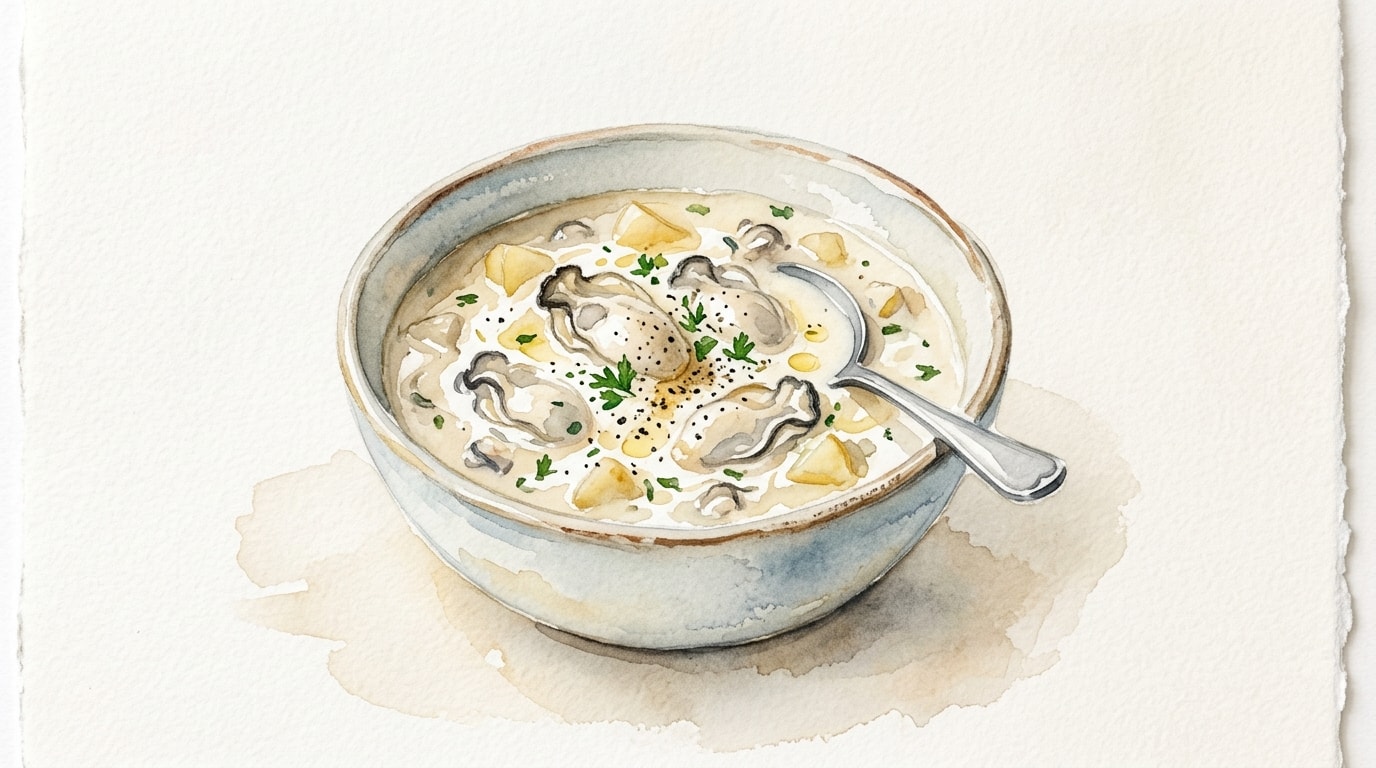
Immediately remove the saucepan from the heat to stop the cooking process. Ladle the stew into warm serving bowls, garnish with freshly chopped chives, and serve at once with oyster crackers.
Chef's Notes
- Always taste the stew for salt only after adding the oyster liquor. The natural salinity of oysters varies vastly by geographic origin and season.
- For the most luxurious dining experience, gently warm your serving bowls before ladling the stew. This prevents the heavy butterfat from congealing rapidly against cold porcelain.
- If you are concerned about curdling, you can warm the milk and cream in a separate saucepan before whisking it into the butter and oyster liquor base.
- To elevate the presentation, add a final tiny pat of cold unsalted butter to the center of each bowl right before serving to create a beautiful, rich sheen on the surface.
Storage
Refrigerator: 1 day — Reheat extremely gently over low heat to avoid overcooking the oysters and curdling the dairy.
Troubleshooting
Oysters are tough and rubbery
Cause: The stew was boiled, or the oysters were poached for too long
Fix: Cannot be fixed
Prevention: Maintain a gentle sub-simmer and remove from heat the exact moment the oyster edges begin to curl
Broth has a gritty texture
Cause: Sand or shell fragments remained in the oyster liquor
Fix: Cannot be fixed once combined
Prevention: Always strain the oyster liquor through a fine cheesecloth or unbleached coffee filter
Dairy has curdled or separated
Cause: The milk and cream mixture reached a rolling boil
Fix: Cannot be fixed, though it remains safe to eat
Prevention: Keep the temperature carefully controlled below 85°C/185°F
Cultural Context
Oyster stew has deep roots in Irish and English coastal traditions, brought to New England by early settlers. Because oysters were historically harvested during colder months and highly perishable, the rich, warming stew became a traditional feature of Thanksgiving and Christmas Eve dinners across early America.


