
Equipment
Ingredients
Vegetables
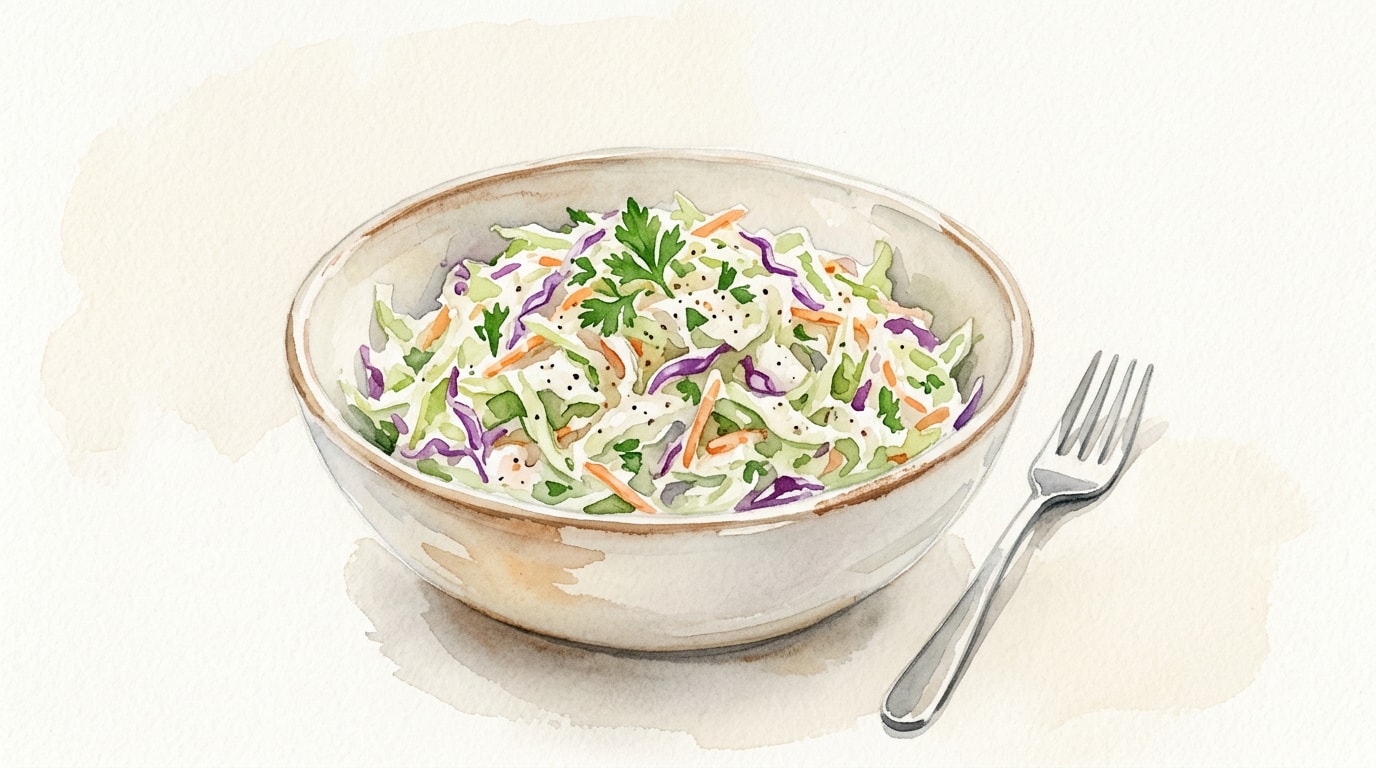
- 400 g green cabbage, finely shredded
- 100 g carrots, peeled and grated
Creamy Dressing
- 120 g mayonnaise
- 30 ml apple cider vinegar
- 15 g granulated sugar
- 10 g dijon mustard
- 1 g celery seed
- 3 g kosher salt
- 1 g black pepper, freshly ground
Nutrition (per serving)
Nutrition is estimated per serving. Nutrients without complete source data are omitted.
Full nutrition
- Calories
- 259 kcal
- Protein
- 2 g
- Carbohydrates
- 13 g
- Fat
- 23 g
- Fiber
- 3 g
- Sugar
- 8 g
- Sodium
- 546 mg
- Saturated Fat
- 4 g
- Trans Fat
- 0 g
- Monounsaturated Fat
- 5 g
- Polyunsaturated Fat
- 13 g
- Cholesterol
- 13 mg
- Potassium
- 272 mg
- Calcium
- 60 mg
- Iron
- 0.8 mg
- Magnesium
- 17 mg
- Phosphorus
- 43 mg
- Zinc
- 0.3 mg
- Vitamin A
- 219 mcg
- Vitamin C
- 38 mg
- Vitamin D
- 0.1 mcg
- Vitamin E
- 1.3 mg
- Vitamin K
- 129 mcg
- Vitamin B6
- 0.2 mg
- Vitamin B12
- 0.0 mcg
- Thiamin
- 0.08 mg
- Riboflavin
- 0.06 mg
- Niacin
- 0.5 mg
- Folate
- 49 mcg
- Water
- 128 g
Sources: Aggregated Public Data, USDA FoodData Central
Method
Remove the tough outer leaves and core from the cabbage. Finely shred the cabbage using a sharp chef knife or mandoline, and grate the carrots. Place both in a large mixing bowl.
In a small mixing bowl, combine the mayonnaise, apple cider vinegar, granulated sugar, Dijon mustard, celery seed, kosher salt, and black pepper. Whisk vigorously until the sugar is completely dissolved and the dressing is smooth.
Pour the dressing over the shredded cabbage and carrots. Use tongs or a large spoon to toss the mixture thoroughly, ensuring all the vegetables are evenly coated with the dressing.
Cover the bowl tightly with plastic wrap and refrigerate for at least 1 hour before serving to allow the cabbage to soften slightly and the flavors to meld together.
Chef's Notes
- For the best texture, hand-slice the cabbage with a sharp knife rather than using a food processor, which can bruise the leaves and cause them to release water too quickly.
- Allowing the coleslaw to rest in the refrigerator for at least an hour before serving is crucial; it allows the sugar to dissolve completely, the flavors to marry, and the sharp bite of the raw cabbage to mellow.
- Celery seed is the secret ingredient in classic deli coleslaw, providing a distinct, earthy undertone. Do not skip it, but use it sparingly as its flavor is highly concentrated.
- If you prefer a lighter dressing, you can substitute up to half of the mayonnaise with plain Greek yogurt or sour cream, though this will alter the dairy-free status.
Storage
Refrigerator: 3 days — Store in an airtight container. Cabbage will release moisture and soften over time.
Troubleshooting
The coleslaw is watery at the bottom of the bowl
Cause: The salt in the dressing drew moisture out of the cabbage over time
Fix: Use tongs or a slotted spoon to serve the coleslaw, leaving the excess liquid behind in the bowl
Prevention: If making more than a few hours ahead, toss shredded cabbage with salt in a colander, let sit for 1 hour, and squeeze out excess moisture before dressing
The dressing tastes too sharp or acidic
Cause: The sugar has not fully dissolved or too much vinegar was added
Fix: Stir in an additional 10 grams of mayonnaise and 5 grams of sugar to balance the acidity
Prevention: Measure the vinegar carefully and allow the slaw to rest in the refrigerator for the full hour
Cultural Context
Coleslaw derives its name from the Dutch term koolsla, meaning cabbage salad. Introduced to the Americas by Dutch settlers in New York, it became a staple of American cuisine in the late 18th century following the invention of mayonnaise, cementing its place as an essential side dish for barbecues, picnics, and rich comfort foods.


