Equipment
* optional
Ingredients
Dried Fruits
- 200 g golden raisins
- 100 g dark raisins
- 150 g dried currants
- 100 g pitted prunes, halved
- 50 g dried cherries
- 50 g mixed candied citrus peel
Soaking Liquid and Feeding Rum
- 300 ml dark aged caribbean rum
- 100 ml ruby port
- 15 ml angostura aromatic bitters
- 5 ml vanilla extract
- 60 ml fresh orange juice
- 1 orange zest, from 1 medium orange, finely grated
- 200 ml aged dark rum for weekly feeding
Browning Sauce
- 150 g dark muscovado sugar
- 120 ml boiling water
Cake Batter
- 225 g unsalted butter, softened to room temperature
- 150 g dark muscovado sugar, packed, for batter
- 4 large eggs, room temperature
- 80 ml prepared browning sauce
- 30 ml molasses
- 5 ml almond extract
- 225 g all-purpose flour
- 5 g ground mixed spice
- 5 g ground cinnamon
- 3 g ground allspice
- 2 g ground nutmeg
- 2 g ground ginger
- 2 g fine sea salt
- 3 g baking powder
Nutrition (per serving)
Nutrition is estimated per serving. Nutrients without complete source data are omitted.
Full nutrition
Only basic nutrition values are available for this recipe. More detailed nutrient data is incomplete.
- Calories
- 624 kcal
- Protein
- 6 g
- Carbohydrates
- 92 g
- Fat
- 17 g
Sources: Aggregated Public Data, USDA FoodData Central
Method
Combine the golden raisins, dark raisins, currants, prunes, dried cherries, and candied peel (if using) in a large glass jar or bowl. Pour over the 300ml of dark rum, ruby port, Angostura bitters, vanilla extract, orange juice, and orange zest. Stir well with a wooden spoon, cover tightly, and let soak at cool room temperature for at least 1 week, preferably 2 to 4 weeks, stirring once daily for the first 3 days. The fruit should absorb most of the liquid and plump significantly.
Make the browning sauce: spread 150g of dark muscovado sugar in a heavy-bottomed saucepan over medium-low heat. Stir constantly with a wooden spoon as the sugar softens, darkens, and foams. Continue for 8-12 minutes until the sugar turns a deep mahogany and smells bittersweet. Remove from heat and carefully pour in 120ml of boiling water (the mixture will bubble violently). Stir until smooth, then transfer to a heatproof jar and cool completely. Yields about 250ml.
When the fruit has finished soaking, drain it through a fine-mesh sieve, reserving all the soaking liquid. Transfer the fruit to a food processor in two batches and pulse until coarsely chopped; pieces should be about the size of a small raisin, not puréed.
Preheat the oven to 150°C (300°F). Grease a 20cm (8-inch) round cake tin that is at least 7.5cm (3 inches) deep. Line the bottom with parchment paper, then wrap the outside of the tin tightly with two layers of heavy-duty foil to prevent leaks.
In a large mixing bowl, cream 225g of softened butter and 150g of dark muscovado sugar with an electric mixer on medium-high speed until pale and fluffy, scraping the bowl down halfway through, about 5 minutes.
Add the 4 eggs one at a time, beating well after each addition and scraping down the bowl as needed. The mixture may look slightly curdled at first but will come back together with continued beating.
Beat in 80ml of the prepared browning sauce, 30ml of molasses, and the almond extract (if using) until smooth and evenly colored, about 2 minutes. The batter should now be a deep mahogany brown.
Sift together the flour, mixed spice, cinnamon, allspice, nutmeg, ginger, salt, and baking powder into a medium bowl. Whisk to combine the spices evenly through the flour.
Add the dry ingredients to the wet batter in three additions, alternating with two additions of about 60ml of the reserved fruit-soaking liquid (about 120ml total). Fold gently with a silicone spatula after each addition until just combined; do not overmix.
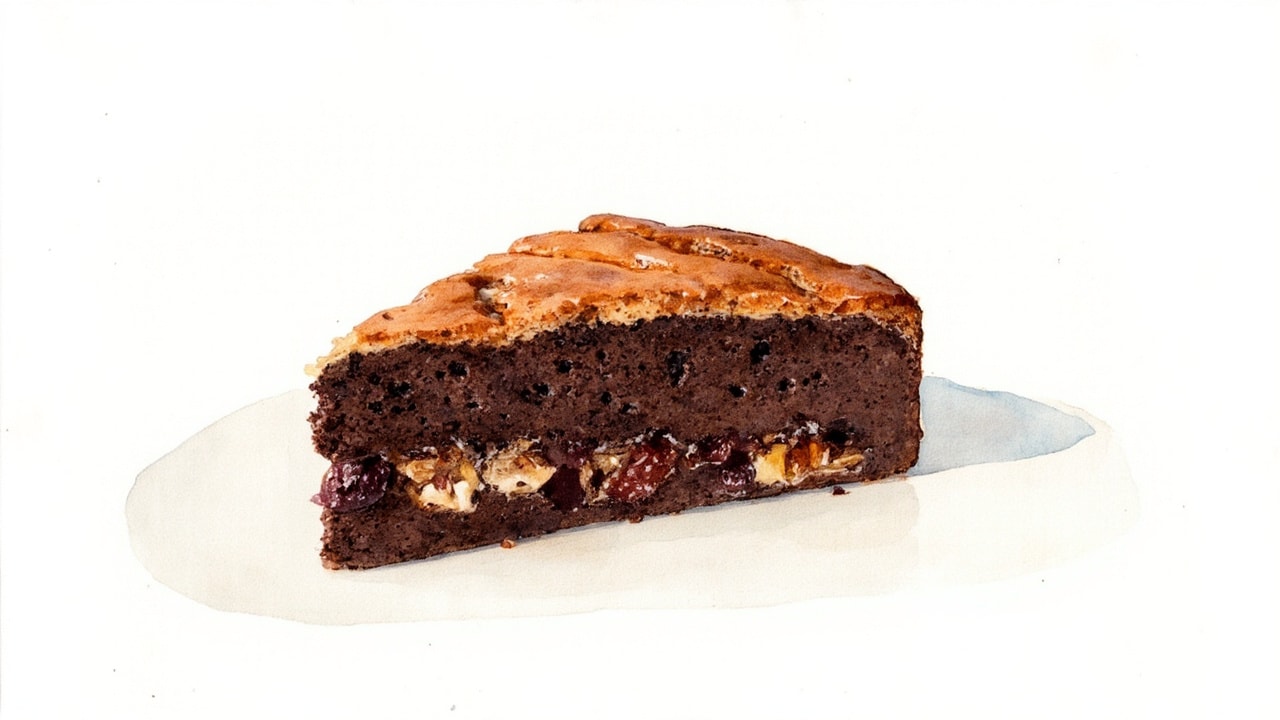
Fold the chopped soaked fruit into the batter, distributing it evenly throughout. The batter will be very thick and heavy; this is normal for a Caribbean black cake.
Transfer the batter to the prepared tin, smoothing the top with the back of a spoon and creating a slight well in the center (the cake will dome as it bakes). Tap the tin firmly on the counter 3 times to release trapped air bubbles.
Bake at 150°C (300°F) for 2 to 2.5 hours. After 1 hour, tent the top loosely with foil if it is browning too quickly. The cake is done when an instant-read thermometer inserted into the center reads 95°C (203°F) and a skewer emerges with moist crumbs but no wet batter. The internal temperature of 95°C (203°F) ensures the dense, fruit-laden center is fully cooked and safe.
Cool the cake in the tin on a wire rack for 30 minutes, then turn it out onto the rack and cool completely, about 1 hour longer.
Pierce the top and sides of the cooled cake all over with a skewer, going about 2-3cm deep. Brush or spoon 60-90ml of the reserved soaking liquid (or fresh dark rum) evenly over the surface, letting it absorb fully into the crumb.
Soak a large piece of cheesecloth in aged dark rum and wrap it snugly around the entire cake. Wrap the cheesecloth-covered cake in a layer of heavy-duty foil, then place it in an airtight cake tin or container.
Age the cake in a cool, dark place (16-21°C / 60-70°F) for at least 1 week, preferably 4 to 6 weeks. Every 7 days, unwrap the cake, brush 30-45ml of aged dark rum evenly over the surface, and rewrap in fresh rum-soaked cheesecloth and foil. The cake is ready when the crumb is saturated, deeply aromatic, and the alcohol has mellowed into the fruit and spice.
Chef's Notes
- The fruit-soaking liquid is the soul of this cake; never discard it. Reserve at least 200ml for the batter and a separate jar for weekly feedings; the longer the fruit soaks (up to 6 months), the more profound the rum-plum character becomes.
- True browning sauce is the signature color and flavor of authentic Caribbean black cake. Caramelize the dark muscovado sugar slowly over medium-low heat, stopping at a deep mahogany; blackened sugar will yield an acrid, bitter note. Quench with hot water and cool before using.
- Baking at 150°C (300°F) is non-negotiable. Higher heat will overcook the exterior before the dense, fruit-laden center sets. The cake is done only when an instant-read thermometer reads 95°C (203°F) in the center; a skewer test alone can be misleading with so much fruit.
- Weekly rum feedings during aging are what transform this from a good cake into a great one. Each feeding saturates the cheesecloth and slowly infuses the crumb with rum aroma, keeping the cake perpetually moist and building complexity.
- Wrap the cake in cheesecloth soaked in dark rum, then in foil, and store in an airtight tin in a cool, dark cupboard. The cake improves with age and is best after 4-6 weeks of weekly rum feedings; it can be aged up to a year with continued feedings.
Storage
Refrigerator: 3 months — Wrap tightly in cheesecloth, foil, then place in an airtight container. Refrigerate if your kitchen is warm (above 24°C/75°F) or for long-term storage beyond 6 weeks.
Freezer: 12 months — Wrap tightly in foil and plastic wrap, then place in an airtight freezer container. Thaw overnight at room temperature before serving.
Reheating: Best served at room temperature. To warm individual slices, place in a 150°C (300°F) oven for 5-8 minutes. A brief pass under a warm broiler caramelizes the surface lightly.
Troubleshooting
Cake is dry, crumbly, or harsh in texture
Cause: Overbaked, or insufficient rum feeding during aging
Fix: Brush generously with warm rum, wrap in rum-soaked cheesecloth, and let rest 3-5 days; this often rescues a slightly dry cake
Prevention: Bake only until an instant-read thermometer reads 95°C (203°F); feed the cake weekly with 30-45ml of rum during aging
Top of cake is cracked and excessively dark
Cause: Oven running too hot, or top exposed to direct heat for too long
Fix: Brush the top with rum; the cosmetic cracks will not affect flavor if the interior is moist
Prevention: Verify oven temperature with a separate thermometer; tent the top loosely with foil after the first hour
Cake sinks in the center after baking
Cause: Oven door opened too early, or cake underbaked in the dense center
Fix: Cannot be fully reversed, but the sunken cake can be leveled with a serrated knife, brushed with rum, and used for trifle or layered with whipped cream
Prevention: Avoid opening the oven in the first 90 minutes; bake until the internal temperature reaches 95°C (203°F)
Flavor is bitter, acrid, or harsh
Cause: Browning sauce overcooked (turned black rather than mahogany), or too much browning added to the batter
Fix: Cannot be reversed in this batch; balance at the table with whipped cream or a sweet rum glaze
Prevention: Stop caramelizing at deep mahogany color; start with 60ml of browning in the batter and adjust upward
Dried fruit pieces are tough and chewy in the finished cake
Cause: Fruit was not soaked long enough, or pulsed too coarsely in the food processor
Fix: Brush individual slices with extra rum 10 minutes before serving, or serve with a rum-spiked cream sauce
Prevention: Soak fruit for at least 1 week (ideally 2-4); pulse to small, even pieces about the size of a small raisin
Cultural Context
The Caribbean black cake descends from the British plum pudding and Christmas fruitcake brought to the West Indies during colonial times. Over generations, bakers swapped European dried fruits and brandy for sun-dried tropical fruits steeped in local rum, ruby port, and aromatic bitters, while slow-caramelized muscovado replaced plain molasses for the signature deep mahogany color. Today it is the centerpiece of Christmas, weddings, and Emancipation Day celebrations across Jamaica, Trinidad, Barbados, and the wider Caribbean, with each family guarding its own closely held recipe.