Equipment
Ingredients
Detrempe (Dough)
- 250 g bread flour
- 250 g all-purpose flour
- 140 ml water, room temperature
- 140 ml whole milk, room temperature
- 50 g granulated sugar
- 10 g fine sea salt
- 11 g instant yeast
- 50 g unsalted butter, softened
Beurrage (Butter Block)
- 250 g unsalted butter, cold, minimum 82 percent butterfat
Egg Wash
- 1 egg
- 15 ml whole milk
Nutrition (per serving)
Nutrition is estimated per serving. Nutrients without complete source data are omitted.
Full nutrition
- Calories
- 363 kcal
- Protein
- 6 g
- Carbohydrates
- 36 g
- Fat
- 22 g
- Fiber
- 1 g
- Sugar
- 5 g
- Sodium
- 339 mg
- Saturated Fat
- 13 g
- Monounsaturated Fat
- 6 g
- Polyunsaturated Fat
- 1 g
- Cholesterol
- 71 mg
- Potassium
- 81 mg
- Calcium
- 30 mg
- Iron
- 1.3 mg
- Magnesium
- 13 mg
- Phosphorus
- 74 mg
- Zinc
- 0.5 mg
- Vitamin A
- 184 mcg
- Vitamin D
- 0.3 mcg
- Vitamin E
- 0.7 mg
- Vitamin K
- 2 mcg
- Vitamin B6
- 0.0 mg
- Vitamin B12
- 0.1 mcg
- Thiamin
- 0.31 mg
- Riboflavin
- 0.20 mg
- Niacin
- 2.2 mg
- Folate
- 68 mcg
- Water
- 36 g
Sources: Aggregated Public Data, USDA FoodData Central
Method
Combine the bread flour, all-purpose flour, water, whole milk, granulated sugar, fine sea salt, instant yeast, and softened butter in the bowl of a stand mixer. Mix on low speed until a rough shaggy dough forms.
Knead the dough on low speed until it becomes smooth and pulls away from the sides of the bowl. The gluten should be moderately developed but not tightly sprung.
Form the dough into a rough rectangle, wrap tightly in plastic wrap or parchment paper, and leave to rest at room temperature to begin fermentation.
Transfer the wrapped dough rectangle to the refrigerator. Allow it to cold ferment overnight, which relaxes the gluten and develops complex flavors.
Place the 250g cold butter between two sheets of parchment paper. Use a rolling pin to firmly pound and roll the butter into an even 18cm by 18cm square. It should be pliable but completely cool.
Roll the chilled dough into a rectangle twice the length of your butter block. Place the butter block in the center and fold the dough edges over to fully encase it. Roll the dough into a long rectangle and fold the ends toward the middle, then fold in half like a book for a double fold.
Wrap the folded dough tightly to prevent drying and refrigerate to relax the gluten network and keep the butter layers strictly defined.
Remove the dough, turn it 90 degrees so the open seam faces you, and roll again into a long rectangle. Fold it in thirds like a business letter for a single fold.
Wrap the dough one final time and refrigerate. This final chill is crucial before the rolling and shaping phase to prevent the butter from melting.
Using a rolling pin and ruler, gently roll the dough into a large rectangle about 4 millimeters thick, measuring roughly 25cm by 60cm.
Trim the uneven edges of the dough with a sharp knife to expose the layers. Cut the rectangle into 12 tall isosceles triangles, with bases measuring about 10cm wide.
Gently elongate each triangle by stretching the base and tip. Roll the dough tightly from the wide base up to the pointed tip. Place them on a parchment-lined baking sheet with the tip tucked underneath.
Proof the shaped croissants in a draft-free environment at around 24°C/75°F. Do not exceed 26°C/79°F or the butter will melt and pool. Wait until they are fully doubled in size.
Whisk the egg and 15ml milk together. Using a pastry brush, gently glaze the delicate, proofed croissants without pressing down and deflating them.
Bake in a preheated oven at 200°C/390°F for 10 minutes to rapidly expand the steam layers. Then, lower the temperature to 190°C/375°F and bake for an additional 15 minutes until evenly deep brown.
Remove from the oven and carefully transfer the croissants to a wire rack. They must cool completely to set the interior crumb structure before eating.
Chef's Notes
- Temperature is your most critical ingredient. The butter and dough must remain at a similar, pliable consistency during lamination. If the butter gets too warm, it absorbs into the dough; if too cold, it shatters and tears the dough.
- Using a high-fat European-style butter, minimum 82 percent butterfat, is absolutely essential. It has a lower water content than American table butter, which creates more distinct, flakier layers.
- Do not rush the final proofing stage. An underproofed croissant will leak its butter in the oven and result in a dense interior rather than the desired open honeycomb crumb.
- When trimming the edges of the laminated dough before shaping, use a very sharp knife and press straight down. Dragging the blade will seal the delicate layers you just worked so hard to create.
Storage
Freezer: 2 months — Freeze fully baked and cooled croissants in airtight bags. Reheat directly from frozen.
Reheating: Refresh baked croissants in a 175 C oven for 3 to 5 minutes to restore crispness.
Troubleshooting
Butter pools on the baking tray during proofing or baking
Cause: The proofing environment was too warm, melting the butter, or the croissants were underproofed, causing butter to escape instead of expanding the layers.
Fix: Cannot be fixed once baking begins. The resulting pastry will have a denser, brioche-like texture but will still be edible.
Prevention: Ensure dough rests strictly at or below 24 C / 75 F while proofing. Be patient and wait for the distinctive wobble and visible layer separation before baking.
Dough resists rolling and springs back heavily
Cause: Gluten is too tightly developed from over-mixing or insufficient resting time between folds.
Fix: Wrap the dough and return it to the refrigerator for an extra 30 to 45 minutes to relax the gluten network before attempting to roll again.
Prevention: Knead only until moderately smooth initially. Never rush the chilling rests between lamination steps.
Cultural Context
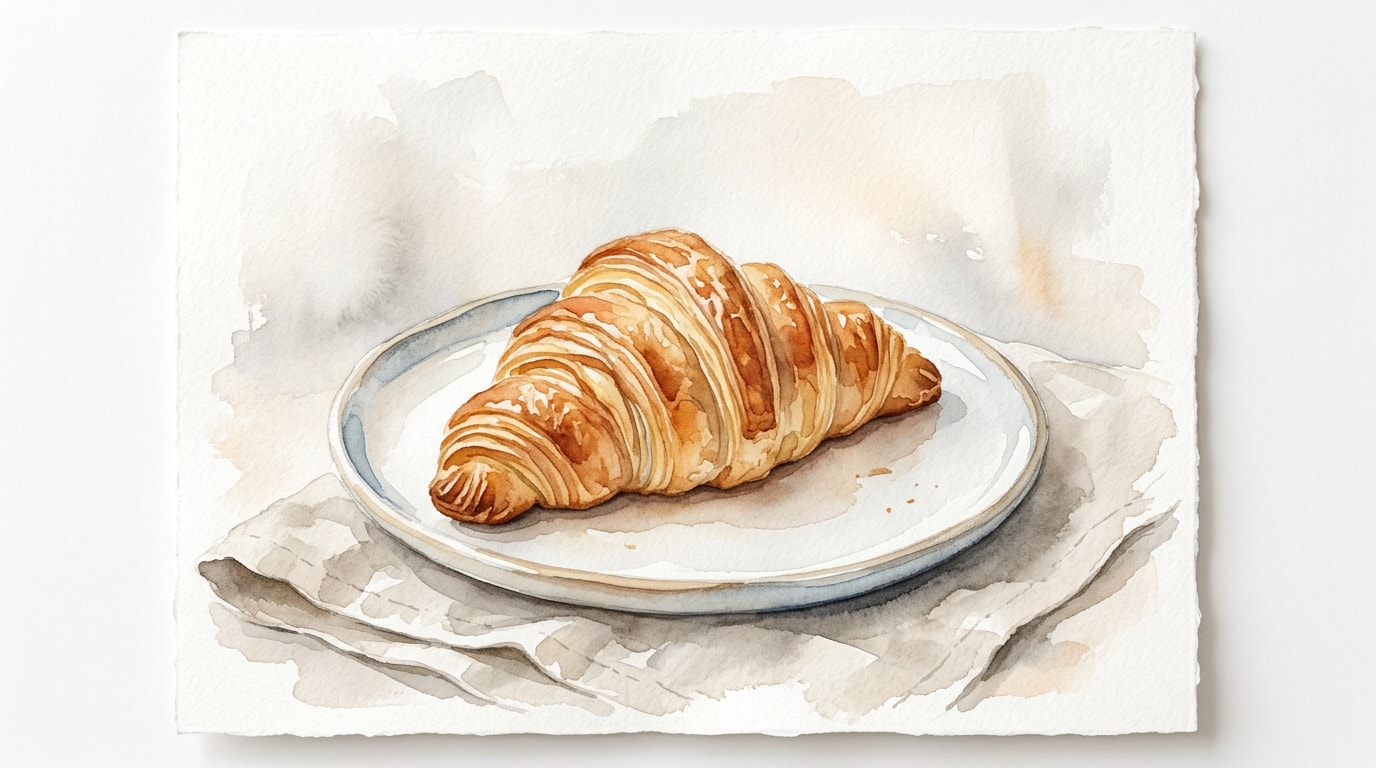
The croissant is the quintessential symbol of French pastry culture, though its true origins actually trace back to the Austrian kipferl, a simpler yeast-leavened bread. It was popularized in Paris during the mid-19th century when forward-thinking bakers began applying sophisticated puff pastry lamination techniques to the yeast dough, transforming it into the flaky, multi-layered masterpiece we recognize today.