
Equipment
Ingredients
Vanilla Custard Base
- 120 ml whole milk
- 120 ml heavy cream
- 3 eggs, room temperature
- 40 g granulated sugar
- 10 ml vanilla extract
- 1 g salt, fine
Brioche
- 200 g brioche loaf, stale, unsliced
- 30 g unsalted butter
Caramelized Apricots
- 4 fresh apricots, halved and pitted
- 40 g unsalted butter
- 40 g brown sugar, lightly packed
- 5 ml lemon juice, freshly squeezed
Nutrition (per serving)
Nutrition is estimated per serving. Nutrients without complete source data are omitted.
Full nutrition
- Calories
- 584 kcal
- Protein
- 10 g
- Carbohydrates
- 42 g
- Fat
- 37 g
- Fiber
- 1 g
- Sugar
- 29 g
- Sodium
- 333 mg
- Saturated Fat
- 17 g
- Trans Fat
- 0 g
- Monounsaturated Fat
- 9 g
- Polyunsaturated Fat
- 2 g
- Cholesterol
- 214 mg
- Potassium
- 246 mg
- Calcium
- 113 mg
- Iron
- 2.4 mg
- Magnesium
- 15 mg
- Phosphorus
- 131 mg
- Zinc
- 0.8 mg
- Vitamin A
- 355 mcg
- Vitamin C
- 5 mg
- Vitamin D
- 1.6 mcg
- Vitamin E
- 1.5 mg
- Vitamin K
- 4 mcg
- Vitamin B6
- 0.1 mg
- Vitamin B12
- 0.6 mcg
- Thiamin
- 0.05 mg
- Riboflavin
- 0.31 mg
- Niacin
- 0.3 mg
- Folate
- 25 mcg
- Water
- 112 g
- Alcohol
- 1 g
Sources: Aggregated Public Data, USDA FoodData Central
Method
In a wide shallow bowl, vigorously whisk together the eggs, whole milk, heavy cream, granulated sugar, vanilla extract, and salt until the sugar is fully dissolved and the mixture is a uniform pale yellow.
Cut the brioche loaf into four slices, each at least 2.5 centimeters thick. Submerge the slices in the custard mixture. Let them rest to absorb the liquid for 5 minutes per side.
While the bread soaks, prepare the fruit. Melt 40g of butter in a skillet over medium heat. Stir in the brown sugar until it bubbles. Place the apricot halves cut-side down into the syrup. Cook undisturbed until deeply browned, about 4 minutes. Remove from heat and stir in the lemon juice.
In a separate large skillet, melt the remaining 30g of butter over medium-low heat. Carefully lift the soaked brioche slices, letting excess custard drip off, and place them in the pan. Cook until deeply golden on the bottom, about 3 to 4 minutes. Flip and repeat on the other side. Cook until the internal temperature of the bread reaches 71°C/160°F to ensure the raw egg custard is fully set and safe to consume.
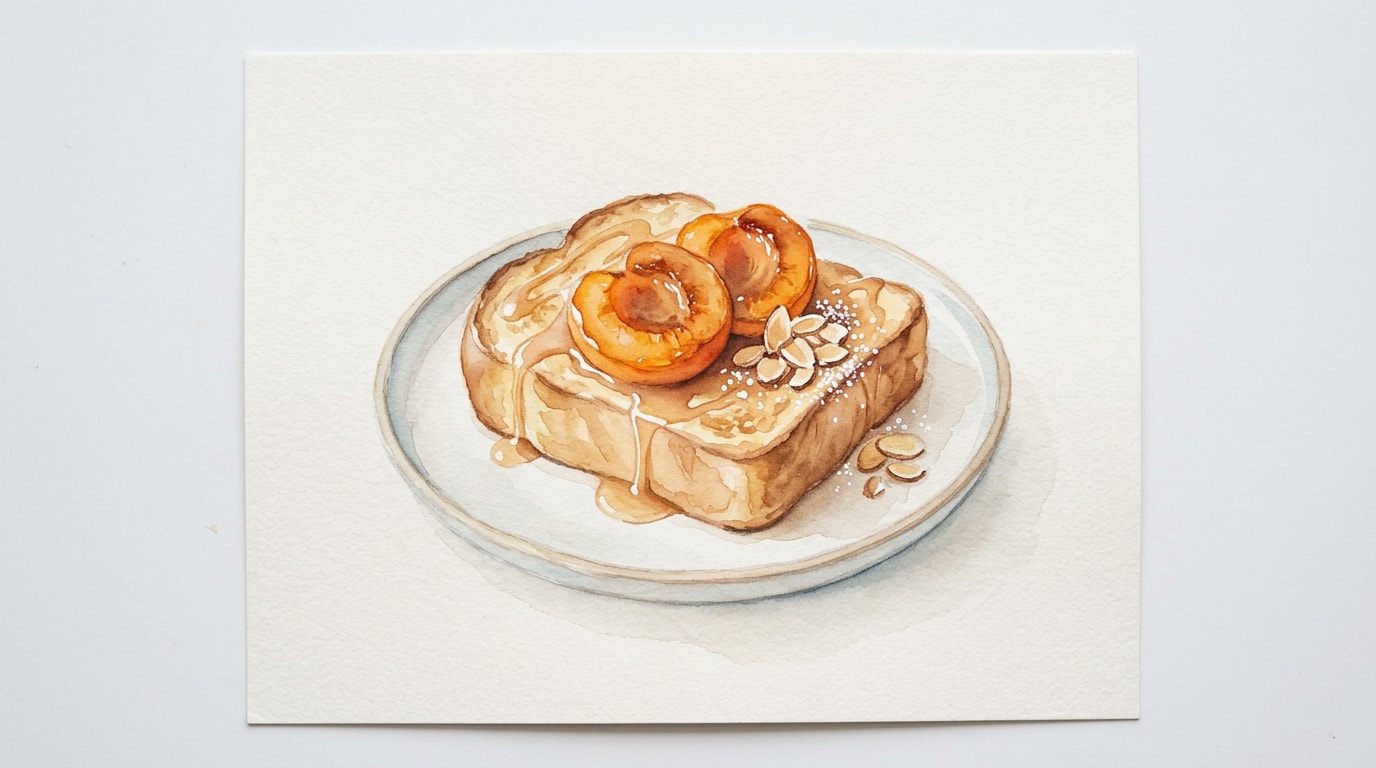
Transfer the hot pain perdu to warmed serving plates. Arrange two caramelized apricot halves over each slice and drizzle generously with the remaining warm buttery pan syrup.
Chef's Notes
- Stale bread is non-negotiable for traditional pain perdu. The dry crumb acts like a sponge, drinking up the rich custard without immediately turning to mush.
- A pinch of salt in the custard base is crucial to elevate the vanilla notes and balance the sweetness of the caramel topping.
- For an extra layer of flavor, deglaze the apricot pan with a splash of brandy or dark rum just before adding the lemon juice.
- Wiping the skillet between batches prevents the milk solids from the previous batch of butter from burning onto the next slices.
Storage
Refrigerator: 2 days — Best stored as separate components. Soaked and cooked brioche loses crispness.
Reheating: Reheat cooked brioche in an oven at 175 degrees Celsius for 8 minutes to restore crispness.
Troubleshooting
Brioche burns on the outside while the inside remains runny and raw
Cause: Skillet temperature was too high, causing the sugars to rapidly scorch before the heat penetrated to the center
Fix: Transfer the browned slices to an oven preheated to 175 degrees Celsius for 5 to 8 minutes to gently finish cooking the center
Prevention: Cook over medium-low heat and monitor constantly, adjusting the burner if the butter begins to smoke
Bread disintegrates when trying to move it from the soaking dish to the pan
Cause: Slices were cut too thin or soaked for too long, especially if using extremely fresh bread
Fix: Cannot be fixed cleanly, but broken pieces can be roughly chopped, baked in a dish with the remaining custard at 175 degrees Celsius for 25 minutes, and served as a bread pudding
Prevention: Slice brioche thickly and leave slices out overnight to stale slightly so they hold their structure
Cultural Context
Pain perdu translates literally to lost bread, historically serving as a clever peasant technique to rescue stale, hardened loaves from the bin. By upgrading the base to an already rich, butter-heavy brioche and pairing it with seasonal fresh fruits like apricots, this humble thrifty practice is elevated into a luxurious patisserie-worthy dessert.


