
Equipment
* optional
Ingredients
Fruit
- 800 g yellow peaches, ripe but firm
Maceration Liquid
- 50 g granulated sugar
- 30 ml balsamic vinegar
- 3 g pink peppercorns
- 1 g fine sea salt
Nutrition (per serving)
Nutrition is estimated per serving. Nutrients without complete source data are omitted.
Full nutrition
- Calories
- 135 kcal
- Protein
- 2 g
- Carbohydrates
- 33 g
- Fat
- 1 g
- Fiber
- 3 g
- Sugar
- 30 g
- Sodium
- 99 mg
- Saturated Fat
- 0 g
- Monounsaturated Fat
- 0 g
- Polyunsaturated Fat
- 0 g
- Potassium
- 389 mg
- Calcium
- 15 mg
- Iron
- 0.6 mg
- Magnesium
- 19 mg
- Phosphorus
- 41 mg
- Zinc
- 0.3 mg
- Vitamin A
- 32 mcg
- Vitamin C
- 13 mg
- Vitamin E
- 1.5 mg
- Vitamin K
- 5 mcg
- Vitamin B6
- 0.1 mg
- Thiamin
- 0.04 mg
- Riboflavin
- 0.06 mg
- Niacin
- 1.6 mg
- Folate
- 8 mcg
- Water
- 184 g
Sources: Aggregated Public Data, USDA FoodData Central
Method
Using a mortar and pestle or the flat side of a knife, gently crush the pink peppercorns until coarsely broken. Do not grind into a fine powder; you want texture and bursts of flavor.
Cut the peaches in half, remove the pits, and slice each half into wedges approximately 2cm (0.75 inch) thick. Place the slices into a large mixing bowl.
Sprinkle the sugar, crushed pink peppercorns, and sea salt over the peaches. Drizzle with the balsamic vinegar. Gently toss with a spoon or clean hands until the fruit is evenly coated.
Let the mixture stand at room temperature for at least 30 minutes, tossing once halfway through. This process (maceration) draws moisture from the peaches to create a syrup.
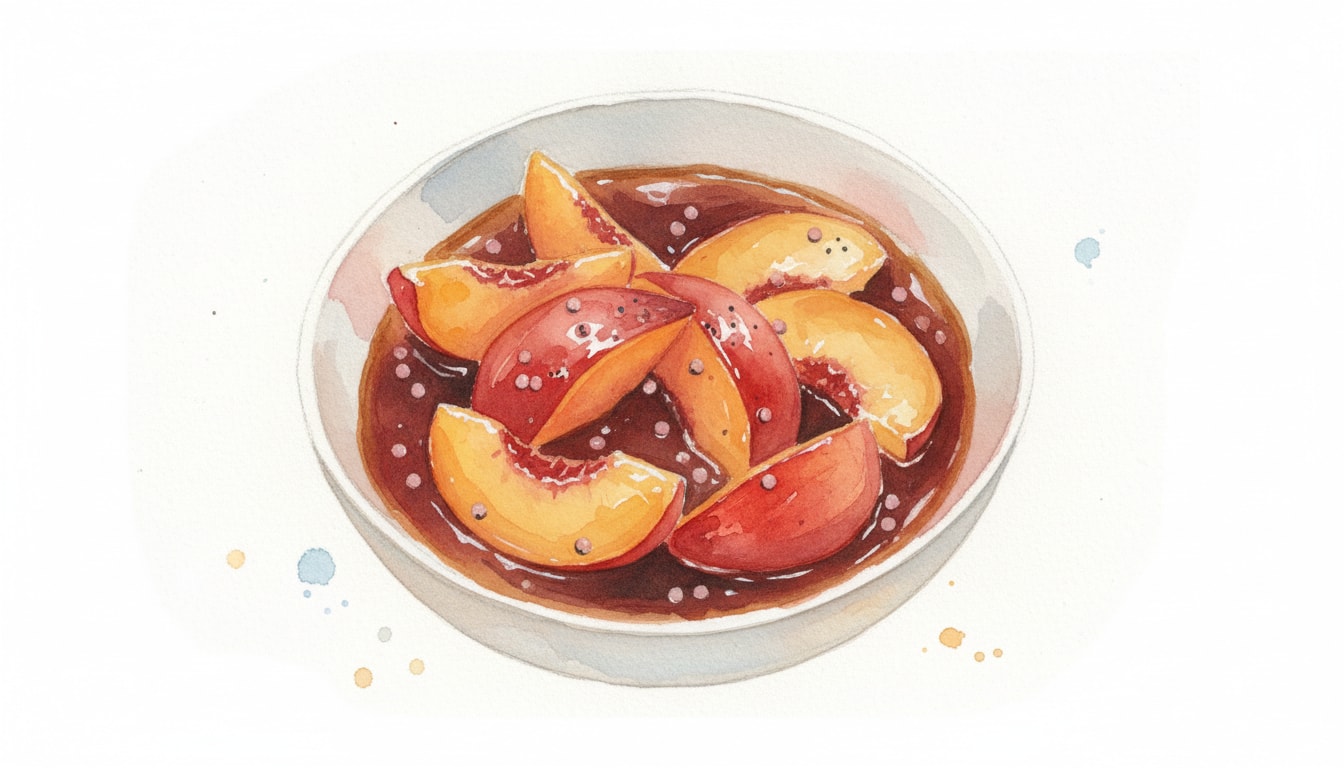
Give the peaches a final toss to coat them in the accumulated juices and serve immediately.
Chef's Notes
- The quality of the balsamic vinegar makes or breaks this dish. Use an aged Balsamic Vinegar of Modena (IGP or DOP) which has a natural syrupy consistency and sweetness, rather than a thin, astringent salad vinegar.
- If pink peppercorns are unavailable, do not substitute with black pepper as it is too harsh. Fresh basil or tarragon leaves make a suitable alternative for an herbal note.
- This technique, maceration, relies on osmosis. The sugar draws water out of the fruit cells, dissolving the sugar and creating a self-saucing dessert without any heat.
Storage
Refrigerator: 1 day — Best eaten fresh; texture degrades and becomes mushy after 24 hours.
Troubleshooting
Peaches are mushy
Cause: Fruit was over-ripe before starting or macerated too long
Fix: Puree the mixture and serve as a sauce for ice cream or yogurt
Prevention: Select fruit that yields slightly to pressure but is not soft; limit maceration to 30 minutes
Dish is too sour
Cause: Peaches were under-ripe or vinegar was low quality/too acidic
Fix: Stir in an additional 10-15g of sugar or a drizzle of honey and let sit for 10 more minutes
Prevention: Taste peaches before slicing; use aged balsamic which is sweeter
Cultural Context
While macerating fruit is a universal technique, the combination of stone fruit with balsamic vinegar is distinctly Italian in profile. It highlights the Italian philosophy of 'agrodolce' (sour-sweet), utilizing the region's prized vinegar to enhance the natural sugars of summer produce.


