
Equipment
Ingredients
Mussels & Steaming Liquid
- 1000 g fresh mussels, live
- 120 ml dry white wine
- 1 shallot, finely minced
Herb & Cheese Gratin
- 60 g unsalted butter, softened
- 50 g panko breadcrumbs
- 30 g parmesan cheese, finely grated
- 2 garlic, minced to paste
- 10 g flat-leaf parsley, finely chopped
- 1 lemon zest
- 2 g salt
- 1 g black pepper, freshly ground
Nutrition (per serving)
Nutrition is estimated per serving. Nutrients without complete source data are omitted.
Full nutrition
- Calories
- 456 kcal
- Protein
- 35 g
- Carbohydrates
- 21 g
- Fat
- 20 g
- Fiber
- 1 g
- Sugar
- 2 g
- Sodium
- 1094 mg
- Saturated Fat
- 10 g
- Monounsaturated Fat
- 5 g
- Polyunsaturated Fat
- 2 g
- Cholesterol
- 107 mg
- Potassium
- 880 mg
- Calcium
- 191 mg
- Iron
- 10.8 mg
- Magnesium
- 97 mg
- Phosphorus
- 577 mg
- Zinc
- 4.5 mg
- Vitamin A
- 249 mcg
- Vitamin C
- 25 mg
- Vitamin D
- 0.0 mcg
- Vitamin E
- 1.8 mg
- Vitamin K
- 44 mcg
- Vitamin B6
- 0.2 mg
- Vitamin B12
- 30.2 mcg
- Thiamin
- 0.54 mg
- Riboflavin
- 0.61 mg
- Niacin
- 4.9 mg
- Folate
- 125 mcg
- Water
- 216 g
Sources: Aggregated Public Data, USDA FoodData Central
Method
Inspect the mussels. Discard any with broken shells or open shells that do not close when tapped. Remove the fibrous beard by pulling it firmly towards the hinge of the shell.
In a large pot over high heat, combine the white wine and minced shallot. Bring to a boil.
Add the mussels to the pot, cover tightly with a lid, and steam for 3-4 minutes, shaking the pot occasionally, until the shells just open. Do not overcook.
Drain the mussels and let them cool slightly. Discard any mussels that remain closed. Twist off and discard the empty top half of each shell. Loosen the meat from the bottom shell but leave it resting inside.
In a mixing bowl, combine softened butter, breadcrumbs, grated Parmesan, minced garlic, parsley, lemon zest, salt, and pepper. Mash with a fork until well combined and crumbly.
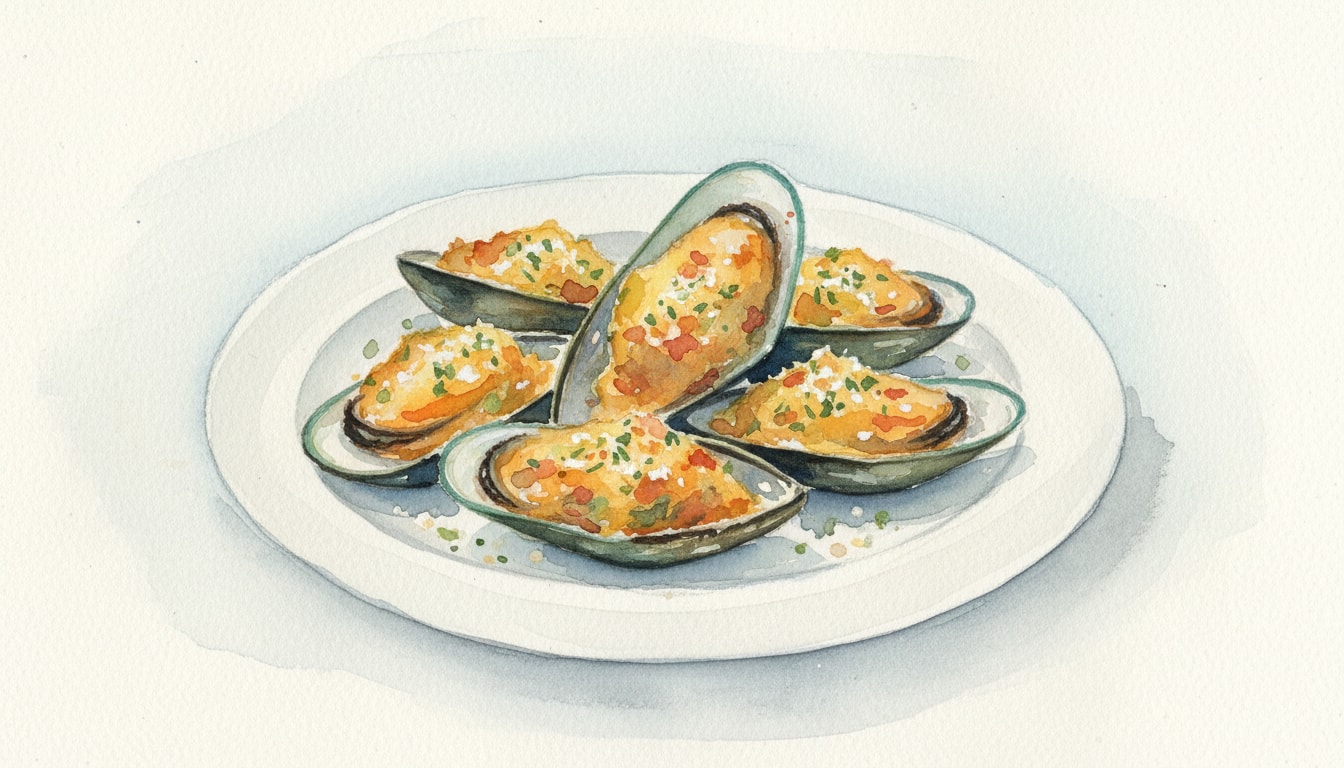
Arrange the mussels on the half-shell on a baking sheet. Spoon roughly 1 teaspoon of the butter mixture onto each mussel, pressing gently to adhere.
Bake in a preheated oven at 220°C/425°F (or use the broiler/grill setting) for 4-5 minutes until the topping is golden brown and bubbling.
Chef's Notes
- Select mussels that feel heavy for their size; light mussels may be dead or dehydrated.
- The breadcrumb mixture can be made a day in advance and stored in the fridge to save time.
- If using a broiler, watch the tray constantly as the transition from golden to burnt happens in seconds.
- Save the steaming liquid! Strain it through cheesecloth to remove grit and use it as a base for a seafood chowder or pasta sauce.
Storage
Refrigerator: 1 day — Best consumed immediately. Texture of crumb topping degrades rapidly in storage.
Reheating: Reheat under a broiler for 2-3 minutes to crisp the topping, though fresh is significantly superior.
Troubleshooting
Mussels are rubbery
Cause: Overcooked during the initial steaming or baked too long
Fix: Cannot be fixed
Prevention: Remove mussels from the steam exactly when they open; they will cook further in the oven.
Gritty texture when eating
Cause: Sand left inside the mussel or beard not fully removed
Fix: Cannot be fixed
Prevention: Scrub shells thoroughly and purge in cold salted water for 20 minutes before cooking if they are wild-harvested.
Cultural Context
Baked mussels, often known as 'Moules Farcies' in France, are a bistro staple that transforms the humble, inexpensive mussel into a luxurious appetizer. This preparation method dates back to classic Provençal cooking, where garlic, herbs, and breadcrumbs are used to extend and enhance fresh seafood catches.


