Equipment
* optional
Ingredients
Fruit Base
- 1000 g crab apples, washed and roughly chopped
- 1000 g mixed hedgerow berries, washed
- 1200 ml water
Sugar and Acid
- 1000 g granulated sugar
- 30 ml lemon juice, freshly squeezed
Nutrition (per serving)
Nutrition is estimated per serving. Nutrients without complete source data are omitted.
Full nutrition
- Calories
- 1267 kcal
- Protein
- 5 g
- Carbohydrates
- 324 g
- Fat
- 2 g
- Fiber
- 22 g
- Sugar
- 298 g
- Sodium
- 15 mg
- Saturated Fat
- 0 g
- Monounsaturated Fat
- 0 g
- Polyunsaturated Fat
- 1 g
- Potassium
- 904 mg
- Calcium
- 126 mg
- Iron
- 2.6 mg
- Magnesium
- 71 mg
- Phosphorus
- 93 mg
- Zinc
- 1.4 mg
- Vitamin A
- 33 mcg
- Vitamin C
- 75 mg
- Vitamin E
- 2.9 mg
- Vitamin K
- 50 mcg
- Vitamin B6
- 0.1 mg
- Thiamin
- 0.05 mg
- Riboflavin
- 0.13 mg
- Niacin
- 1.6 mg
- Folate
- 64 mcg
- Water
- 527 g
Sources: Aggregated Public Data, USDA FoodData Central
Method
Wash and roughly chop the crab apples, leaving the cores and seeds intact as they contain high levels of pectin. Thoroughly wash the mixed hedgerow fruits.
Place all the fruit into a large preserving pan, pour in the water so the fruit is just barely covered, and bring the mixture to a boil.
Reduce the heat and simmer gently until the fruit is very soft, broken down, and pulpy.
Carefully pour the hot fruit mixture into a jelly bag suspended securely over a large clean bowl. Leave to drip overnight. Do not squeeze the bag under any circumstances, or your jelly will become cloudy.
Measure the extracted juice. For every 1000ml of juice, weigh out exactly 1000g of granulated sugar. Pour the measured juice back into a cleaned preserving pan.
Add the sugar and optional lemon juice to the cold juice. Heat gently over low heat, stirring continuously until the sugar crystals have completely dissolved.
Increase the heat and bring to a rapid, rolling boil. Boil hard without stirring until the setting point is reached at 105°C/221°F.
Skim off any surface scum with a slotted spoon. Carefully ladle the hot jelly into hot, sterilized jars, leaving a small gap at the top, and seal immediately.
Chef's Notes
- Crab apples are a preserver's secret weapon. Their incredibly high natural pectin content ensures a reliable, firm set, making them the perfect base to mix with lower-pectin fruits like blackberries or elderberries.
- To test the set without a thermometer, place 2 to 3 small saucers in the freezer before you begin cooking. Spoon a small amount of boiling jelly onto the cold plate, wait exactly one minute, then push it with your finger. If the surface wrinkles visibly, the setting point has been reached.
- Sterilizing your jars properly is absolutely non-negotiable for preservation safety. Wash them thoroughly in hot soapy water, rinse, then place them in a 140°C/285°F oven for 15 minutes while the jelly boils.
- Do not stir the jelly once it has reached a rolling boil. Stirring lowers the temperature and disrupts the rapid evaporation required to reach the setting point efficiently.
Storage
Refrigerator: 6 months — Store in the refrigerator once opened.
Troubleshooting
The jelly is cloudy and opaque
Cause: The jelly bag was squeezed or pressed during the straining process
Fix: Cannot be fixed, but the jelly will still taste perfectly fine
Prevention: Allow the fruit pulp to drip entirely through gravity overnight without applying any pressure
The jelly is runny and has not set properly in the jars
Cause: The mixture was not boiled to a high enough temperature to activate the pectin, or there was an insufficient ratio of pectin to sugar
Fix: Empty the jars back into the preserving pan, add a little extra lemon juice, and boil rapidly for another 5 to 10 minutes until the setting point is reached
Prevention: Ensure the mixture reaches 105°C/221°F on a sugar thermometer and always perform the chilled saucer wrinkle test
Cultural Context
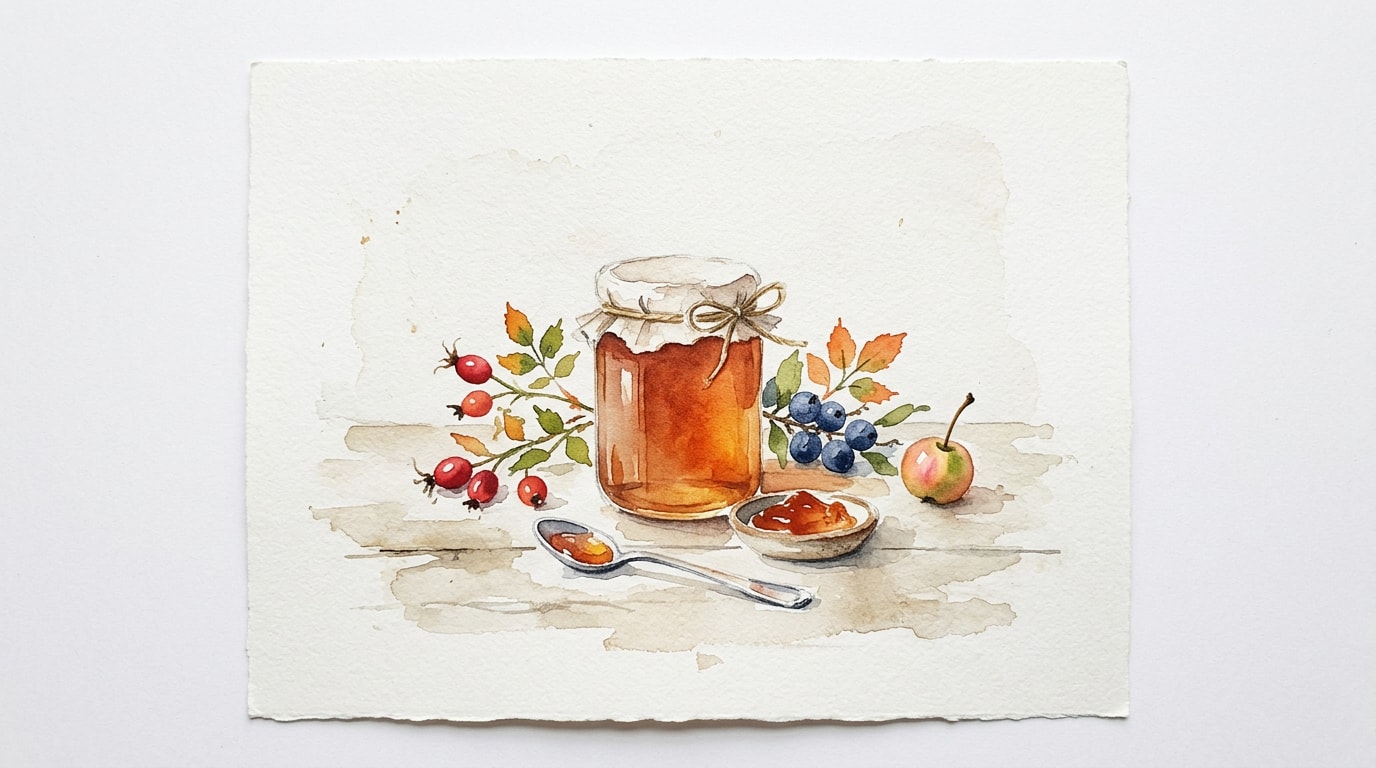
Hedgerow foraging is deeply rooted in British countryside traditions, marking the seasonal shift from late summer to autumn. Historically, crab apples, which are often too sharp to eat raw, were highly prized for their natural pectin. They served as a crucial preserving agent, turning the fleeting, delicate bounty of wild blackberries, sloes, and hawthorn berries into vibrant, long-lasting winter preserves.