Equipment
* optional
Ingredients
Fruit
- 12 hachiya persimmons, unripe and firm
Sanitization
- 3000 ml water
- 50 ml shochu or vodka
Nutrition (per serving)
Nutrition is estimated per serving. Nutrients without complete source data are omitted.
Full nutrition
- Calories
- 140 kcal
- Protein
- 1 g
- Carbohydrates
- 37 g
- Fat
- 0 g
- Fiber
- 7 g
- Sugar
- 25 g
- Sodium
- 2 mg
- Saturated Fat
- 0 g
- Monounsaturated Fat
- 0 g
- Polyunsaturated Fat
- 0 g
- Potassium
- 322 mg
- Calcium
- 16 mg
- Iron
- 0.3 mg
- Magnesium
- 18 mg
- Phosphorus
- 34 mg
- Zinc
- 0.2 mg
- Vitamin A
- 162 mcg
- Vitamin C
- 15 mg
- Vitamin E
- 1.5 mg
- Vitamin K
- 5 mcg
- Vitamin B6
- 0.2 mg
- Thiamin
- 0.06 mg
- Riboflavin
- 0.04 mg
- Niacin
- 0.2 mg
- Folate
- 16 mcg
- Water
- 161 g
Sources: USDA FoodData Central
Method
Trim the calyx leaves from the top of each persimmon using a paring knife, being extremely careful to leave the T-shaped stem fully intact.
Peel the skin completely off each persimmon using a vegetable peeler, starting from the bottom tip and pulling upward to the stem edge.
Cut lengths of kitchen twine and tie them securely around the T-shaped stem of each peeled persimmon.
Bring a large pot of water to a rolling boil at 100°C/212°F.
Holding the twine, submerge each persimmon into the boiling water for exactly ten seconds to pasteurize the exterior and discourage mold growth.
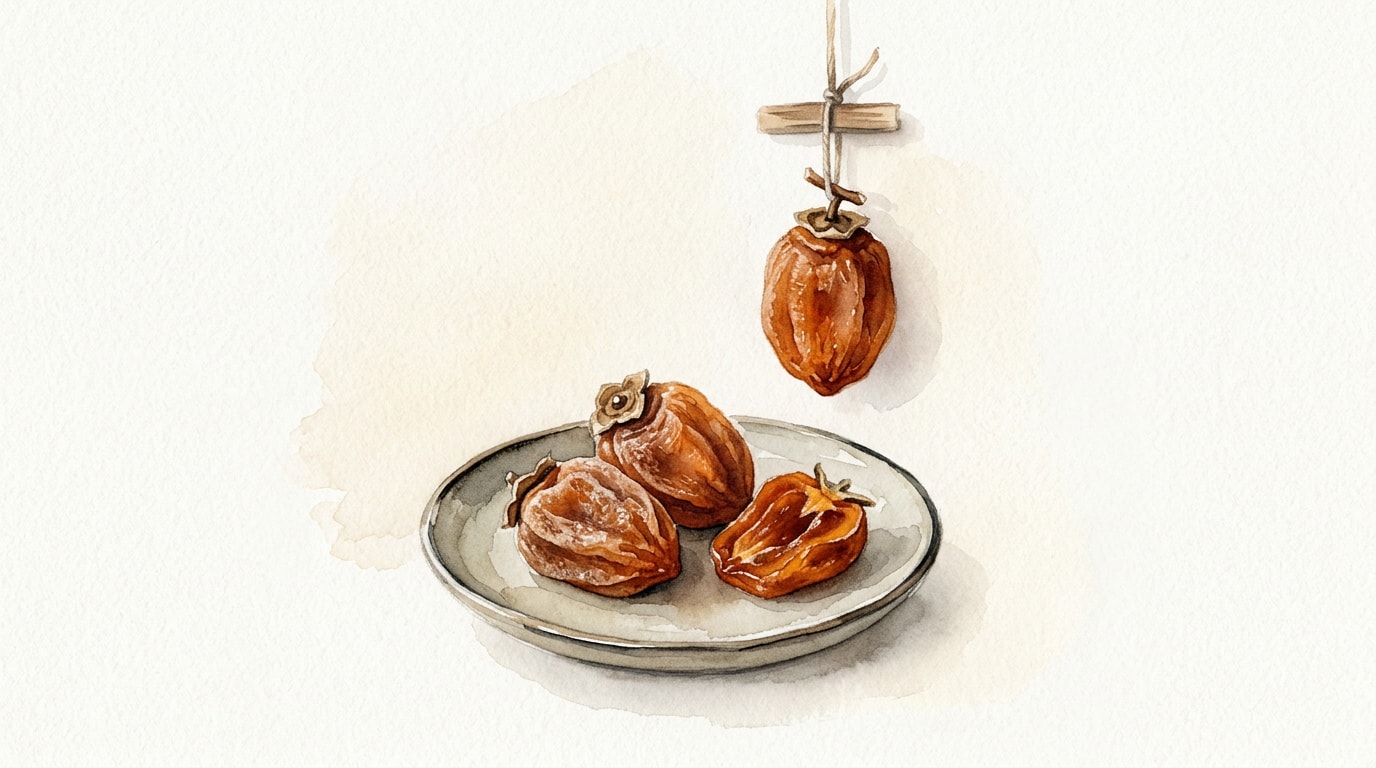
Suspend the persimmons by their twine from a bamboo pole or drying rack in a highly ventilated area, ensuring they do not touch walls, surfaces, or each other.
Allow the fruit to hang completely undisturbed for five to seven days until a leathery pellicle forms on the exterior.
Gently massage each persimmon with clean hands for a few seconds. Repeat this daily for three to four weeks to break up the hard inner core and draw the natural sugars to the surface.
Chef's Notes
- The white powder that eventually forms is not mold, but rather crystallized fructose and glucose drawn to the surface. It is the hallmark of a perfectly cured hoshigaki.
- Selecting the right persimmon is paramount. Fuyu varieties (squat and tomato-shaped) are non-astringent and meant to be eaten fresh. You must use Hachiya varieties (acorn-shaped) for drying.
- Always check for a sturdy piece of stem before purchasing your fruit. Without it, tying and suspending the persimmons becomes incredibly difficult.
- The daily massage serves two purposes: it breaks down the fibrous interior for a supple texture, and it ensures the fruit dries evenly rather than developing a hard outer shell and rotting center.
Storage
Refrigerator: 3 months — Store in an airtight container lined with parchment paper.
Freezer: 1 year — Wrap individually to prevent sticking.
Troubleshooting
White fuzzy growth or black spots appear on the exterior
Cause: High humidity, poor air circulation, or the fruits were touching
Fix: If pure white mold, gently wipe off with a clean cloth dipped in shochu. If mold is black, green, or penetrates the flesh, discard immediately.
Prevention: Ensure rigorous spacing, employ a fan for constant airflow, and mist with high-proof alcohol.
The fruit remains hard as a rock after several weeks
Cause: The drying environment was too hot and dry, or the fruit was not massaged consistently
Fix: Cannot be fixed once completely hardened, but can be chopped and steeped in tea or baked goods.
Prevention: Dry in cool, crisp autumn conditions and adhere to a strict daily massage routine once the pellicle forms.
The persimmon skin tears and leaks pulp during massage
Cause: Squeezing too aggressively too early in the curing process
Fix: Wipe the tear clean, mist with alcohol, and suspend it again without massaging for several days to let it reseal.
Prevention: Wait for a firm leathery skin to form, and apply only the lightest finger pressure in the first two weeks.
Cultural Context
Hoshigaki is an ancient Japanese preservation method born from the necessity to store food for harsh winters, transforming intensely bitter, inedible raw fruit into a prized wagashi (confection). Hung from the eaves of rural homes, the striking orange curtains of drying persimmons are considered a classic symbol of autumn in Japan, often enjoyed with green tea during the New Year.