
Equipment
Ingredients
Pastry
- 320 g puff pastry, thawed if frozen, kept cold
Ricotta Filling
- 250 g ricotta cheese, well-drained
- 50 g parmesan cheese, finely grated
- 1 lemon, zested
- 2 g fresh thyme, leaves picked and lightly chopped
- 1 garlic, minced
- 1 egg, lightly beaten
- 3 g kosher salt
- 1 g black pepper, freshly ground
Vegetable Center
- 200 g asparagus spears, woody ends trimmed
Finishing
- 1 egg, beaten with a splash of water
- flaky sea salt
Nutrition (per serving)
Nutrition is estimated per serving. Nutrients without complete source data are omitted.
Full nutrition
- Calories
- 313 kcal
- Protein
- 9 g
- Carbohydrates
- 22 g
- Fat
- 21 g
- Fiber
- 1 g
- Sugar
- 1 g
- Sodium
- 417 mg
- Saturated Fat
- 7 g
- Trans Fat
- 0 g
- Monounsaturated Fat
- 10 g
- Polyunsaturated Fat
- 2 g
- Cholesterol
- 59 mg
- Potassium
- 169 mg
- Calcium
- 157 mg
- Iron
- 1.9 mg
- Magnesium
- 21 mg
- Phosphorus
- 151 mg
- Zinc
- 0.8 mg
- Vitamin A
- 78 mcg
- Vitamin C
- 2 mg
- Vitamin D
- 0.3 mcg
- Vitamin E
- 0.7 mg
- Vitamin K
- 18 mcg
- Vitamin B6
- 0.1 mg
- Vitamin B12
- 0.4 mcg
- Thiamin
- 0.21 mg
- Riboflavin
- 0.31 mg
- Niacin
- 2.0 mg
- Folate
- 51 mcg
- Water
- 61 g
Sources: USDA FoodData Central
Method
Preheat the oven to 200 degrees Celsius (400 degrees Fahrenheit). Line a baking sheet with parchment paper.
In a mixing bowl, combine the drained ricotta, grated Parmesan, lemon zest, thyme leaves, minced garlic, the binding egg, kosher salt, and black pepper. Stir with a silicone spatula until evenly mixed.
Unroll or roll out the cold puff pastry onto the prepared parchment paper to form a rectangle roughly 25cm by 35cm.
Spread the ricotta mixture evenly down the center third of the pastry rectangle, leaving a 2cm border at the top and bottom ends.
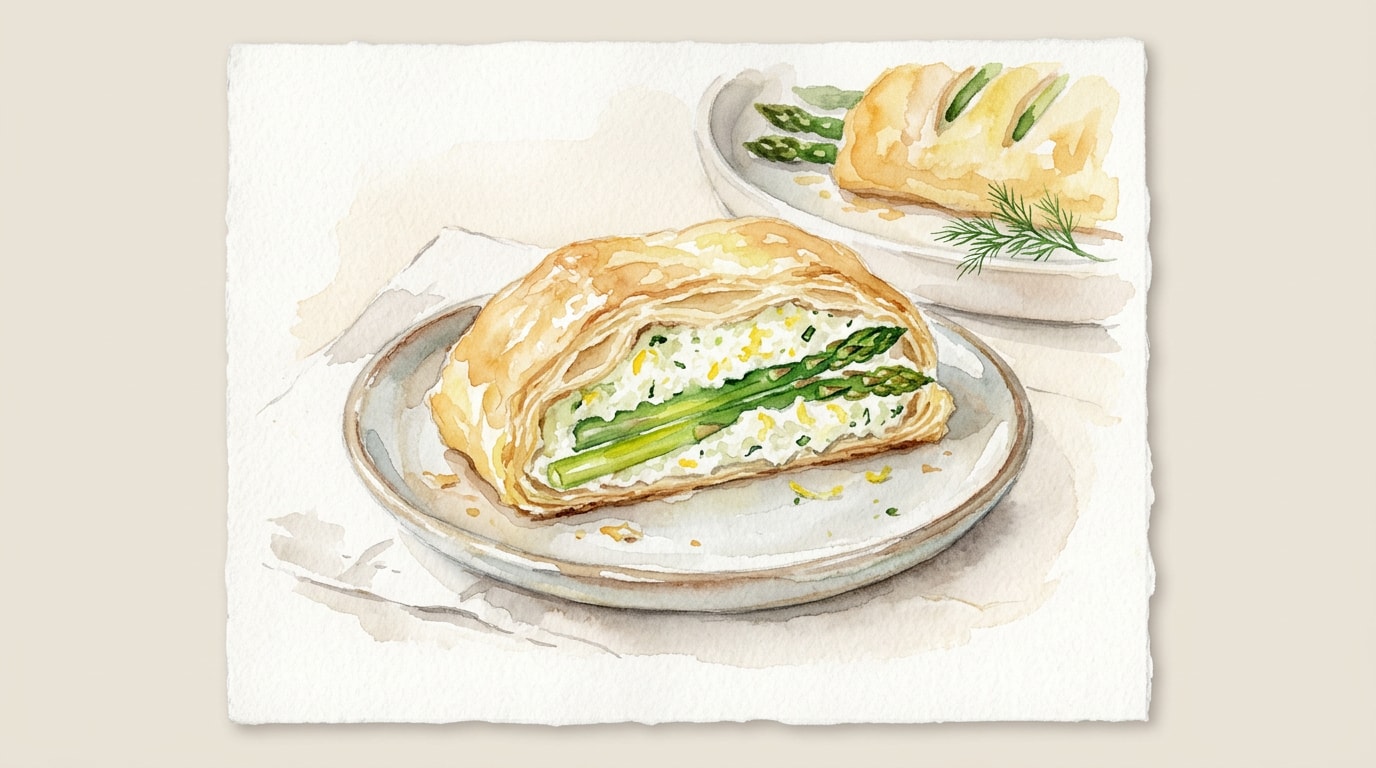
Lay the trimmed asparagus spears lengthwise in a uniform layer directly on top of the ricotta filling.
Fold the long sides of the pastry over the filling so they overlap in the center, creating a log shape. Gently pinch the top and bottom ends closed to seal the log, then carefully roll the entire log over so the seam side is facing down on the parchment paper.
Using a pastry brush, coat the entire exposed surface of the log with the egg wash. Using a sharp paring knife, score shallow diagonal lines across the top of the pastry, and sprinkle lightly with flaky sea salt if using.
Bake in the preheated oven for 25 to 30 minutes, or until the puff pastry is deeply golden brown, puffed, and crisp to the touch.
Remove from the oven and carefully transfer the log to a wire rack. Let it cool for at least 10 minutes before slicing into portions with a chef knife to serve.
Chef's Notes
- Always drain the ricotta in a sieve lined with cheesecloth for at least an hour before mixing; excess moisture is the enemy of flaky puff pastry.
- For extra flavor and tenderness, lightly blanch or grill thicker asparagus spears for 1 minute before adding them to the filling.
- Scoring the top of the pastry not only looks professional but controls where the dough expands, preventing the log from bursting unevenly.
- Keep the puff pastry in the fridge right up until you need it. Laminated doughs rely on cold butter hitting a hot oven to create steam and lift.
- A clean slice through puff pastry requires a sharp, non-serrated chef knife pressed straight down, rather than a sawing motion which can drag and tear the delicate flakes.
Storage
Refrigerator: 3 days — Store in an airtight container. Pastry will lose crispness.
Freezer: 1 month — Freeze unbaked log wrapped tightly in plastic wrap and foil. Bake from frozen, adding 10-15 minutes to baking time.
Reheating: Reheat in a 180C/350F oven for 10-12 minutes until warmed through and pastry is crisp again. Do not microwave.
Troubleshooting
Pastry base is soggy and undercooked
Cause: Ricotta held too much moisture or the baking sheet was placed too high in the oven
Fix: Cover the top loosely with foil and bake on the lowest oven rack for an additional 5-8 minutes to crisp the bottom.
Prevention: Drain ricotta in a cheesecloth-lined sieve for 1-2 hours before use. Bake on the lower-middle oven rack.
Pastry layers did not puff up
Cause: Pastry became too warm before baking, melting the butter layers into the dough
Fix: Cannot be fixed once baked, though the flavor will remain good.
Prevention: Keep pastry in the refrigerator until the exact moment of assembly. If the assembled log feels warm, chill for 15 minutes before baking.
Filling leaked out during baking
Cause: Ends were not sealed properly or the pastry split along the seam
Fix: Scoop the leaked filling back toward the slice when serving; cosmetic issue only.
Prevention: Ensure the seam is placed completely face down on the pan and the ends are crimped or tucked tightly.
Cultural Context
Savory filled pastries have robust roots across European culinary traditions. This dish borrows the French mastery of laminated doughs (pâte feuilletée) and pairs it with a classic Italian springtime flavor profile of ricotta, lemon, and asparagus, resulting in an elegant modern fusion perfect for brunch.


