
Equipment
Ingredients
Chicken and Seasoning
- 1 whole chicken, giblets removed
- 15 ml olive oil
- 15 g kosher salt
- 5 g black pepper, freshly ground
- 4 g paprika
- 4 g garlic powder
Root Vegetables
- 500 g baby potatoes, halved
- 300 g carrots, peeled and cut into 3cm pieces
- 150 g red onion, cut into thick wedges
- 15 ml olive oil
- 10 g fresh rosemary, left as whole sprigs
- 1 lemon, halved
Nutrition (per serving)
Nutrition is estimated per serving. Nutrients without complete source data are omitted.
Full nutrition
- Calories
- 1196 kcal
- Protein
- 88 g
- Carbohydrates
- 37 g
- Fat
- 76 g
- Fiber
- 7 g
- Sugar
- 7 g
- Sodium
- 1834 mg
- Saturated Fat
- 21 g
- Trans Fat
- 0 g
- Monounsaturated Fat
- 34 g
- Polyunsaturated Fat
- 16 g
- Cholesterol
- 338 mg
- Potassium
- 1779 mg
- Calcium
- 122 mg
- Iron
- 6.1 mg
- Magnesium
- 141 mg
- Phosphorus
- 785 mg
- Zinc
- 6.7 mg
- Vitamin A
- 840 mcg
- Vitamin C
- 53 mg
- Vitamin D
- 0.9 mcg
- Vitamin E
- 3.3 mg
- Vitamin K
- 27 mcg
- Vitamin B6
- 2.2 mg
- Vitamin B12
- 1.4 mcg
- Thiamin
- 0.46 mg
- Riboflavin
- 0.66 mg
- Niacin
- 32.9 mg
- Folate
- 74 mcg
- Water
- 520 g
Sources: USDA FoodData Central
Method
Preheat the oven to 220C (430F). Position a rack in the middle of the oven.
Thoroughly pat the whole chicken dry with paper towels to ensure crispy skin. Always wash your hands immediately after handling raw poultry.
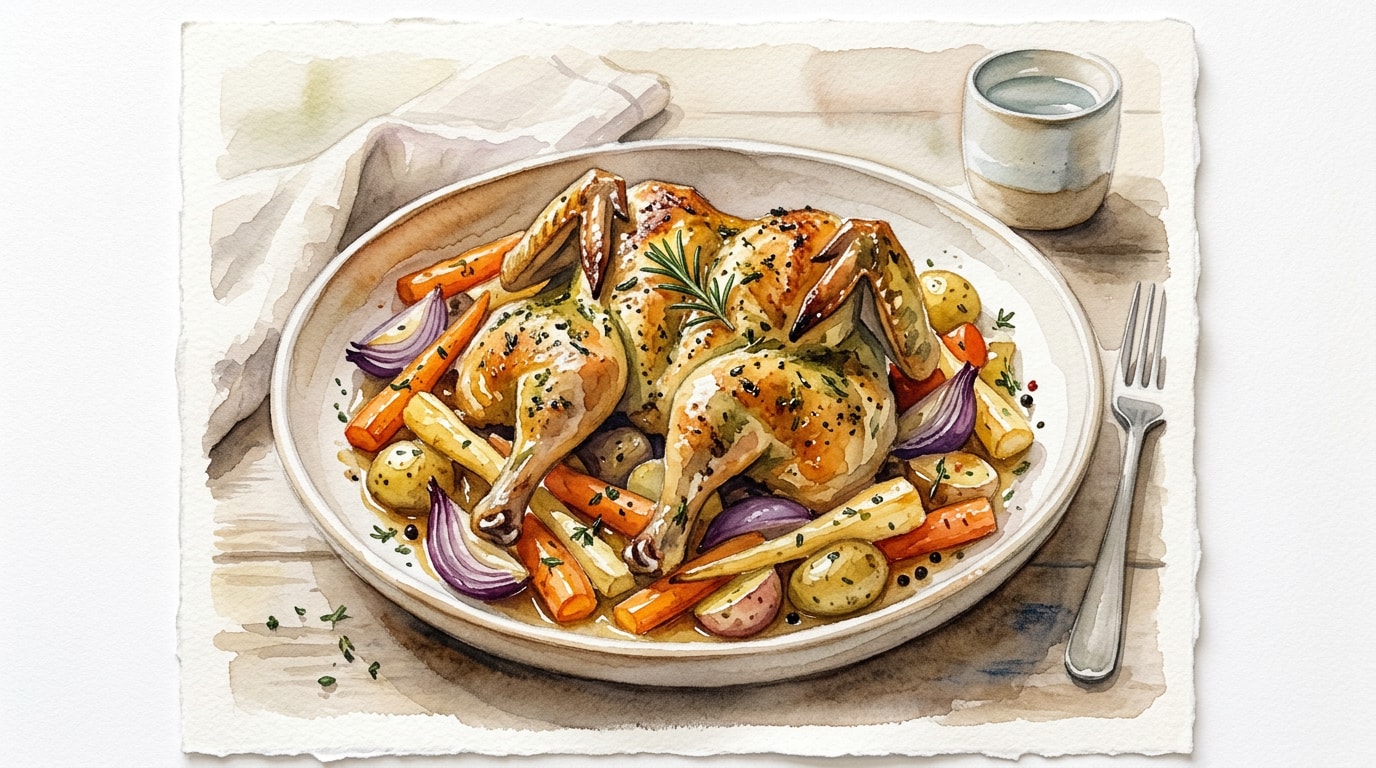
Using heavy-duty kitchen shears, remove the backbone of the chicken by cutting along both sides of the spine. Open the bird, flip it over so the breast side is up, and press down firmly on the breastbone with the heel of your hand to flatten it.
In a small mixing bowl, combine 15ml of olive oil, kosher salt, black pepper, paprika, and garlic powder. Rub this mixture evenly over both sides of the flattened chicken.
In the heavy roasting pan, toss the halved baby potatoes, chopped carrots, and red onion wedges with the remaining 15ml of olive oil and the fresh rosemary sprigs.
Place the seasoned chicken directly on top of the root vegetables, skin side up. Nestle the lemon halves into the pan alongside the chicken, cut side up.
Transfer the pan to the preheated oven. Roast for 45 to 50 minutes. The chicken is safe to eat when a meat thermometer inserted into the thickest part of the thigh registers 80C (175F) and the thickest part of the breast reaches 74C (165F), with juices running clear.
Remove from the oven and carefully transfer the chicken to a clean cutting board. Let the meat rest for 10 minutes before carving. Serve the carved chicken over the schmaltz-roasted vegetables with a generous squeeze of juice from the roasted lemon.
Chef's Notes
- Drying the chicken skin is the single most important step for achieving a perfect crunch. Moisture creates steam, which is the enemy of a crisp crust.
- Spatchcocking, or butterflying, the chicken exposes all the skin to the direct heat and allows the dark and white meat to cook more evenly in a fraction of the time.
- Do not skip the resting phase. Carving immediately straight out of the oven causes the muscle fibers to seize and squeeze out all the flavorful juices onto the cutting board.
- Maintain strict hygiene when handling raw poultry. Cross-contamination is a serious safety risk, so ensure your shears, cutting board, and hands are thoroughly washed with hot soapy water immediately after flattening the bird.
- The fat that renders from the roasting chicken, known as schmaltz, drips down to baste the vegetables automatically, imparting an incredibly savory, luxurious depth of flavor without extra effort.
Storage
Refrigerator: 4 days — Store chicken and vegetables in separate airtight containers if possible to maintain the texture of the vegetables.
Freezer: 3 months — Freeze meat removed from the bone. The roasted vegetables may become mushy when thawed and are best eaten fresh.
Reheating: Reheat chicken pieces on a baking sheet in a 180C/350F oven for 10-15 minutes until warmed through and the skin crisps up again.
Troubleshooting
Chicken skin is pale and rubbery rather than crispy.
Cause: The chicken surface was too wet before oiling, or the oven temperature dropped.
Fix: Turn on the oven broiler for the final 3 to 4 minutes of cooking, watching closely to prevent burning.
Prevention: Thoroughly pat the chicken dry inside and out with paper towels before applying the oil rub. Avoid opening the oven door frequently.
Vegetables are burning before the chicken is cooked through.
Cause: Vegetables were cut too small or the pan is too thin.
Fix: Carefully add 60ml of chicken broth or water to the bottom of the pan to halt burning and create steam.
Prevention: Ensure potatoes and carrots are cut into large, uniform 3cm pieces to withstand the high-heat roasting time.
Cultural Context
The classic roast chicken is a foundational comfort food across many global cuisines, often reserved for lazy weekend dinners due to long cooking times. By adopting the spatchcock technique, a method with origins in 18th-century Irish and French cooking, this centerpiece dish is transformed into a fast, highly-efficient weeknight meal while dramatically improving the skin-to-meat ratio.


