Equipment
* optional
Ingredients
Meringue cake layers
- 6 egg whites, room temperature
- 300 g caster sugar
- 1 g cream of tartar
- 12 g cornflour
- 5 ml white wine vinegar
- 5 ml vanilla extract
Whipped vanilla cream
- 400 ml double cream, well chilled
- 30 g icing sugar
- 5 ml vanilla extract
Berry filling
- 200 g strawberries, hulled and halved or quartered
- 100 g raspberries
- 75 g blackberries
- 75 g blueberries
- 15 ml lemon juice
- 15 g icing sugar
Swiss meringue decoration
- 2 egg whites, room temperature
- 120 g caster sugar
- ½ g cream of tartar
- 3 ml vanilla extract
Fondant violets
- 200 g ready-to-roll fondant
- violet gel food colour
- 20 g cornflour
- 5 ml clear vanilla extract or cooled boiled water
Nutrition (per serving)
Nutrition is estimated per serving. Nutrients without complete source data are omitted.
Full nutrition
Only basic nutrition values are available for this recipe. More detailed nutrient data is incomplete.
- Calories
- 435 kcal
- Protein
- 4 g
- Carbohydrates
- 73 g
- Fat
- 15 g
Sources: Aggregated Public Data, USDA FoodData Central
Method
Preheat the oven to 120°C (250°F) fan-forced. Line three baking sheets with parchment. Using a pencil and the 20cm template, trace three circles on the parchment, then flip the sheets so the pencil side faces down.
Separate the six eggs while cold, then let the whites stand at room temperature for about 30 minutes. Ensure no trace of yolk or shell enters the whites; even a speck of fat will prevent stiff peaks.
Sift the cornflour onto a small piece of parchment and set aside. Measure the caster sugar into a bowl so it is ready to add gradually.
Pour the egg whites into the stand mixer bowl. Add the cream of tartar. Whip on medium speed until the whites form soft, droopy peaks.
With the mixer running on medium-high, add the caster sugar one tablespoon at a time, waiting 10 to 15 seconds between additions. The meringue should become thick, glossy, and hold a stiff peak that stands upright when the whisk is lifted.
Sprinkle the sifted cornflour over the meringue. Drizzle in the vinegar and vanilla. Gently fold with a rubber spatula using a cut-through-and-under motion until just combined, preserving the air you have whipped in.
Divide the meringue evenly between the three traced circles on the prepared sheets. Use an offset spatula to spread each into a neat 20cm round about 2cm thick, smoothing the tops.
Bake the meringues on the middle and lower racks for 1 hour 30 minutes at 120°C (250°F). They should feel dry and crisp on the surface and lift easily from the parchment.
Turn the oven off, prop the door open with a wooden spoon, and leave the meringues inside for 1 hour to cool slowly. This prevents cracking and creates the crisp-outside, marshmallow-inside contrast. Once removed, transfer to a cooling rack if you are not assembling the cake immediately.
While the meringues cool, prepare the berries. Hull and quarter the strawberries. Gently tumble the strawberries, raspberries, blackberries, and blueberries together in a bowl. Add the lemon juice and icing sugar, if using, and toss very lightly so the berries do not bruise.
Make the whipped cream. Pour the chilled double cream into a cold bowl. Add the icing sugar and vanilla. Whip on medium speed to medium-soft peaks that hold their shape but look billowy, not stiff.
Make the Swiss meringue. Combine the two egg whites, caster sugar, and cream of tartar in the heatproof bowl. Set over a saucepan of barely simmering water, making sure the bowl does not touch the water. Whisk constantly until the sugar dissolves and the mixture reaches 71°C (160°F).
Transfer the bowl to the stand mixer. Whip on high speed for 4 to 5 minutes until the meringue is thick, glossy, and holds a stiff peak that curls only slightly at the tip. Beat in the vanilla at the end.
Spoon two-thirds of the Swiss meringue into the large piping bag fitted with the open star tip. Spoon the remaining one-third into the small piping bag with the round tip. Set aside at room temperature while you shape the violets.
Shape the fondant violets while the meringues finish cooling. Lightly dust the work surface with cornflour. Divide the fondant: 150g for purple petals, 30g for yellow centres, 20g for green sepals. Tint each portion by kneading in a tiny amount of gel colour until evenly coloured.
Roll the purple fondant to 2mm thickness. Cut out small teardrop-shaped petals using a knife or petal cutter, each about 1.5cm long. Roll out the green fondant and cut tiny leaf shapes. Pinch off small yellow fondant balls for the centres.
Place each purple petal on the foam pad and gently rub the edge with a ball tool to thin and ruffle it. Cup each petal slightly by pressing its centre into a small curved surface, such as the back of a teaspoon.
Assemble each violet by overlapping five petals in a circle on parchment, dabbing the base of each petal with a tiny brushstroke of clear vanilla or water to adhere them. Press a yellow centre ball into the middle and tuck a small green sepal underneath. Make 12 to 15 violets and leave to dry for at least 30 minutes.
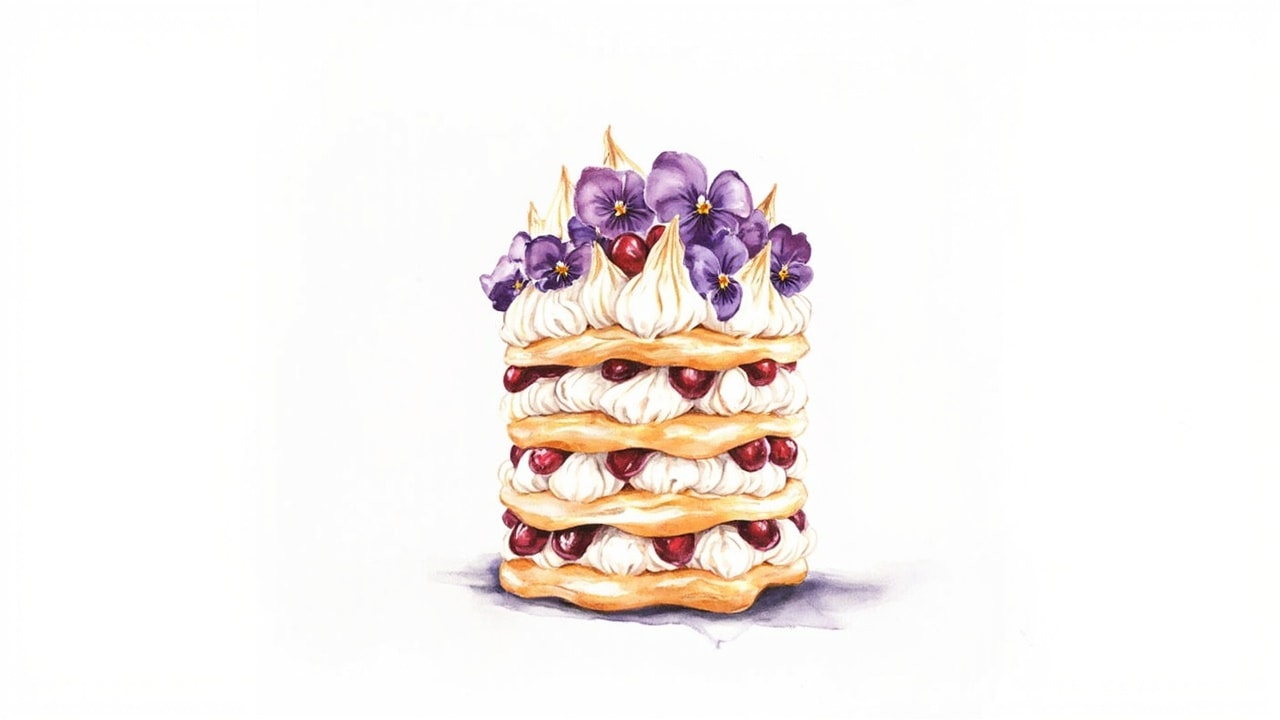
Place the first meringue layer on the cake board. Spread about one-third of the whipped cream over the top in an even layer using an offset spatula, leaving a 1cm border around the edge. Scatter over one-third of the berry mixture.
Carefully place the second meringue layer on top, pressing down very gently so it sits level. Repeat the cream and berries, then top with the final meringue layer.
Spread the remaining cream over the top of the cake only, not the sides, where the meringue shell should remain visible and crisp. Arrange the reserved perfect berries in a loose cluster in the centre.
Pipe tall Swiss meringue peaks around the top edge of the cake and around the base where it meets the cake board using the large star tip. Use the small round tip to add delicate rosettes between the berries.
Lightly toast the meringue peaks with a kitchen blowtorch, moving the flame continuously so the sugar just turns a pale caramel in patches. Alternatively, place the finished cake under a hot grill for 30 to 60 seconds, watching closely.
Arrange the fondant violets and green leaves in a loose garland around the top of the cake, tucking some against the meringue peaks and others onto the cream between the berries. Serve within 30 minutes for the crispest meringue.
Chef's Notes
- Always weigh egg whites in grams for meringue work; volume measurements of separated whites are unreliable and a difference of a few grams can change the final texture dramatically.
- The slow oven-cooling step is non-negotiable for pavlova-style meringue: it sets the crisp shell and prevents the centres from collapsing into a chewy lump.
- For the cleanest slices, dip a long serrated knife in hot water and wipe it between every cut; this keeps the meringue from shattering onto the plate.
- Swiss meringue reaches the safe temperature of 71°C (160°F) during the bain-marie step, so it is safe for pregnant guests and other vulnerable groups once whipped.
- Make the fondant violets a day ahead if possible; fully dried flowers hold their shape better when nestled into the cream and meringue.
Storage
Refrigerator: 1 day — Assembled cake keeps 1 day refrigerated; meringue will gradually soften from the cream moisture. Cover loosely with a cake dome, not cling film.
Freezer: 1 month — Unfilled meringue layers freeze well wrapped in parchment then foil for up to 1 month. Thaw in the wrapping to avoid condensation on the crisp shells.
Reheating: Do not reheat. Serve cool from the refrigerator; remove 15 to 20 minutes before slicing so the cream softens slightly for cleaner cuts.
Troubleshooting
Meringue layers crack or weep clear syrup
Cause: Oven temperature was too high, or the meringue was cooled too quickly outside the oven
Fix: Minor cracks can be hidden under piped cream; weeping cannot be reversed once it starts
Prevention: Bake at a steady low temperature and always cool the meringues inside the turned-off oven with the door propped open
Egg whites will not whip to stiff peaks
Cause: A trace of yolk or fat contaminated the whites, or the bowl was greasy
Fix: Cannot be fixed once fat is present; start again with a clean bowl and fresh whites
Prevention: Wipe the bowl and whisk with lemon juice or vinegar on paper towel before starting; separate eggs one at a time into a small bowl before adding to the main bowl
Swiss meringue is soft or deflates after piping
Cause: Sugar was not fully dissolved before whipping, or the mixture did not reach 71°C (160°F)
Fix: Return the meringue to the mixer and re-whip on high for 1 to 2 minutes until it recovers stiffness
Prevention: Heat over barely simmering water while whisking constantly until a thermometer reads 71°C, then whip on high until the bowl feels cool
Whipped cream weeps and the meringue softens quickly after assembly
Cause: Cream was over-whipped to stiff peaks, or the assembled cake was left at room temperature too long
Fix: Cannot restore crispness to softened meringue; eat the cake sooner and keep leftovers refrigerated
Prevention: Whip to medium-soft peaks only, refrigerate the assembled cake, and serve within 30 minutes of removing from the fridge
Fondant violets tear or stick while shaping
Cause: Fondant was rolled too thin, or the foam pad and brush were not dusted with cornflour
Fix: Re-knead torn fondant, re-roll, and cut fresh petals; discard stuck pieces and dust the surface again
Prevention: Keep fondant at 2mm thickness and dust tools lightly with cornflour before shaping each petal
Cultural Context
This cake takes its cue from the Pavlova, the meringue-and-cream dessert created in honour of the Russian ballerina Anna Pavlova during her tours of Australasia in the 1920s, with Australia and New Zealand still amiably disputing its origin. The crisp-shelled, marshmallow-hearted meringue and whipped cream filling remain the defining features; the Swiss meringue piping and hand-shaped fondant violet garland borrow techniques from classical European patisserie and sugar-flower craft, layering French and Viennese traditions onto the Antipodean classic.