Equipment
Ingredients
Dry Ingredients
- 400 g all-purpose flour, spooned and leveled
- 3 g salt, fine sea salt
- 2 g baking powder
Wet Ingredients
- 227 g unsalted butter, room temperature
- 200 g granulated sugar
- 1 egg, room temperature
- 10 ml vanilla extract
- 2 ml almond extract
Nutrition (per serving)
Nutrition is estimated per serving. Nutrients without complete source data are omitted.
Full nutrition
- Calories
- 165 kcal
- Protein
- 2 g
- Carbohydrates
- 21 g
- Fat
- 8 g
- Fiber
- 0 g
- Sugar
- 8 g
- Sodium
- 62 mg
- Saturated Fat
- 5 g
- Monounsaturated Fat
- 2 g
- Polyunsaturated Fat
- 0 g
- Cholesterol
- 28 mg
- Potassium
- 24 mg
- Calcium
- 11 mg
- Iron
- 0.3 mg
- Magnesium
- 4 mg
- Phosphorus
- 26 mg
- Zinc
- 0.1 mg
- Vitamin A
- 68 mcg
- Vitamin D
- 0.0 mcg
- Vitamin E
- 0.3 mg
- Vitamin K
- 1 mcg
- Vitamin B6
- 0.0 mg
- Vitamin B12
- 0.0 mcg
- Thiamin
- 0.02 mg
- Riboflavin
- 0.02 mg
- Niacin
- 0.2 mg
- Folate
- 6 mcg
- Water
- 5 g
- Alcohol
- 0 g
Sources: Aggregated Public Data, USDA FoodData Central
Method
In a medium mixing bowl, whisk together the all-purpose flour, salt, and baking powder. Set aside.
In the bowl of a stand mixer fitted with the paddle attachment, beat the unsalted butter and granulated sugar on medium speed until smooth and creamy, about 2 minutes.
Add the egg, vanilla extract, and almond extract to the butter mixture. Mix on medium speed until completely incorporated.
Turn the mixer to low speed and gradually add the dry ingredients in three additions. Mix just until the dough pulls away from the sides of the bowl.
Divide the dough into two equal halves. Shape each half into a flat disc, wrap tightly in plastic wrap, and chill in the refrigerator for at least 1 hour.
Preheat the oven to 175°C/350°F. Line a baking sheet with parchment paper.
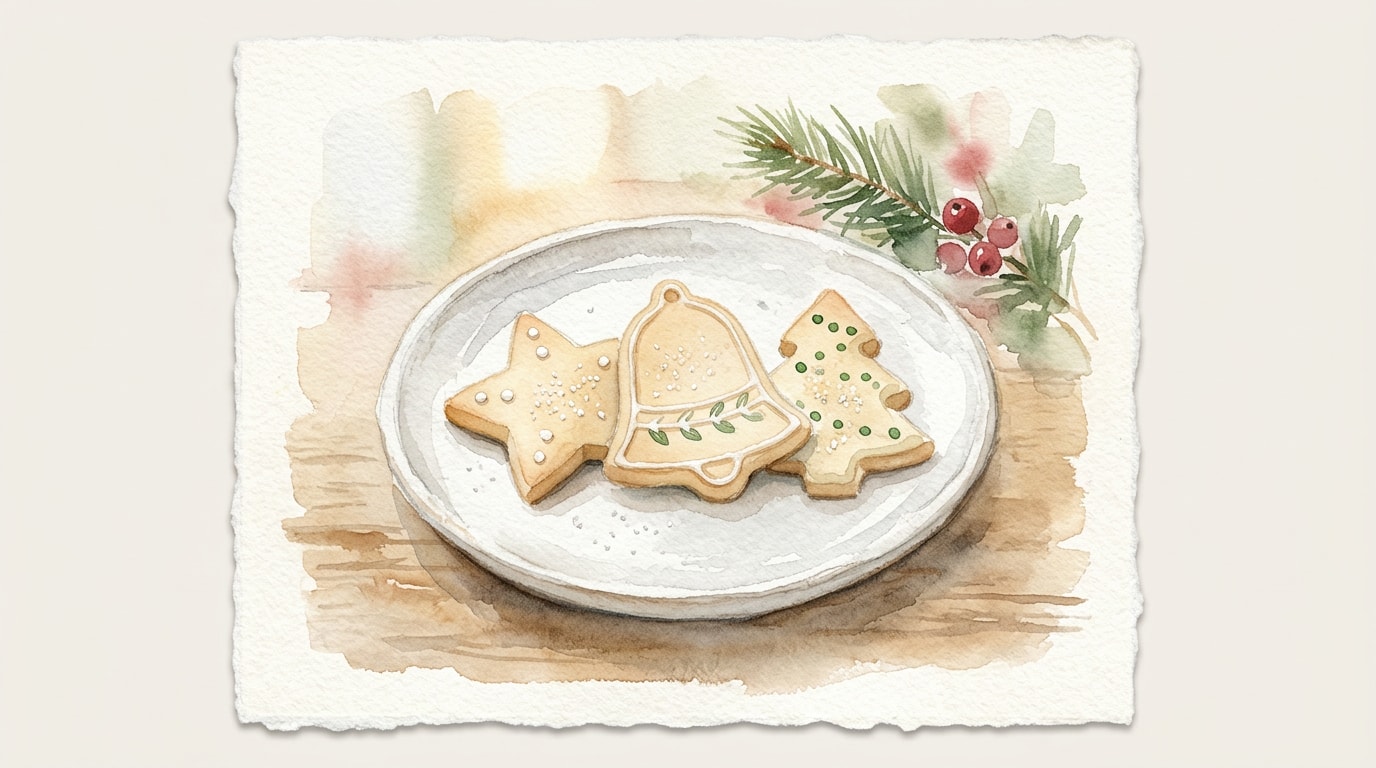
On a lightly floured surface, roll out one disc of dough using a rolling pin to a thickness of 6mm. Cut into desired shapes using cookie cutters.
Transfer the cut shapes to the prepared baking sheet, spacing them 2cm apart. Bake at 175°C/350°F for 10 to 12 minutes.
Allow the cookies to rest on the baking sheet for 5 minutes before carefully transferring them to a wire cooling rack to cool completely.
Chef's Notes
- To eliminate the need for extra bench flour, roll the freshly made, unchilled dough between two sheets of parchment paper, then chill the rolled slabs. This prevents extra flour from drying out your cookies and speeds up the cutting process.
- For the sharpest edges possible, place your tray of cut-out cookies into the freezer for 10 to 15 minutes right before they go into the hot oven. The cold fat will take longer to melt, preserving the structure.
- Raw cookie dough contains uncooked flour and unpasteurized eggs. Do not consume raw dough. If you wish to make edible cookie dough, you must heat-treat the flour and omit the eggs.
- Always use unsalted butter to control the exact sodium content. If you only have salted butter, omit the added salt from the dry ingredients.
- When re-rolling dough scraps, gently press them together rather than kneading them to prevent the cookies from becoming tough from over-worked gluten.
Storage
Refrigerator: 3 days — Wrap tightly in plastic wrap to prevent the dough from drying out.
Freezer: 3 months — Freeze unbaked discs of dough wrapped tightly, or freeze fully baked but undecorated cookies in an airtight container.
Troubleshooting
Cookies spread too much during baking and lose their detailed shapes
Cause: Dough was too warm when entering the oven or the butter was overly softened before creaming
Fix: Cannot be fixed once baked, but while still hot out of the oven, you can gently nudge the edges back into shape with a spatula or use a slightly larger cutter to re-stamp the warm cookie
Prevention: Chill the cut-out cookies on the baking sheet in the freezer for 10 minutes directly before baking
Cookies are tough and dry instead of tender
Cause: The dough was overmixed after the flour was added, developing too much gluten
Fix: Cannot be fixed
Prevention: Mix the flour on the lowest speed and stop exactly when the last streaks of flour disappear
Cultural Context
Sugar cookies evolved from the early English ringlet and the Dutch koekje, becoming a foundational staple of North American baking. Their structural integrity and neutral, buttery flavor profile make them the ideal canvas for royal icing, a tradition that peaked during the Victorian era and remains central to modern celebrations from Christmas to Valentine's Day.