
Equipment
Ingredients
Vegetables and Aromatics
- 200 g waxy potatoes, peeled and diced small
- 150 g red bell pepper, stemmed, seeded, and diced small
- 100 g yellow onion, peeled and diced small
- 2 garlic, minced
Spices and Flavorings
- 30 ml extra virgin olive oil
- 15 g harissa paste
- 15 g tomato paste
- 2 g ground cumin
- 1 g ground caraway
- 3 g fine sea salt
Eggs and Garnish
- 4 large eggs, room temperature
- 10 g fresh coriander, roughly chopped
Nutrition (per serving)
Nutrition is estimated per serving. Nutrients without complete source data are omitted.
Full nutrition
- Calories
- 395 kcal
- Protein
- 18 g
- Carbohydrates
- 26 g
- Fat
- 25 g
- Fiber
- 6 g
- Sugar
- 7 g
- Sodium
- 784 mg
- Saturated Fat
- 5 g
- Trans Fat
- 0 g
- Monounsaturated Fat
- 15 g
- Polyunsaturated Fat
- 4 g
- Cholesterol
- 372 mg
- Potassium
- 921 mg
- Calcium
- 131 mg
- Iron
- 6.7 mg
- Magnesium
- 59 mg
- Phosphorus
- 291 mg
- Zinc
- 2.1 mg
- Vitamin A
- 324 mcg
- Vitamin C
- 117 mg
- Vitamin D
- 2.0 mcg
- Vitamin E
- 4.6 mg
- Vitamin K
- 29 mcg
- Vitamin B6
- 0.7 mg
- Vitamin B12
- 0.9 mcg
- Thiamin
- 0.14 mg
- Riboflavin
- 0.61 mg
- Niacin
- 2.0 mg
- Folate
- 111 mcg
- Water
- 285 g
Sources: Aggregated Public Data, USDA FoodData Central
Method
Prepare the potatoes, bell pepper, and onion by dicing them into uniform 5 millimeter pieces to ensure even and rapid cooking.
Heat the olive oil in a large skillet over medium heat. Add the diced potatoes and a pinch of the salt. Cook, stirring occasionally, until the potatoes begin to soften and develop a light golden color.
Add the diced onion and red bell pepper to the skillet. Continue to cook until all the vegetables are completely tender and the onions become translucent.
Stir in the minced garlic, harissa paste, tomato paste, cumin, and caraway. Cook for one minute to bloom the spices and cook off the raw flavor of the tomato paste.
Crack the eggs into a mixing bowl, add the remaining salt, and whisk vigorously until the yolks and whites are completely homogenous and slightly frothy.
Reduce the skillet heat to low. Pour the beaten eggs over the vegetable mixture. Using a silicone spatula, gently sweep across the bottom of the pan to fold the eggs as they set, creating soft, large curds. Ensure eggs reach an internal temperature of 74C or 165F if serving to highly vulnerable populations.
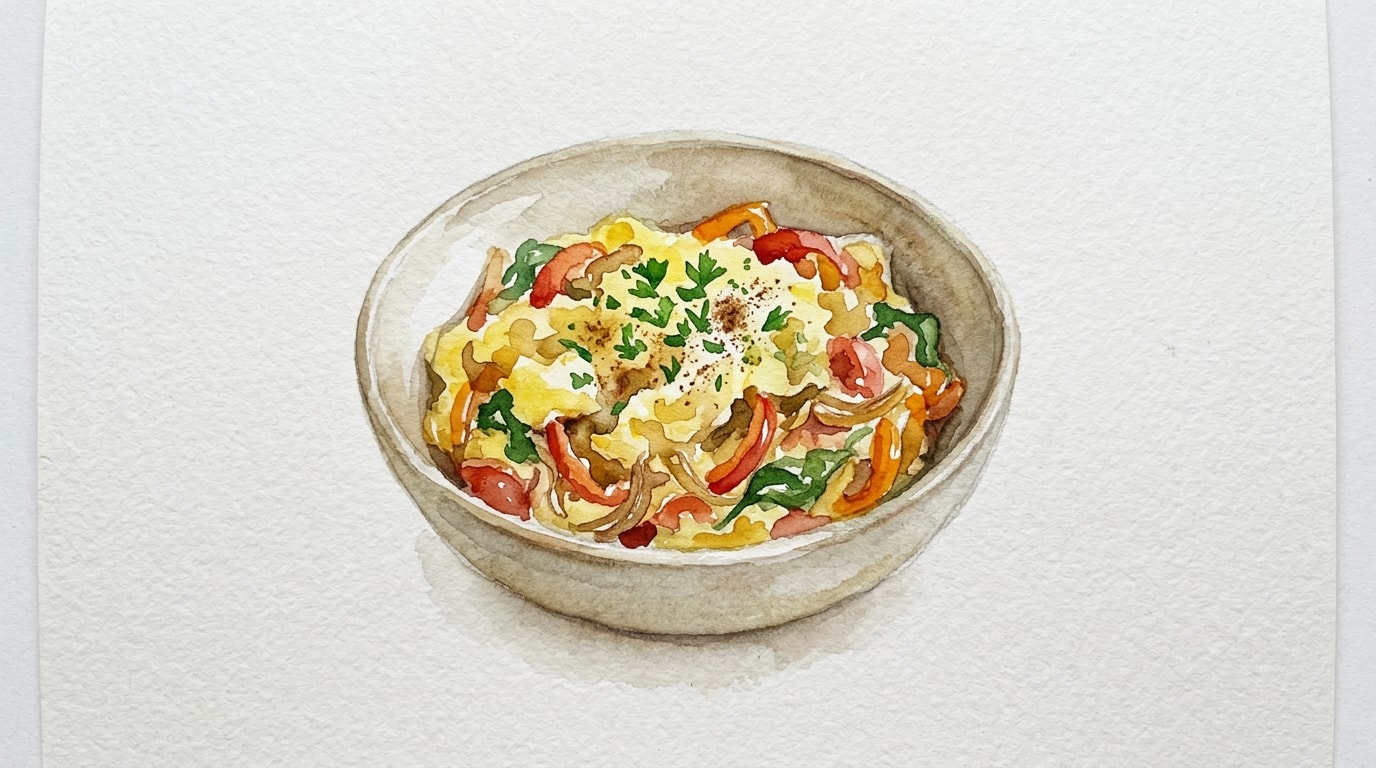
Remove the pan from the heat immediately, as residual heat will continue to cook the eggs. Garnish with chopped fresh coriander and serve straight from the skillet.
Chef's Notes
- Dicing the potatoes finely into 5 millimeter cubes is crucial; it allows them to cook evenly in the skillet without needing a separate parboiling step.
- Harissa varies significantly in heat and salt levels between brands. Always taste your specific paste before adding it to the pan, and adjust the quantity to suit your preference.
- The secret to excellent scrambled eggs is residual heat. Always pull the pan off the burner just before the eggs look completely finished. The dense, hot vegetables and the thermal mass of the skillet will carryover cook the eggs to perfect doneness by the time you plate them.
Storage
Refrigerator: 1 day — Best eaten immediately. Leftovers can be refrigerated but the texture of the eggs will degrade.
Reheating: Gently reheat in a skillet over low heat with a splash of olive oil, stirring frequently until just warmed through.
Troubleshooting
Potatoes remain hard and crunchy when it is time to add the eggs
Cause: The potatoes were diced too large or the heat was too high, causing the exterior to brown before the interior cooked.
Fix: Before adding the eggs, pour two tablespoons of water into the skillet and cover with a lid for 3 minutes to steam the potatoes until tender.
Prevention: Ensure potatoes are diced into uniform, small cubes no larger than 5 millimeters across.
Eggs become rubbery and separate from the oil
Cause: Cooking the eggs over high heat or leaving them on the burner for too long.
Fix: Cannot be fixed once fully overcooked, but serving with a small dollop of plain yogurt can add missing moisture.
Prevention: Always lower the heat before pouring in the eggs, and remove the pan from the stove while they still appear slightly underdone.
Cultural Context
While traditional Tunisian Ojja features eggs gently poached in a simmering, spicy tomato and pepper stew, this dish adapts those iconic North African flavor profiles into a faster scrambled format. It draws heavy inspiration from Tastira, another popular Tunisian side dish where fried peppers, tomatoes, and eggs are chopped and mixed together, resulting in a comforting and highly spiced everyday meal.


