
Equipment
Ingredients
Potato Farls
- 250 g mashed potatoes, cooked, completely cooled, unseasoned
- 50 g all-purpose flour
- 15 g unsalted butter, melted
- 2 g kosher salt, fine
Soda Farls
- 150 g all-purpose flour
- 2 g baking soda
- 2 g kosher salt
- 120 ml buttermilk, cold
The Fry Meats
- 4 pork sausages
- 4 back bacon slices
- 2 black pudding slices
- 20 g lard
Vegetables & Eggs
- 2 large eggs, room temperature, about 100g total
- 1 beefsteak tomato, halved crosswise, about 200g
- 100 g button mushrooms, cleaned, stems trimmed
Nutrition (per serving)
Nutrition is estimated per serving. Nutrients without complete source data are omitted.
Full nutrition
- Calories
- 1553 kcal
- Protein
- 61 g
- Carbohydrates
- 108 g
- Fat
- 99 g
- Fiber
- 9 g
- Sugar
- 12 g
- Sodium
- 3977 mg
- Saturated Fat
- 33 g
- Trans Fat
- 0 g
- Monounsaturated Fat
- 36 g
- Polyunsaturated Fat
- 23 g
- Cholesterol
- 386 mg
- Potassium
- 1554 mg
- Calcium
- 199 mg
- Iron
- 8.8 mg
- Magnesium
- 104 mg
- Phosphorus
- 651 mg
- Zinc
- 6.3 mg
- Vitamin A
- 244 mcg
- Vitamin C
- 14 mg
- Vitamin D
- 3.8 mcg
- Vitamin E
- 7.6 mg
- Vitamin K
- 4 mcg
- Vitamin B6
- 1.0 mg
- Vitamin B12
- 2.5 mcg
- Thiamin
- 3.97 mg
- Riboflavin
- 1.31 mg
- Niacin
- 18.2 mg
- Folate
- 103 mcg
- Water
- 367 g
Sources: Aggregated Public Data, USDA FoodData Central
Method
Combine the cold mashed potatoes, 50g all-purpose flour, melted butter, and salt in a mixing bowl. Work the mixture with your hands until it forms a cohesive, pliable dough.
Transfer the potato dough to a lightly floured surface. Flatten it into a circle roughly 1cm thick, then cut into four equal wedges or farls. Set aside.
In a clean bowl, whisk together the 150g flour, baking soda, and salt for the soda farls. Pour in the cold buttermilk and mix swiftly with your hands or a fork just until a shaggy dough forms. Do not overwork.
Turn the soda bread dough onto a floured board, shape gently into a circle about 1.5cm thick, and cut into four wedges. Dust lightly with flour.
Heat a dry griddle or heavy pan over medium-low heat to approximately 150 degrees Celsius or 300 degrees Fahrenheit. Bake the soda farls for 10 to 12 minutes per side until deeply golden and cooked through to the center.
On the same dry griddle, cook the potato farls for 4 to 5 minutes per side until they develop a crisp, golden-brown crust. Remove all farls and cover with a clean kitchen towel to keep warm.
In a separate large cast iron skillet, melt the lard over medium heat 160 degrees Celsius or 320 degrees Fahrenheit. Fry the pork sausages, turning frequently, for 12 to 15 minutes until heavily browned and the internal temperature reaches 74 degrees Celsius or 165 degrees Fahrenheit. Push to the cooler edge of the pan.
Add the back bacon and black pudding slices to the skillet. Fry the bacon for 3 minutes per side until the fat renders and crisps. Fry the black pudding for 2 minutes per side until the edges are crispy. Remove all meats to a warmed plate.
Place the tomato halves cut-side down and the whole mushrooms into the rendered pork fat. Sauté for 4 to 5 minutes until the tomatoes caramelize and the mushrooms are tender and browned.
Push the vegetables to the side. Fry the eggs in the remaining seasoned pan fat for 2 to 3 minutes, basting the whites with hot fat occasionally, until the whites are fully set and the yolks are still runny.
Briefly drop the cooked potato and soda farls into the skillet for 30 seconds per side to absorb the deeply flavored pan drippings. This is the defining characteristic of an Ulster Fry.
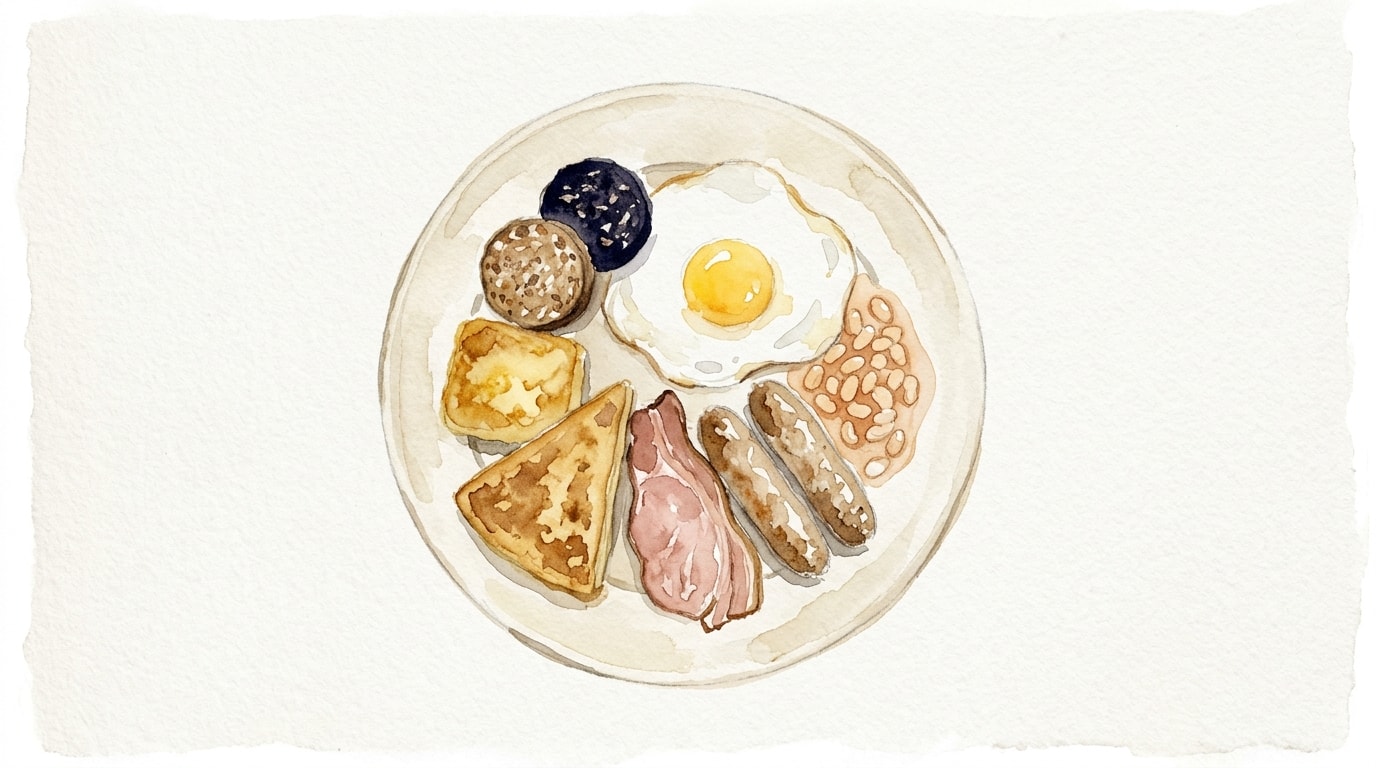
Transfer all components to warmed serving plates immediately. Arrange the meats, vegetables, and fried farls around the fried egg.
Chef's Notes
- The hallmark of an authentic Ulster Fry is that the breads are fried in the residual pork fat, creating an unctuous, savory crust you cannot achieve with butter alone.
- Baking soda reacts immediately with the acidic buttermilk. You must work quickly once the liquid is added to the soda bread dough to preserve the leavening power.
- Never prick your sausages before frying. Keeping the casing intact acts as a natural pressure cooker, ensuring the pork remains succulent and moist.
- If using a traditional heavy cast iron pan, heat management is crucial. Let the pan heat slowly rather than blasting it on high, which causes hot spots and uneven searing.
Storage
Refrigerator: 3 days — Store meats, breads, and vegetables separately. Fried eggs do not keep well and should be made fresh.
Freezer: 1 month — Potato and soda farls freeze exceptionally well. Meats can be frozen prior to cooking.
Reheating: Reheat meats and breads in a 180C/350F oven for 10 minutes or pan-fry to restore crispness.
Troubleshooting
Soda farls are raw and doughy in the center but dark on the outside
Cause: The griddle temperature was too high, causing the exterior to cook before the heat could penetrate the dense dough
Fix: Transfer the farls to a 180C/350F oven for 5-8 minutes to bake the centers without burning the crust
Prevention: Cook soda farls on a medium-low heat, adjusting downward if they brown faster than 10 minutes
Potato farl dough is incredibly sticky and impossible to roll out
Cause: The mashed potatoes were warm when mixed, or boiled rather than steamed, retaining too much moisture
Fix: Knead in extra flour 10g at a time until workable, though this will result in a tougher, heavier farl
Prevention: Ensure potatoes are entirely cold and dry before mixing; prefer baking or steaming potatoes for farls
Cultural Context
The Ulster Fry is the celebrated regional breakfast of Northern Ireland, distinct from the broader Full Irish or Full English breakfast primarily due to the inclusion of griddle-baked breads. Historically designed to provide sustained, heavy caloric energy for farm laborers facing a hard day of manual work, the potato and soda farls served as inexpensive carbohydrate staples that beautifully soaked up the rich pan drippings. Today, it stands as a cherished weekend tradition and a renowned point of culinary pride throughout the province.


