Equipment
* optional
Ingredients
Flavor Base
- 100 g benne seeds or white sesame seeds, raw, unhulled preferred if available
Wet Ingredients
- 115 g unsalted butter, room temperature
- 150 g light brown sugar, packed
- 50 g granulated sugar
- 1 egg, room temperature
- 5 ml vanilla extract
Dry Ingredients
- 120 g all-purpose flour
- 2 g baking powder
- 3 g kosher salt
Nutrition (per serving)
Nutrition is estimated per serving. Nutrients without complete source data are omitted.
Full nutrition
- Calories
- 75 kcal
- Protein
- 1 g
- Carbohydrates
- 9 g
- Fat
- 4 g
- Fiber
- 0 g
- Sugar
- 5 g
- Sodium
- 42 mg
- Saturated Fat
- 2 g
- Monounsaturated Fat
- 1 g
- Polyunsaturated Fat
- 1 g
- Cholesterol
- 12 mg
- Potassium
- 25 mg
- Calcium
- 36 mg
- Iron
- 0.5 mg
- Magnesium
- 11 mg
- Phosphorus
- 26 mg
- Zinc
- 0.3 mg
- Vitamin A
- 24 mcg
- Vitamin D
- 0.0 mcg
- Vitamin E
- 0.1 mg
- Vitamin K
- 0 mcg
- Vitamin B6
- 0.0 mg
- Vitamin B12
- 0.0 mcg
- Thiamin
- 0.03 mg
- Riboflavin
- 0.02 mg
- Niacin
- 0.2 mg
- Folate
- 4 mcg
- Water
- 2 g
- Alcohol
- 0 g
Sources: USDA FoodData Central
Method
Preheat your oven to 165°C/325°F. Line two baking sheets with parchment paper.
Place the benne seeds in a dry skillet over medium heat. Toast them, stirring constantly, until they are fragrant and golden brown. Remove from heat immediately and let cool.
In a large mixing bowl, beat the softened butter, light brown sugar, and granulated sugar together until smooth and creamy.
Add the egg and vanilla extract to the creamed butter and sugar mixture, mixing until fully incorporated and lightened in color.
Add the all-purpose flour, baking powder, and kosher salt to the bowl. Mix on low speed just until the dry ingredients disappear into the dough. Do not overmix.
Gently stir the cooled, toasted benne seeds into the dough until they are evenly distributed.
Place the dough in the refrigerator to firm up slightly. This helps control spreading during baking.
Scoop small portions of dough, about 15 grams or one level teaspoon each, and place them on the prepared baking sheets. Leave at least 5 centimeters of space between each cookie to allow for significant spreading.
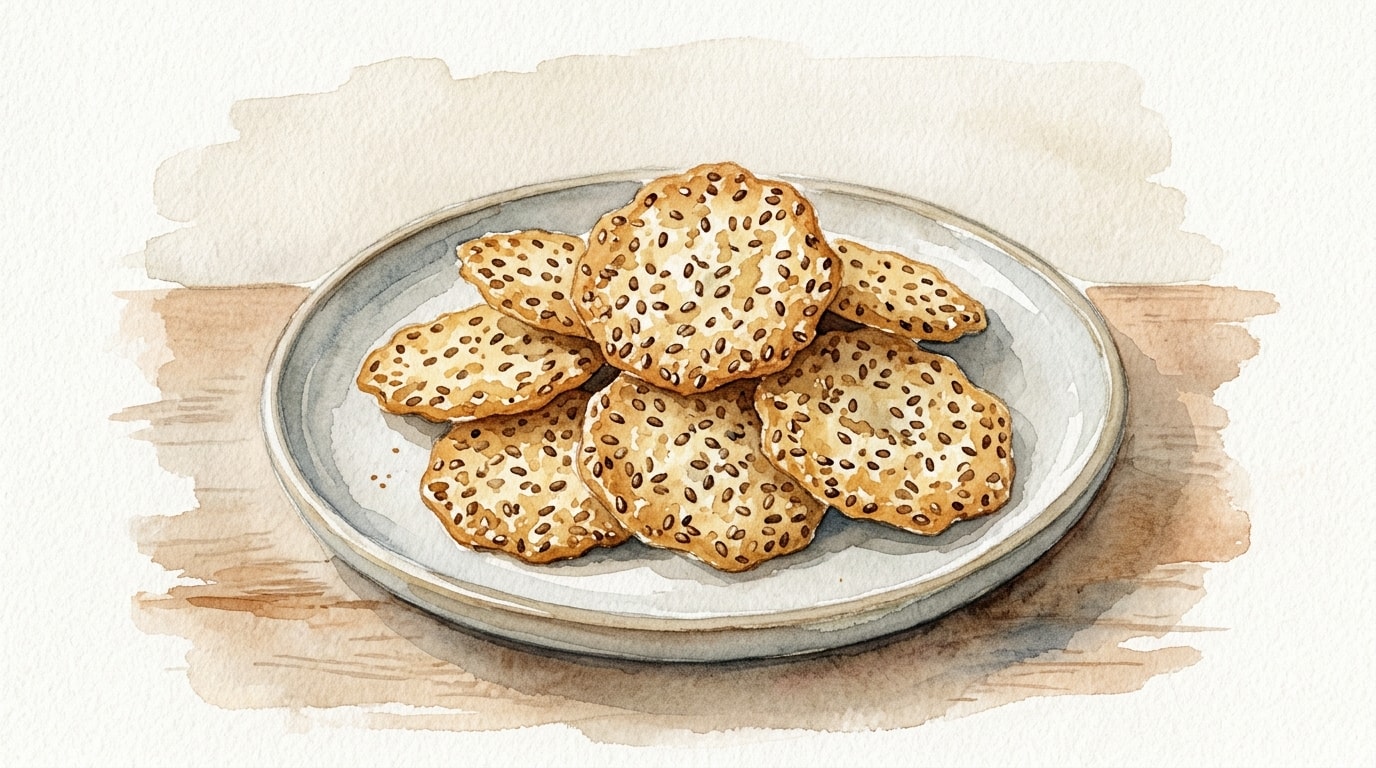
Bake at 165°C/325°F until the edges are a deep, lacy golden brown and the centers are lightly colored but set.
Allow the cookies to rest on the baking sheet for 2 to 3 minutes before carefully transferring them to a wire rack to cool completely and crisp up.
Chef's Notes
- For the deepest flavor, do not skip toasting the sesame seeds in the skillet. The natural oils must be released to achieve the authentic savory-sweet balance these wafers are famous for.
- If you have access to heirloom unhulled benne seeds, use them instead of standard white sesame seeds. They possess a higher oil content and a more robust, slightly bitter nuttiness.
- These wafers spread significantly in the oven. Be disciplined about portion size; a level measuring teaspoon of dough is truly all you need per cookie.
- Baking time can vary drastically depending on your oven and the exact size of your scoops. Watch the first batch like a hawk starting at the 8-minute mark.
Storage
Refrigerator: 1 week — Store raw dough tightly wrapped in plastic.
Freezer: 3 months — Baked cookies freeze beautifully. Raw dough can also be frozen.
Troubleshooting
Cookies merge into one giant sheet on the baking pan
Cause: Dough portions were too large or placed too closely together
Fix: Cut them into squares immediately after removing from the oven while still soft
Prevention: Ensure dough balls are no larger than a teaspoon and spaced 5 centimeters apart
Edges are burnt but centers are raw
Cause: Oven temperature too high or using a dark-coated baking sheet
Fix: Cannot be fixed
Prevention: Use an oven thermometer and opt for heavy-bottomed, light-colored aluminum baking sheets
Cookies are soft and chewy rather than crisp
Cause: Underbaked or stored in a humid environment before fully cooling
Fix: Return to a low oven at 150C/300F for 3 to 5 minutes to dry out, then cool again
Prevention: Bake until edges are deeply golden and let cool completely on a wire rack
Cultural Context
Benne is a Bantu word for sesame, a resilient crop brought to the American South by enslaved West Africans in the early 18th century. In the coastal Lowcountry, the Gullah Geechee people transformed these seeds into various savory and sweet dishes. The benne wafer emerged as an iconic Charleston specialty, heavily relying on the deeply toasted seeds to provide a complex, savory counterpart to the sweet, buttery dough. Historically, planting and eating benne was associated with bringing good luck.