
Equipment
Ingredients
Filling
- 150 g fresh spinach, washed and roughly chopped
- 50 g walnuts, toasted and finely chopped
- 2 garlic, minced
- 15 ml olive oil
Chicken
- 4 boneless skinless chicken breast
- 5 g kosher salt
- 2 g black pepper, freshly ground
- 15 ml olive oil
Balsamic Red Wine Glaze
- 120 ml dry red wine
- 60 ml balsamic vinegar
- 120 ml chicken broth, low sodium
- 1 shallot, finely diced
- 30 g unsalted butter, cold and cubed
Nutrition (per serving)
Nutrition is estimated per serving. Nutrients without complete source data are omitted.
Full nutrition
- Calories
- 604 kcal
- Protein
- 45 g
- Carbohydrates
- 9 g
- Fat
- 40 g
- Fiber
- 2 g
- Sugar
- 4 g
- Sodium
- 759 mg
- Saturated Fat
- 11 g
- Trans Fat
- 0 g
- Monounsaturated Fat
- 16 g
- Polyunsaturated Fat
- 11 g
- Cholesterol
- 145 mg
- Potassium
- 804 mg
- Calcium
- 89 mg
- Iron
- 3.3 mg
- Magnesium
- 108 mg
- Phosphorus
- 430 mg
- Zinc
- 2.3 mg
- Vitamin A
- 275 mcg
- Vitamin C
- 12 mg
- Vitamin D
- 0.8 mcg
- Vitamin E
- 2.7 mg
- Vitamin K
- 188 mcg
- Vitamin B6
- 1.3 mg
- Vitamin B12
- 0.7 mcg
- Thiamin
- 0.21 mg
- Riboflavin
- 0.31 mg
- Niacin
- 20.4 mg
- Folate
- 96 mcg
- Water
- 249 g
- Alcohol
- 3 g
Sources: USDA FoodData Central
Method
Heat 15ml of olive oil in a large skillet over medium heat. Add the minced garlic and chopped spinach, sauteing until the spinach is completely wilted and any excess moisture has evaporated.
Transfer the wilted spinach mixture to a small bowl. Add the toasted, chopped walnuts, stirring well to combine the filling ingredients. Set aside to cool slightly.
Place the chicken breasts flat on a clean cutting board. Using a sharp knife, cut a horizontal pocket into the thickest side of each breast, being careful not to slice all the way through to the other side.
Spoon an equal amount of the cooled spinach and walnut filling into the pocket of each chicken breast. Secure the open edges of the chicken with wooden toothpicks, then season the outside of the breasts evenly with kosher salt and black pepper.
Wipe out the skillet used for the spinach, add the remaining 15ml of olive oil, and place over medium-high heat. Once the oil shimmers, carefully add the stuffed chicken breasts and sear until deeply browned on the bottom, about 4 minutes.
Flip the chicken breasts, reduce the heat to medium-low, and cover the skillet. Cook until the chicken is firm and the internal temperature reaches 74°C/165°F. Transfer the chicken to a clean plate and loosely cover to keep warm.
Return the empty skillet to medium heat. Add the finely diced shallot and cook briefly until translucent. Pour in the red wine, balsamic vinegar, and chicken broth, using a wooden spoon to scrape up the browned bits from the bottom of the pan.
Allow the liquid to simmer vigorously until it reduces by more than half, thickening into a light syrup consistency. This should take approximately 5 to 7 minutes.
Remove the skillet from the heat. Add the cold, cubed unsalted butter to the reduction, swirling the pan continuously until the butter is completely melted and the sauce is glossy.
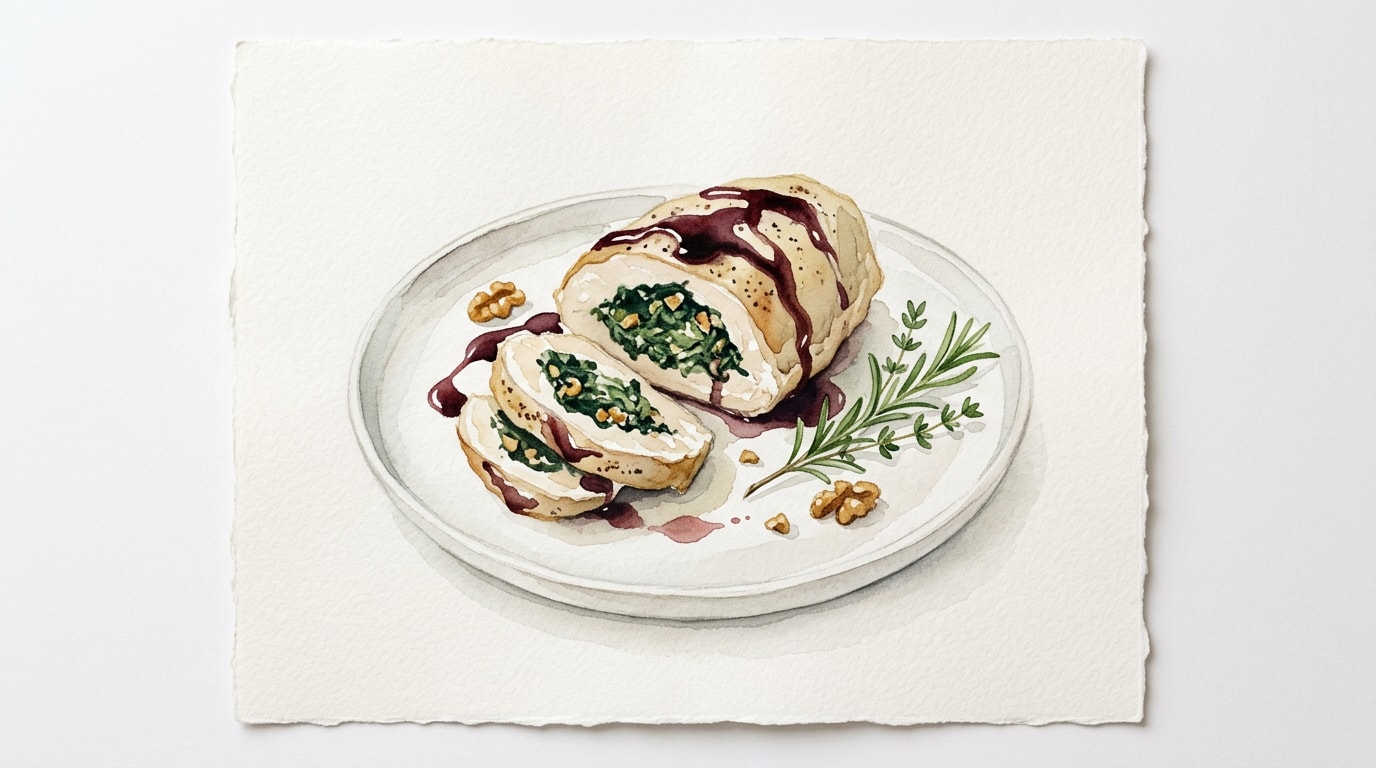
Carefully remove and discard all toothpicks from the chicken breasts. Slice the chicken crosswise to reveal the filling, plate the portions, and generously drizzle the warm balsamic red wine glaze over the top.
Chef's Notes
- Toasting the walnuts before chopping releases their essential oils, transforming them from slightly bitter to rich and buttery, which perfectly complements the earthy spinach.
- When cutting the pocket into the chicken breast, keep your knife perfectly horizontal and rest your non-dominant hand flat on top of the meat to gauge the blade's position safely.
- The technique of whisking cold butter into a sauce off the heat is known as monter au beurre. It creates a stable emulsion, thickening the reduction while adding a luxurious, velvety shine.
- Always allow the seared chicken to rest for a few minutes before slicing. This gives the muscle fibers time to relax and reabsorb juices, preventing the meat from drying out on the plate.
Storage
Refrigerator: 3 days — Store in an airtight container. The sauce may solidify when chilled but will melt upon reheating.
Reheating: Reheat gently in a covered skillet over low heat or in an oven until the internal temperature reaches 74 degrees Celsius.
Troubleshooting
Filling falls out of the chicken breast during cooking
Cause: The pocket was cut too wide or the edges were not secured adequately with toothpicks
Fix: Carefully press the filling back into the pocket using a spoon and add an extra toothpick if needed. Handle gently when flipping.
Prevention: Cut a deeper, narrower pocket rather than a wide slit, and use multiple toothpicks to weave the edges shut tightly
Balsamic red wine sauce is too thin and watery
Cause: The reduction step was too brief or the heat was too low to properly evaporate the liquids
Fix: Return the skillet to medium-high heat and simmer for an additional 3 to 5 minutes until the sauce coats the back of a spoon.
Prevention: Allow the sauce to maintain a steady, vigorous simmer until the volume is visibly reduced by half
Cultural Context
Stuffed poultry dishes have a rich history in Mediterranean culinary traditions, originally developed as an ingenious method to stretch expensive meat by packing it with abundant local greens and nuts. The integration of walnuts and spinach offers a harmonious contrast of earthy flavors and robust textures. Meanwhile, the finishing touch of a balsamic and red wine reduction draws heavy inspiration from Italian agrodolce profiles, providing a sophisticated balance of sweet and sour notes that perfectly cuts through the savory filling.


