
Equipment
Ingredients
Main Ingredients
- 600 g fluke fillets, boneless and skinless, cut into 4 equal portions
- 500 g gold potatoes, peeled and sliced 5mm thick
- 200 g romesco sauce, prepared or store-bought
- 400 ml fish stock, warmed
- 30 ml extra virgin olive oil
Pantry Staples
- kosher salt
- black pepper, freshly cracked
Nutrition (per serving)
Nutrition is estimated per serving. Nutrients without complete source data are omitted.
Full nutrition
- Calories
- 399 kcal
- Protein
- 25 g
- Carbohydrates
- 31 g
- Fat
- 19 g
- Fiber
- 6 g
- Sugar
- 3 g
- Sodium
- 1283 mg
- Saturated Fat
- 3 g
- Trans Fat
- 0 g
- Monounsaturated Fat
- 7 g
- Polyunsaturated Fat
- 1 g
- Cholesterol
- 69 mg
- Potassium
- 1329 mg
- Calcium
- 77 mg
- Iron
- 2.0 mg
- Magnesium
- 106 mg
- Phosphorus
- 551 mg
- Zinc
- 0.6 mg
- Vitamin A
- 191 mcg
- Vitamin C
- 48 mg
- Vitamin D
- 4.2 mcg
- Vitamin E
- 2.2 mg
- Vitamin K
- 5 mcg
- Vitamin B6
- 0.2 mg
- Vitamin B12
- 2.4 mcg
- Thiamin
- 0.06 mg
- Riboflavin
- 0.11 mg
- Niacin
- 2.8 mg
- Folate
- 10 mcg
- Water
- 224 g
Sources: Aggregated Public Data, USDA FoodData Central
Method
Season the fluke fillets and sliced gold potatoes evenly on all sides with kosher salt and freshly cracked black pepper.
Heat the extra virgin olive oil in a large sauté pan over medium heat. Arrange the potato slices in an even layer and cook for 3 to 4 minutes without moving them, allowing the bottoms to develop a slight golden color.
Whisk the romesco sauce into the warm fish stock. Pour this mixture over the potatoes. Bring the liquid to a gentle boil, then reduce the heat to medium-low. Cover the pan and simmer for 12 to 15 minutes, or until the potatoes are completely tender when pierced with a fork.
Gently lay the seasoned fluke fillets on top of the cooked potatoes and sauce. Cover the pan again and let the fish poach in the gentle steam and simmering sauce for 5 to 7 minutes. The fish should reach an internal temperature of 63 degrees Celsius or 145 degrees Fahrenheit.
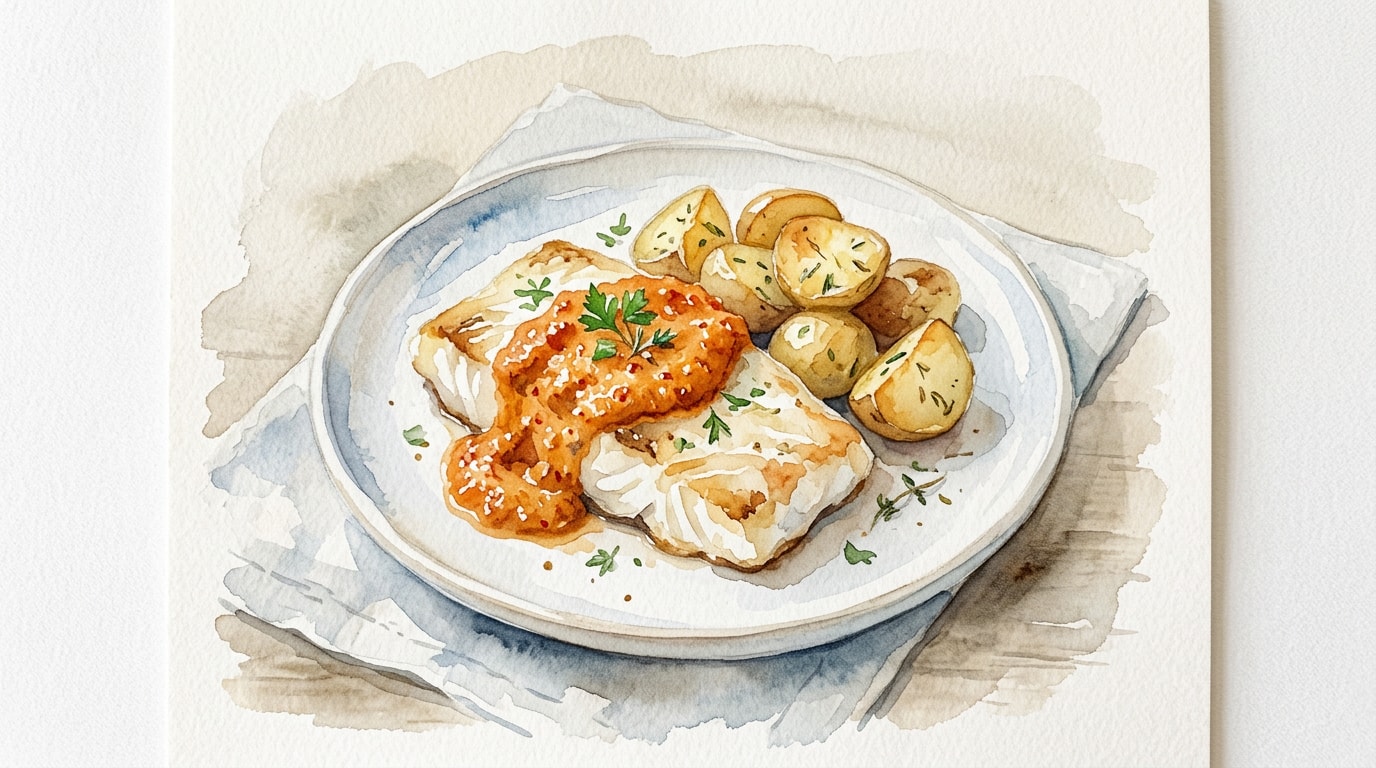
Remove from heat. Use a fish spatula to carefully lift a portion of the potatoes along with a fluke fillet onto each warmed serving plate. Spoon the reduced, rich romesco broth generously over the top of the fish.
Chef's Notes
- Uniformity is critical when slicing the gold potatoes. Using a mandoline slicer set to exactly 5mm ensures they all cook at the identical rate, preventing a mix of mushy and undercooked bites.
- Since this is a five-ingredient recipe, the quality of your romesco sauce is paramount. If purchasing store-bought, look for brands where olive oil, almonds, and roasted red peppers are the first ingredients, avoiding those with excessive fillers or sugar.
- Fluke is a delicate flatfish that cooks very quickly. Residual heat will continue to cook the fish once the heat is turned off, so err on the side of slightly undercooking if you plan to let the pan sit for a minute before serving.
- The fish stock provides a backbone of savory depth. If you cannot find high-quality fish stock, clam juice mixed with a splash of water is an excellent, readily available alternative that mimics the briny sweetness of the ocean.
Storage
Refrigerator: 2 days — Store in an airtight container.
Reheating: Gently reheat on the stovetop over low heat until just warmed through. Avoid microwaving to prevent the fish from overcooking.
Troubleshooting
Potatoes are still hard while the sauce is drying out
Cause: Potatoes were sliced too thickly or the simmering heat was too high, causing rapid evaporation
Fix: Add 60ml of water or extra stock, reduce heat to low, cover, and continue cooking until tender
Prevention: Ensure uniform 5mm slices and maintain a gentle simmer with the lid completely sealed
Fluke falls apart completely when plating
Cause: The fish was overcooked or handled too roughly
Fix: Cannot be fixed structurally, but the flavor remains excellent. Serve as a rustic seafood stew instead
Prevention: Watch the time closely during the poaching step and use a wide, flexible fish spatula for plating
Cultural Context
This dish is heavily inspired by Suquet de Peix, a rustic Catalan fisherman stew originating on the coasts of Spain. Historically, fishermen would make a rapid stew using unsold catch, potatoes, and whatever base sauces they had on hand, commonly relying on regional picada or romesco to thicken and flavor the broth.


