
Equipment
Ingredients
Fish and Clam Prep
- 600 g sole fillets, skinless, about 4 fillets of 150g each
- 500 g littleneck clams, scrubbed and purged
- 100 ml dry white wine
Vegetable Farce (Stuffing)
- 30 g unsalted butter, divided
- 40 g shallot, finely brunoise
- 50 g fennel, finely brunoise
- 5 g garlic, minced
- 40 g baby spinach, finely chopped
- 30 g panko breadcrumbs
Finishing Sauce and Seasoning
- 50 ml heavy cream
- 30 g unsalted butter, cold, cubed
- 15 ml lemon juice, freshly squeezed
- fine sea salt
- white pepper
Nutrition (per serving)
Nutrition is estimated per serving. Nutrients without complete source data are omitted.
Full nutrition
- Calories
- 427 kcal
- Protein
- 39 g
- Carbohydrates
- 15 g
- Fat
- 21 g
- Fiber
- 1 g
- Sugar
- 3 g
- Sodium
- 1722 mg
- Saturated Fat
- 11 g
- Trans Fat
- 0 g
- Monounsaturated Fat
- 6 g
- Polyunsaturated Fat
- 1 g
- Cholesterol
- 151 mg
- Potassium
- 481 mg
- Calcium
- 118 mg
- Iron
- 3.1 mg
- Magnesium
- 68 mg
- Phosphorus
- 661 mg
- Zinc
- 1.3 mg
- Vitamin A
- 334 mcg
- Vitamin C
- 7 mg
- Vitamin D
- 4.4 mcg
- Vitamin E
- 2.5 mg
- Vitamin K
- 58 mcg
- Vitamin B6
- 0.3 mg
- Vitamin B12
- 15.9 mcg
- Thiamin
- 0.07 mg
- Riboflavin
- 0.14 mg
- Niacin
- 2.2 mg
- Folate
- 42 mcg
- Water
- 290 g
- Alcohol
- 3 g
Sources: Aggregated Public Data, USDA FoodData Central
Method
Place the scrubbed clams and white wine in a medium saucepan. Cover and steam over medium-high heat until the clams open, discarding any that remain closed.
Remove clams from the shells and finely chop the meat. Strain the cooking liquid through a fine mesh sieve to remove any grit, reserving the broth for the sauce.
Melt half of the stuffing butter in a skillet over medium heat. Sauté the shallot, fennel, and garlic until softened but not browned. Fold in the chopped spinach and cook until wilted.
Transfer the vegetable mixture to a mixing bowl. Add the chopped clams, panko breadcrumbs, and remaining stuffing butter. Season sparingly with salt and white pepper, mixing thoroughly to bind the farce.
Preheat the oven to 190°C (375°F). Lightly butter the small baking dish.
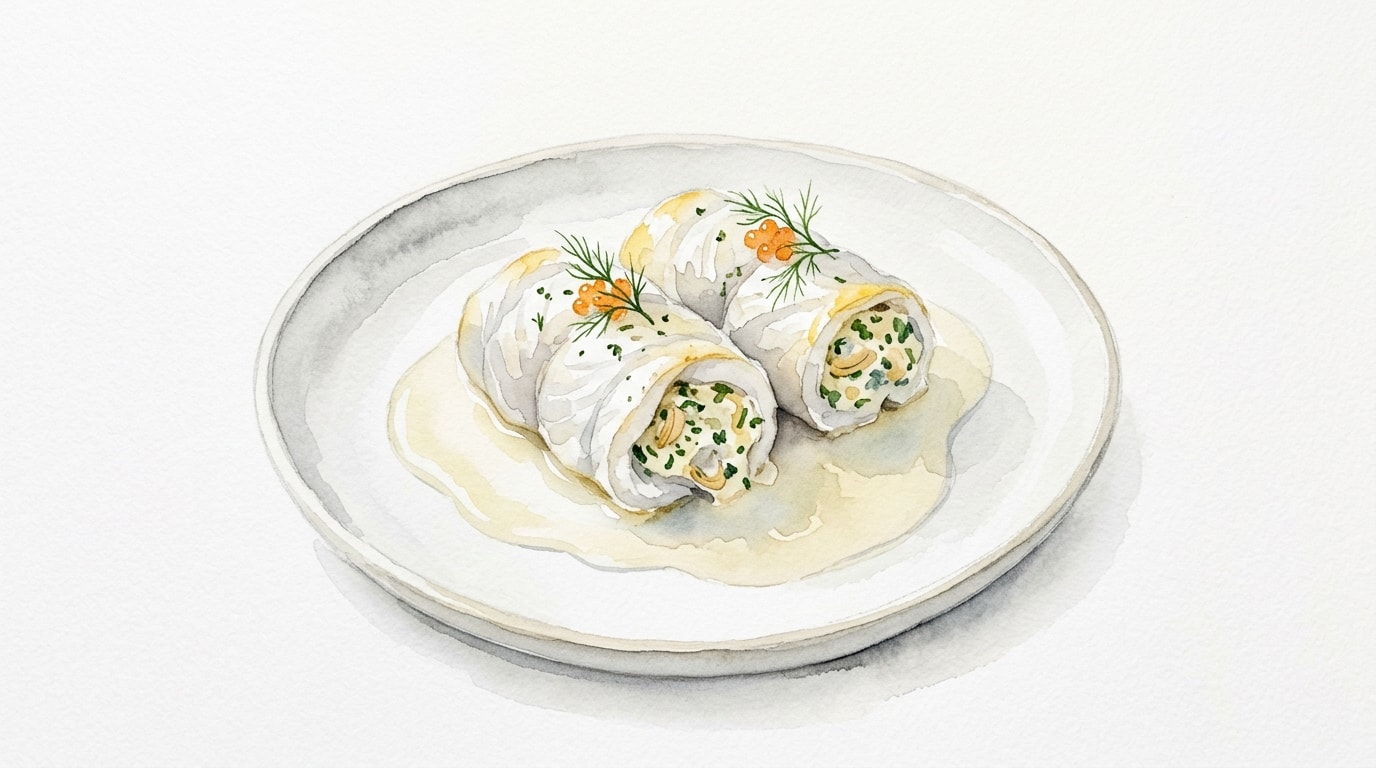
Lay the sole fillets flat on a work surface, skin side up. Season lightly with salt and white pepper. Spread a quarter of the clam farce evenly over each fillet. Starting from the thicker end, roll the fillet tightly into a cylinder and secure the seam with a wooden toothpick.
Place the rolled paupiettes in the prepared baking dish. Pour half of the reserved clam broth around the fish. Bake until the fish is opaque and yields easily to a fork, reaching an internal temperature of 60°C (140°F).
Carefully transfer the baked paupiettes to a warm serving platter and remove toothpicks. Pour the baking liquids and remaining reserved clam broth into a saucepan. Reduce over high heat by half. Lower heat, stir in the heavy cream and lemon juice, then whisk in the cold cubed butter to create a smooth emulsion.
Spoon the rich white wine butter sauce generously over the resting sole paupiettes and serve immediately.
Chef's Notes
- Placing the skin side of the fillet facing up on your cutting board ensures it ends up on the inside of the roll, which helps prevent the fish from uncurling as the skin-side connective tissue contracts during cooking.
- White pepper is specifically chosen here to preserve the pristine, elegant appearance of the fish and the pale sauce, avoiding the black specks that regular pepper would impart.
- For an impeccably smooth sauce, mount the cold butter cubes off the heat. Rapid boiling will break the emulsion, resulting in a greasy, split sauce.
Storage
Refrigerator: 1 day — Store in an airtight container. The fish will become firmer upon resting.
Reheating: Reheat very gently in a covered pan over low heat with a splash of water until just warmed through.
Troubleshooting
Grit or sand in the finished dish
Cause: Clams were not purged properly before steaming
Fix: Cannot be fixed once mixed into the stuffing, but straining the broth through cheesecloth will save the sauce
Prevention: Soak live clams in heavily salted cold water for 1 hour before using to encourage them to expel sand
Sole falls apart when rolling or baking
Cause: Fillets were rolled too loosely or the wrong end was rolled first
Fix: Secure with an extra toothpick, or serve as a stacked fillet rather than a roll
Prevention: Roll tightly from the thick head end toward the thin tail end, keeping the seam side down in the dish
Sauce is too salty
Cause: Natural clam juices contained more salt than expected, which concentrated during reduction
Fix: Mount with additional unsalted butter and a splash of heavy cream to dilute the salinity
Prevention: Taste the clam broth before reducing and hold back on adding any extra salt to the sauce until the very end
Cultural Context
The paupiette technique, wrapping meat or fish around a savory filling, dates back to 18th-century France. It was originally designed to stretch luxurious proteins and showcase a chef's knife skills, elevating simple fillets into structural, self-contained centerpieces that preserve the delicate moisture of the fish.


