
Equipment
Ingredients
Main
- 2500 g whole salmon, cleaned, gutted, and scaled
- 250 ml dry white wine
- 45 ml olive oil
- 2 lemon, sliced
- 15 g fresh dill, whole sprigs
Pantry Seasonings
- 15 g kosher salt
- 5 g black pepper, freshly cracked
Nutrition (per serving)
Nutrition is estimated per serving. Nutrients without complete source data are omitted.
Full nutrition
- Calories
- 903 kcal
- Protein
- 77 g
- Carbohydrates
- 13 g
- Fat
- 86 g
- Fiber
- 1 g
- Sugar
- 1 g
- Sodium
- 6668 mg
- Saturated Fat
- 1 g
- Monounsaturated Fat
- 4 g
- Polyunsaturated Fat
- 1 g
- Potassium
- 86 mg
- Calcium
- 877 mg
- Iron
- 37.6 mg
- Magnesium
- 945 mg
- Phosphorus
- 950 mg
- Zinc
- 2.9 mg
- Vitamin A
- 855 mcg
- Vitamin C
- 17 mg
- Vitamin E
- 0.9 mg
- Vitamin K
- 5 mcg
- Vitamin B6
- 0.1 mg
- Thiamin
- 0.02 mg
- Riboflavin
- 0.02 mg
- Niacin
- 0.1 mg
- Folate
- 7 mcg
- Water
- 56 g
- Alcohol
- 3 g
Sources: Aggregated Public Data, USDA FoodData Central
Method
Preheat your oven to 200 degrees Celsius or 400 degrees Fahrenheit. Line a large roasting pan with parchment paper. Always wash your hands and sanitize your surfaces thoroughly after handling raw fish to prevent cross-contamination.
Score the skin of the salmon with shallow diagonal cuts on both sides, spaced a few centimeters apart. Rub the interior cavity and exterior skin with the olive oil, kosher salt, and black pepper.
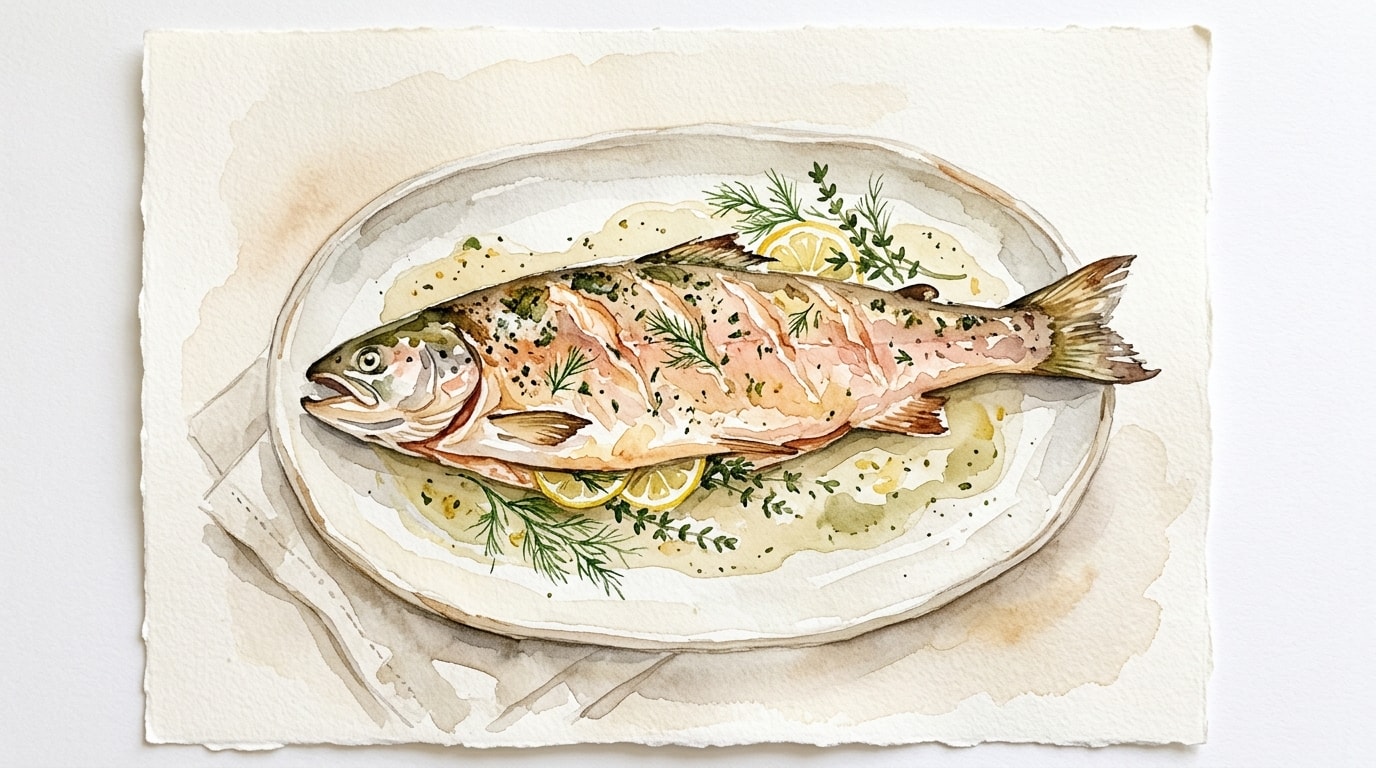
Stuff the prepared cavity of the salmon evenly with the lemon slices and the sprigs of fresh dill.
Place the stuffed salmon in the roasting pan. Pour half of the dry white wine around the base of the fish. Roast for 40 to 45 minutes until the flesh is opaque and the internal temperature reaches 63 degrees Celsius or 145 degrees Fahrenheit at the thickest part.
Carefully transfer the roasted salmon to a serving platter to rest. Pour the accumulated roasting juices and leftover wine from the bottom of the pan into a small saucepan.
Add the remaining dry white wine to the saucepan. Simmer the liquid over medium-high heat until it reduces by half, concentrating the rich flavors of the fish and wine.
Pour the reduced pan sauce over the rested salmon just before presenting to the table.
Chef's Notes
- Scoring the skin of the whole salmon is essential. It prevents the fish from curling as the proteins violently contract under heat, and it allows the seasoning to penetrate deeper into the thickest parts of the flesh.
- Selecting the right wine is crucial for a five-ingredient profile. A crisp, high-acid white wine like Sauvignon Blanc or Pinot Grigio will brilliantly cut through the natural richness and fats of the salmon without overpowering the delicate fish flavor.
- For strict food safety, always ensure raw fish is kept properly chilled in the refrigerator until right before preparation. Promptly wash and sanitize any cutting boards or knives used to process the raw fish.
- Resting the whole fish for about 10 minutes before serving allows the muscle fibers to relax and the juices to redistribute, ensuring every slice is moist and tender.
Storage
Refrigerator: 3 days — Store leftover salmon and sauce in separate airtight containers.
Freezer: 1 month — Freezing is possible but textural quality will degrade upon thawing.
Reheating: Reheat gently in a 135C/275F oven to avoid drying out the fish, or serve chilled over greens.
Troubleshooting
Salmon flesh is dry and chalky
Cause: The fish was left in the oven too long or the oven temperature was inaccurate
Fix: Cannot be fixed texturally, but generously spooning the reduced pan sauce over the portions will help restore some moisture
Prevention: Begin checking the internal temperature at the thickest part 10 minutes prior to the estimated completion time
Pan sauce lacks depth or is too watery
Cause: The sauce was not reduced long enough, or the caramelized bits were left behind in the roasting pan
Fix: Continue to simmer the sauce for another 5 minutes until it coats the back of a spoon
Prevention: Ensure a vigorous simmer and use a wooden spoon to scrape the browned bits from the roasting pan into the saucepan
Cultural Context
Serving a whole roasted fish is a time-honored communal tradition across global coastal cultures, widely symbolizing abundance, unity, and shared prosperity at the dinner table. The technique of transforming natural roasting juices into a refined pan sauce reflects classic European culinary resourcefulness, ensuring that every drop of natural flavor is preserved, elevated, and enjoyed.


