
Equipment
Ingredients
Parmesan Custard
- 2 eggs, room temperature
- 60 ml whole milk, room temperature
- 30 g parmigiano-reggiano, finely grated
- 5 g dijon mustard
- 1 g black pepper, freshly cracked
- 1 g fine sea salt
Bread
- 4 sourdough bread, thickly sliced
Cooking and Garnish
- 15 g unsalted butter
- 5 ml olive oil
- 3 g chives, finely chopped
- 5 g parmigiano-reggiano, finely grated
Nutrition (per serving)
Nutrition is estimated per serving. Nutrients without complete source data are omitted.
Full nutrition
- Calories
- 445 kcal
- Protein
- 21 g
- Carbohydrates
- 41 g
- Fat
- 20 g
- Fiber
- 2 g
- Sugar
- 3 g
- Sodium
- 1389 mg
- Saturated Fat
- 9 g
- Trans Fat
- 0 g
- Monounsaturated Fat
- 7 g
- Polyunsaturated Fat
- 2 g
- Cholesterol
- 217 mg
- Potassium
- 141 mg
- Calcium
- 276 mg
- Iron
- 1.2 mg
- Magnesium
- 20 mg
- Phosphorus
- 252 mg
- Zinc
- 1.3 mg
- Vitamin A
- 191 mcg
- Vitamin C
- 1 mg
- Vitamin D
- 1.5 mcg
- Vitamin E
- 1.1 mg
- Vitamin K
- 3 mcg
- Vitamin B6
- 0.1 mg
- Vitamin B12
- 0.8 mcg
- Thiamin
- 0.05 mg
- Riboflavin
- 0.34 mg
- Niacin
- 0.1 mg
- Folate
- 27 mcg
- Water
- 73 g
Sources: Aggregated Public Data, USDA FoodData Central
Method
In a wide, shallow bowl, vigorously whisk together the eggs, milk, grated Parmigiano-Reggiano, Dijon mustard, black pepper, and fine sea salt until well combined and slightly frothy.
Place the bread slices into the egg mixture. Let them soak for 2 minutes per side, pressing down lightly so the dense crumb absorbs the savory custard evenly.
Heat a large skillet over medium heat. Add the unsalted butter and olive oil, swirling the pan until the butter melts and foams. Combining butter with oil raises the smoke point and prevents the milk solids from burning at the 175 degrees Celsius or 350 degrees Fahrenheit cooking temperature.
Using a spatula, carefully transfer the soaked bread to the hot skillet. Cook for 3 to 4 minutes on the first side until a deep, golden-brown crust forms from the melting Parmesan.
Flip the slices and cook for an additional 2 to 3 minutes on the second side until browned. Ensure the internal temperature reaches 74 degrees Celsius or 165 degrees Fahrenheit so the egg is fully cooked through and no longer runny in the center.
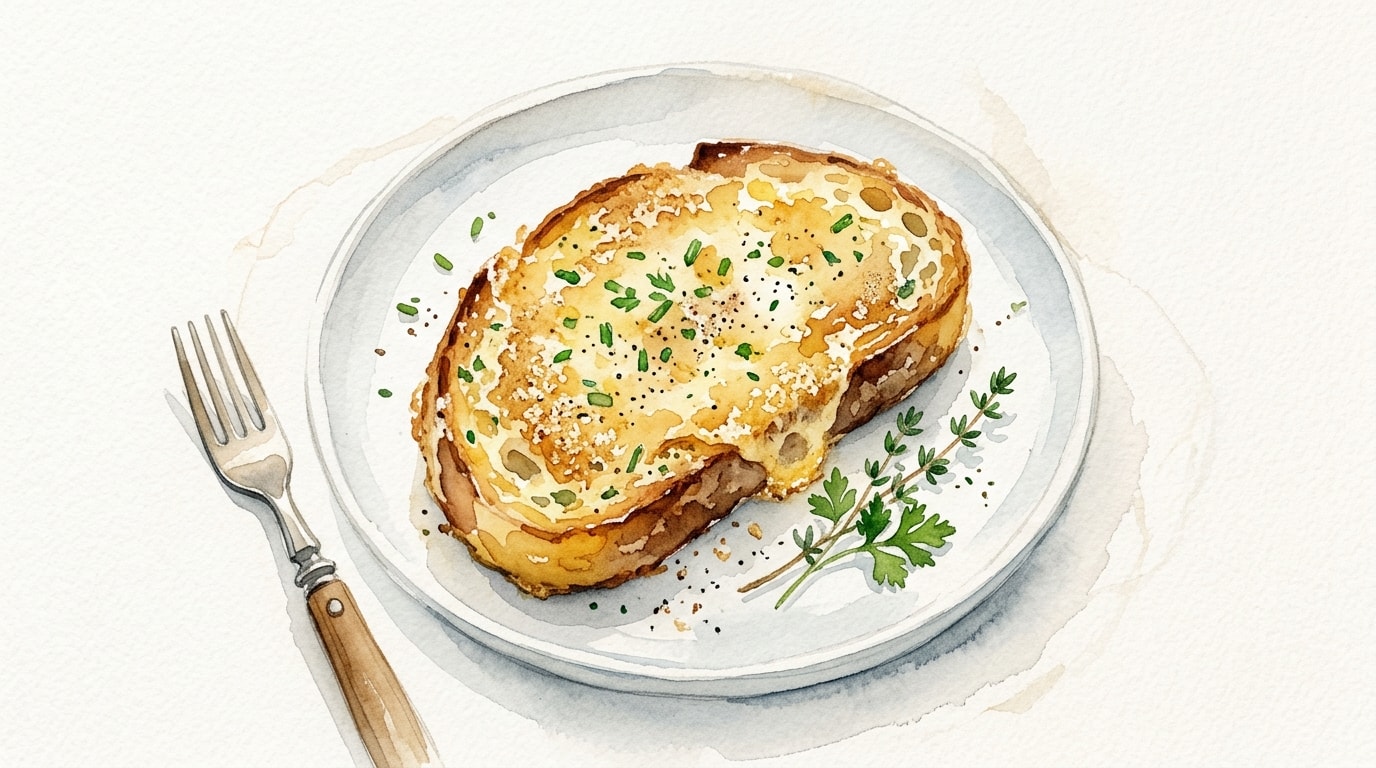
Transfer the hot savory French toast to warm plates. Garnish with freshly chopped chives and a final dusting of grated Parmigiano-Reggiano. Serve immediately.
Chef's Notes
- Using stale or slightly dried-out sourdough bread is essential. Fresh bread is too soft and will disintegrate when soaked in the egg custard.
- A touch of Dijon mustard acts as a gentle emulsifier for the custard and adds a subtle, sharp tang that cuts through the richness of the cheese and butter.
- Finely grating the Parmigiano-Reggiano with a microplane rather than using coarse shreds ensures it melts evenly into the liquid, creating a uniform, lacy crust on the exterior of the toast.
- For an extra layer of savory depth, try rubbing a halved raw garlic clove over the toasted exterior immediately after removing the slices from the pan.
Storage
Refrigerator: 2 days — Store in an airtight container with parchment paper between slices to prevent sticking.
Freezer: 1 month — Freeze slices individually on a baking sheet before transferring to a freezer-safe bag.
Reheating: Reheat in a toaster or an oven preheated to 180 degrees Celsius (350 degrees Fahrenheit) for 5 minutes to restore the crispy crust. Avoid microwaving.
Troubleshooting
French toast is soggy in the middle
Cause: Bread slices were too thick, fresh bread was used instead of stale, or the pan heat was too high, cooking the outside before the inside set.
Fix: Transfer the slices to a baking sheet and bake at 180 degrees Celsius (350 degrees Fahrenheit) for 5 to 8 minutes until the center sets.
Prevention: Use day-old bread sliced to about 2 centimeters thick. Lower the stove heat slightly to allow the center to cook before the crust burns.
Parmesan crust burns rapidly before the bread cooks
Cause: The skillet was too hot, or only butter was used without the stabilizing addition of olive oil.
Fix: Reduce heat immediately. Cannot be fully fixed once burnt, but slightly dark pieces can be served dark-side down.
Prevention: Maintain medium to medium-low heat and always use the oil-butter combination to pan-fry.
Cultural Context
French toast, historically known as pain perdu or lost bread, was originally a frugal method of salvaging stale loaves across European households. While modern iterations lean heavily toward sweet flavor profiles with syrup and cinnamon, this savory variation reclaims the dish as a robust, umami-rich meal. It draws upon traditional continental flavor pairings of aged cheese, mustard, and eggs.


