
Equipment
Ingredients
Seafood and Produce
- 4 halibut fillets, room temperature
- 400 g baby potatoes, halved
- 250 g asparagus, woody ends trimmed, cut into 5cm pieces
Saffron Broth
- 500 ml fish stock
- 30 ml lemon juice, freshly squeezed
- ½ g saffron threads
- 15 ml olive oil
Almond-Anchovy Seasoning
- 50 g blanched almonds, toasted
- 15 g garlic, peeled
- 12 g anchovy fillets in oil, drained
- 15 g fresh parsley, roughly chopped
- 30 ml extra virgin olive oil
Nutrition (per serving)
Nutrition is estimated per serving. Nutrients without complete source data are omitted.
Full nutrition
- Calories
- 465 kcal
- Protein
- 43 g
- Carbohydrates
- 22 g
- Fat
- 24 g
- Fiber
- 6 g
- Sugar
- 2 g
- Sodium
- 438 mg
- Saturated Fat
- 4 g
- Monounsaturated Fat
- 14 g
- Polyunsaturated Fat
- 4 g
- Cholesterol
- 111 mg
- Potassium
- 1667 mg
- Calcium
- 128 mg
- Iron
- 6.0 mg
- Magnesium
- 110 mg
- Phosphorus
- 513 mg
- Zinc
- 2.1 mg
- Vitamin A
- 110 mcg
- Vitamin C
- 24 mg
- Vitamin D
- 0.1 mcg
- Vitamin E
- 8.5 mg
- Vitamin K
- 95 mcg
- Vitamin B6
- 1.0 mg
- Vitamin B12
- 2.7 mcg
- Thiamin
- 0.25 mg
- Riboflavin
- 0.40 mg
- Niacin
- 11.4 mg
- Folate
- 85 mcg
- Water
- 266 g
Sources: Aggregated Public Data, USDA FoodData Central
Method
Place the toasted almonds, garlic cloves, anchovy fillets, and parsley on a cutting board. Finely chop them together until they form a coarse, rustic mixture. Transfer to a small bowl, stir in the 30ml of extra virgin olive oil, and set aside.
Warm 60ml of the fish stock in a small bowl and add the saffron threads. Allow the saffron to bloom for 10 minutes to release its aromatic oils and deep golden color.
Heat 15ml of olive oil in a large braiser or deep skillet over medium heat. Add the halved baby potatoes and cook for 5 minutes, tossing occasionally, until they begin to soften around the edges.
Pour the remaining fish stock, freshly squeezed lemon juice, and the bloomed saffron mixture into the braiser. Bring the liquid to a gentle bubble, lower the heat, cover, and cook for 10 minutes until the potatoes are mostly tender.
Nestle the halibut fillets and asparagus pieces into the saffron broth among the potatoes. Cover the braiser and cook gently over low heat for 5 to 7 minutes. The fish should reach an internal temperature of 63°C/145°F.
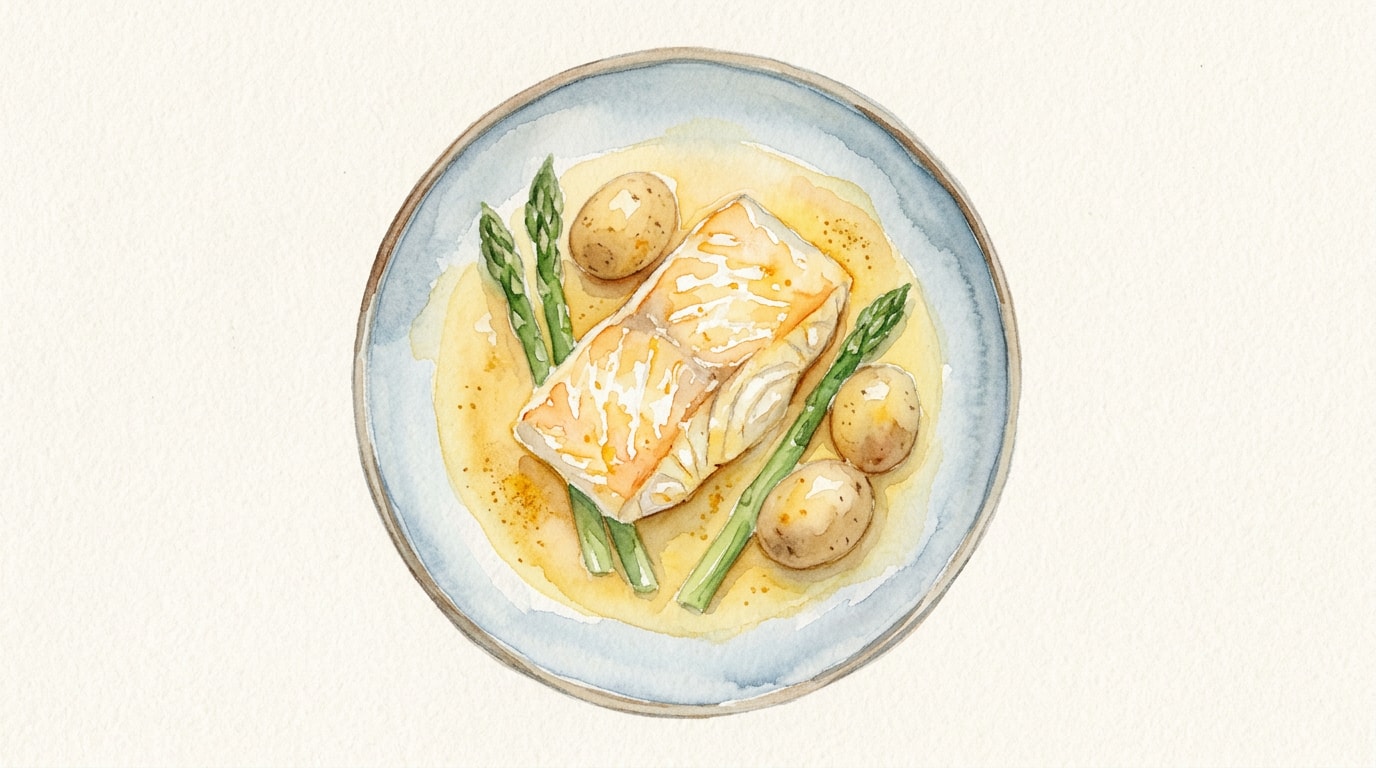
Carefully divide the braised halibut, potatoes, and asparagus among four wide, shallow bowls. Ladle the hot saffron broth over each portion, then spoon the reserved almond, garlic, and anchovy seasoning generously over the top of the fish.
Chef's Notes
- Always practice proper food safety by sanitizing cutting boards and washing hands immediately after handling raw halibut to prevent cross-contamination.
- Anchovies act as a potent source of umami in this dish. They will melt into the palate profile without leaving an overtly fishy taste, enhancing the savoriness of the mild halibut.
- To achieve the absolute best texture, remove the halibut from the heat right when it reaches 54C (130F). The carryover cooking as it rests in the hot broth will gently bring it up to the safe serving temperature of 63C (145F).
- If asparagus stalks are thick, peel the bottom halves slightly with a vegetable peeler to ensure they cook at the same rate as the fish.
Storage
Refrigerator: 2 days — Store the fish, vegetables, and broth together in an airtight container.
Reheating: Reheat gently on the stovetop over low heat until just warmed through to an internal temperature of 63 Celsius or 145 Fahrenheit to avoid rubbery fish.
Troubleshooting
Halibut is dry, tough, or rubbery
Cause: The cooking liquid was boiling rapidly rather than simmering, or the fish was left in the pan too long.
Fix: Cannot be fixed. Spoon extra olive oil and broth over the flesh to add perceived moisture when eating.
Prevention: Maintain a gentle, bare simmer during the braising step and monitor the internal temperature closely starting at the 5-minute mark.
Broth lacks depth and depth of color
Cause: Saffron was not steeped in warm liquid prior to adding it to the main pot.
Fix: Simmer the broth uncovered for an extra 2-3 minutes before adding the fish to reduce and concentrate the flavors.
Prevention: Always bloom saffron in warm water or stock for at least 10 minutes to extract maximum flavor and dye.
Cultural Context
This dish exemplifies modern American coastal cooking, which frequently adopts Mediterranean sensibilities to elevate fresh, local ingredients. The crunchy almond and anchovy topping pays homage to the Spanish picada, traditionally used to thicken and enliven seafood stews right before serving.


