
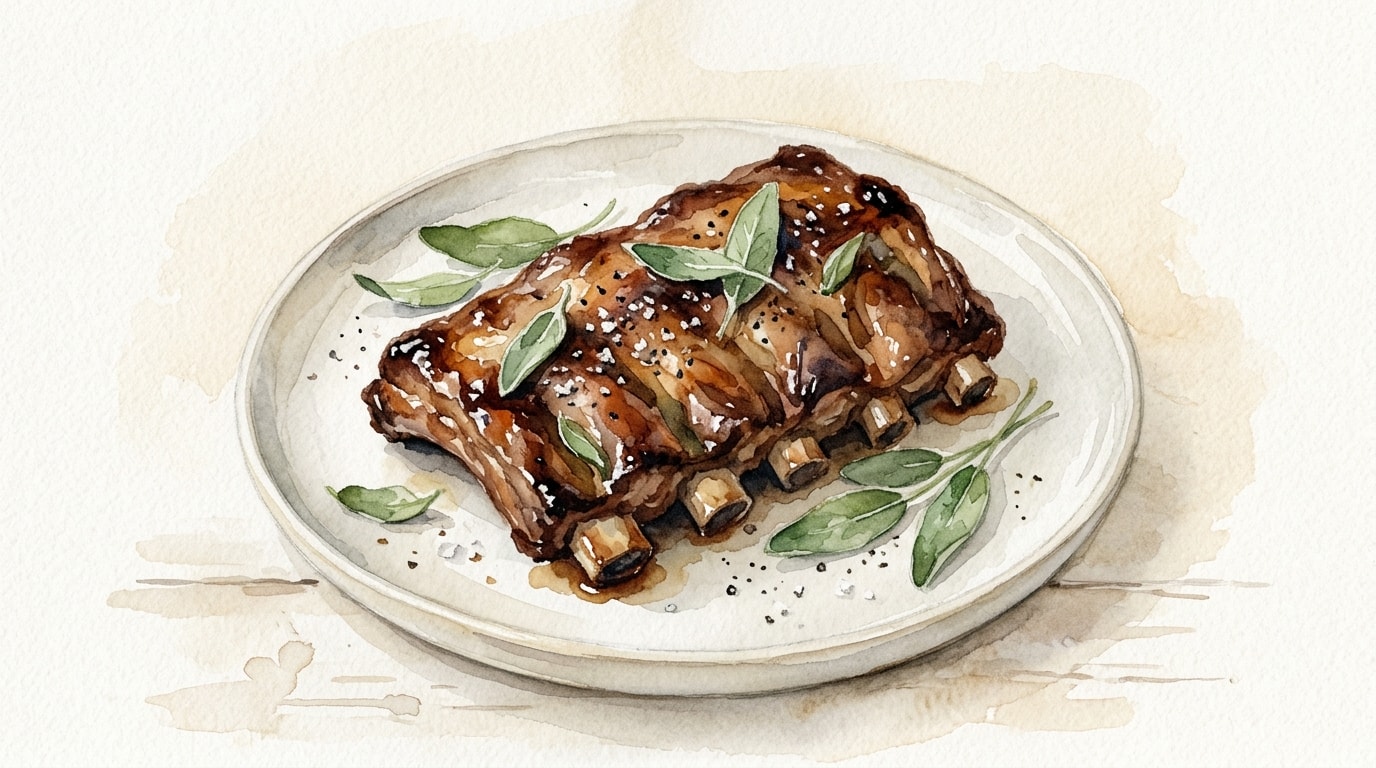
Equipment
Ingredients
Ribs and Dry Rub
- 1500 g pork baby back ribs, membrane removed
- 15 g kosher salt
- 5 g black pepper, freshly ground
- 5 g smoked paprika
- 5 g garlic powder
Saba and Sage Glaze
- 15 ml olive oil
- 2 garlic, minced
- 10 g fresh sage, finely chopped
- 120 ml saba
- 30 ml balsamic vinegar
- 15 g dijon mustard
Nutrition (per serving)
Nutrition is estimated per serving. Nutrients without complete source data are omitted.
Full nutrition
- Calories
- 1375 kcal
- Protein
- 104 g
- Carbohydrates
- 44 g
- Fat
- 91 g
- Fiber
- 2 g
- Sugar
- 36 g
- Sodium
- 2111 mg
- Saturated Fat
- 33 g
- Monounsaturated Fat
- 3 g
- Polyunsaturated Fat
- 1 g
- Potassium
- 2212 mg
- Calcium
- 231 mg
- Iron
- 8.8 mg
- Magnesium
- 157 mg
- Phosphorus
- 1078 mg
- Zinc
- 16.3 mg
- Vitamin A
- 31 mcg
- Vitamin C
- 2 mg
- Vitamin E
- 0.9 mg
- Vitamin K
- 5 mcg
- Vitamin B6
- 0.1 mg
- Thiamin
- 0.03 mg
- Riboflavin
- 0.03 mg
- Niacin
- 0.2 mg
- Folate
- 2 mcg
- Water
- 11 g
Sources: Aggregated Public Data, USDA FoodData Central
Method
Preheat your oven to 135C (275F). Ensure the tough silverskin membrane on the back of each rib rack has been peeled off. You can grip it with a paper towel to pull it away cleanly.
Combine the kosher salt, black pepper, smoked paprika, and garlic powder in a small bowl. Rub the spice mixture evenly over both sides of the ribs.
Wrap each rack of ribs tightly in heavy-duty aluminum foil to create a sealed packet. Place the packets on a baking sheet and bake for 2.5 hours, until the meat is tender and begins to pull back from the ends of the bones.
While the ribs are in their final 15 minutes of baking, heat the olive oil in a small saucepan over medium-low heat. Add the minced garlic and fresh chopped sage, sauteing for 1 minute until highly fragrant.
Stir the saba, balsamic vinegar, and dijon mustard into the saucepan. Bring to a gentle simmer and cook for 5 to 7 minutes until the glaze thickens slightly and easily coats the back of a spoon. Remove from heat.
Preheat your grill to medium-high heat. Carefully remove the tender ribs from the foil packets, discarding the collected juices and fat.
Place the ribs on the hot grill. Brush generously with the saba glaze. Grill for 3 to 5 minutes per side, basting frequently, until the glaze caramelizes and becomes sticky. Watch closely to prevent burning, as the sugars in the saba will catch quickly. Ensure the internal temperature of the meat reaches at least 74C (165F) for safety.
Transfer the glazed ribs to a cutting board and let them rest for 10 minutes before slicing between the bones to serve.
Chef's Notes
- Saba is cooked grape must, essentially the unfermented precursor to balsamic vinegar. It has a complex, raisiny sweetness that makes an exceptional barbecue base without relying on refined sugars.
- Do not skip the dijon mustard in the glaze; the emulsifying properties of the mustard bind the oil, vinegar, and saba together while adding necessary acidic tension.
- If saba is unavailable, you can substitute with an equal amount of high-quality balsamic glaze, though you may want to add a tablespoon of honey to replicate saba's distinct sweetness.
- Always apply a dry rub to ribs even when utilizing a heavy, wet glaze. The rub establishes a foundational flavor profile directly on the meat that a surface glaze cannot provide.
Storage
Refrigerator: 3 days — Store in an airtight container. The glaze may thicken significantly when cold.
Freezer: 2 months — Wrap tightly in foil and place in a heavy-duty freezer bag.
Reheating: Reheat gently in the oven at 150C/300F covered tightly with foil for 20 minutes, or until warmed through.
Troubleshooting
The glaze burned rapidly on the grill, turning bitter.
Cause: Saba has a very high natural sugar content which scorches easily over direct, high heat.
Fix: Cannot be completely fixed. Scrape off the most severely charred areas and apply a light coating of fresh glaze off the heat.
Prevention: Ensure your grill heat is not too high, keep the ribs moving, or apply the bulk of the glaze during the final 2 minutes of grilling over indirect heat.
Rib meat is tough and does not pull cleanly from the bone.
Cause: The ribs were not baked long enough in the foil, or the oven temperature dropped.
Fix: If caught before grilling, re-wrap tightly in foil and return to the oven for another 30 to 45 minutes.
Prevention: Check for visual cues of doneness before removing from the foil, such as the meat shrinking back from the bone ends.
Cultural Context
Saba holds ancient roots in Italian gastronomy, historically used as a natural sweetener long before cane sugar became widely accessible in Europe. By adapting this traditional Emilia-Romagna staple into a sticky barbecue glaze, this dish bridges old-world Italian pantry traditions with the quintessential techniques of American backyard grilling.


