
Equipment
Ingredients
Fish and Scallions
- 600 g sea bass fillets, skin-on, pin bones removed
- 200 g scallions, roots trimmed, left completely whole
- 15 ml olive oil
- 30 g unsalted butter
- salt
- black pepper
Beurre Rouge
- 250 ml dry red wine
- 150 ml fish stock
- 50 g shallots, finely minced
- 120 g unsalted butter, very cold, cut into small cubes
- 2 g fresh thyme
- 2 g black peppercorns, lightly crushed
Nutrition (per serving)
Nutrition is estimated per serving. Nutrients without complete source data are omitted.
Full nutrition
- Calories
- 535 kcal
- Protein
- 30 g
- Carbohydrates
- 8 g
- Fat
- 38 g
- Fiber
- 2 g
- Sugar
- 3 g
- Sodium
- 662 mg
- Saturated Fat
- 20 g
- Monounsaturated Fat
- 12 g
- Polyunsaturated Fat
- 3 g
- Cholesterol
- 143 mg
- Potassium
- 723 mg
- Calcium
- 78 mg
- Iron
- 1.8 mg
- Magnesium
- 88 mg
- Phosphorus
- 363 mg
- Zinc
- 1.0 mg
- Vitamin A
- 353 mcg
- Vitamin C
- 11 mg
- Vitamin D
- 8.4 mcg
- Vitamin E
- 3.0 mg
- Vitamin K
- 111 mcg
- Vitamin B6
- 0.7 mg
- Vitamin B12
- 0.8 mcg
- Thiamin
- 0.23 mg
- Riboflavin
- 0.29 mg
- Niacin
- 3.3 mg
- Folate
- 47 mcg
- Water
- 269 g
- Alcohol
- 7 g
Sources: USDA FoodData Central
Method
Using a chef knife and cutting board, finely mince the shallots. Trim the root ends off the scallions, leaving the green and white stalks entirely whole.
Thoroughly pat the sea bass fillets completely dry using paper towels to ensure a crisp sear. Season both sides evenly with salt and black pepper. Immediately wash your hands and sanitize the cutting board and any surfaces that contacted the raw fish to prevent cross-contamination.
In a small saucepan over medium-high heat, combine the dry red wine, fish stock, minced shallots, fresh thyme sprigs, and crushed black peppercorns. Bring the mixture to a boil and reduce the liquid aggressively until only about 45ml to 60ml of thick, syrupy liquid remains. This should take roughly 15 minutes.
While the wine reduces, heat the skillet over medium heat. Add the 30g of unsalted butter and a small splash of water. Add the whole scallions, season lightly with salt, and cook gently for 8 to 10 minutes until deeply tender and slightly glazed. Transfer the scallions to a warm plate and wipe the skillet clean.
Return the clean skillet to medium-high heat and add the olive oil. Once the oil is shimmering, place the sea bass fillets skin-side down. Press gently on the fillets with a fish spatula for the first 30 seconds to prevent curling. Cook without moving for 4 minutes until the skin is crisp. Carefully flip and cook for 1 to 2 more minutes until the internal temperature reaches 63 C / 145 F. Remove from the skillet.
Turn the heat under the reduced wine mixture to the lowest possible setting. Remove and discard the thyme sprigs. Gradually whisk in the 120g of cold cubed butter, incorporating only two or three cubes at a time. Whisk constantly until the sauce is thick, glossy, and fully emulsified. Do not let the sauce boil, or the butter will separate. Taste and season with a pinch of salt if necessary.
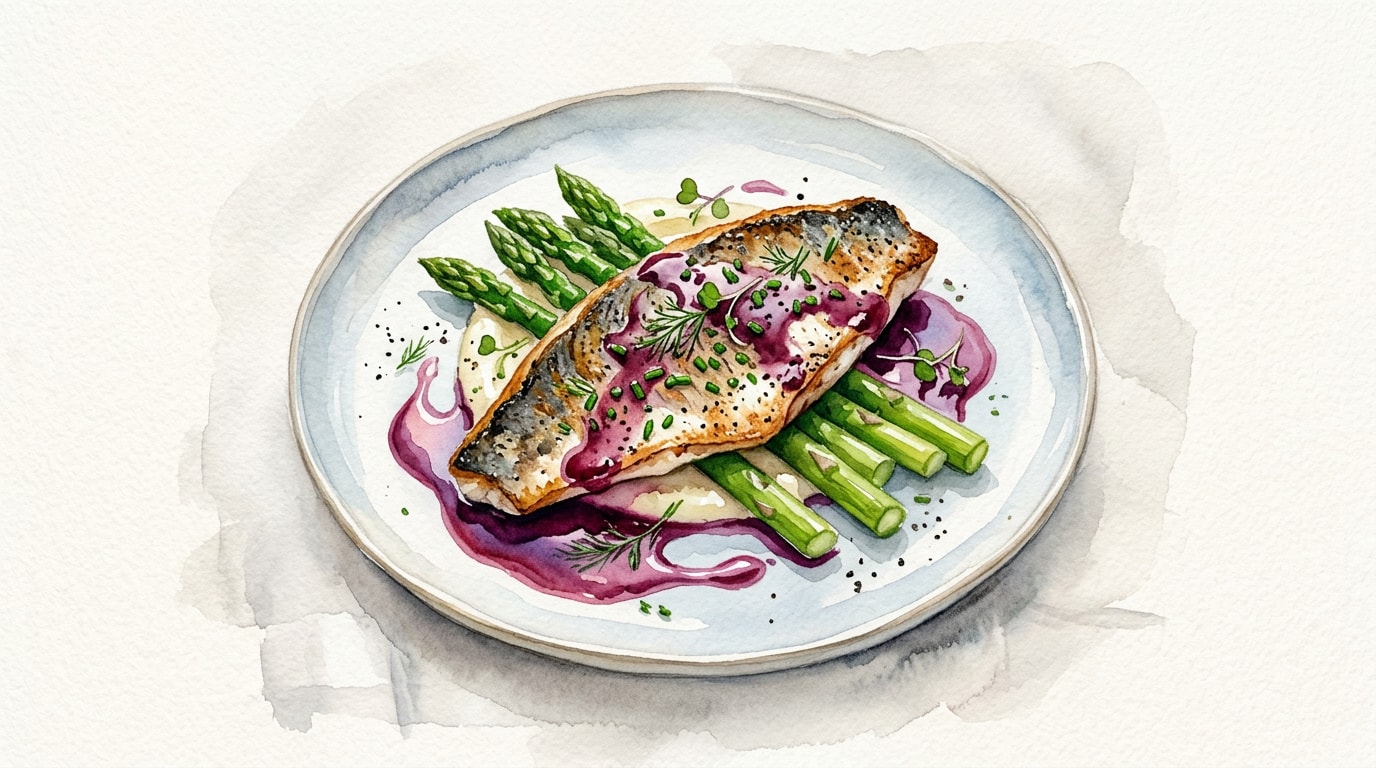
Divide the tender, glazed scallions evenly among four warm serving plates. Lay a crisp sea bass fillet over the scallions on each plate. Generously spoon the rich beurre rouge over the bottom of the fish and around the plate. Serve immediately.
Chef's Notes
- Choosing the right wine is crucial for a balanced beurre rouge. Avoid heavily oaked or highly tannic wines like Cabernet Sauvignon, which can become unpleasantly bitter when reduced. A light, fruity Pinot Noir or Gamay provides the perfect acidic backbone.
- Patting the fish fillets completely dry and bringing them close to room temperature before cooking is the secret to a perfectly crisp skin that will not stick to the pan.
- When searing the sea bass, always press down gently on the fillets with a fish spatula for the first thirty seconds. Fish skin contracts rapidly when it hits intense heat, and pressing ensures an even, golden-brown crust rather than a curled fillet.
- For the sauce to hold a stable emulsion, temperature contrast is key. The butter must be kept as cold as possible right up until it meets the warm wine reduction.
Storage
Refrigerator: 1 day — Store the fish and scallions separately. The beurre rouge sauce may split upon reheating.
Reheating: Reheat the fish gently in a low oven. For the sauce, warm over very low heat while whisking constantly to maintain the emulsion. Do not boil.
Troubleshooting
Beurre rouge sauce separates, turning thin and producing pools of clear melted butter.
Cause: The heat was too high when the butter was incorporated, or the butter was not cold enough to form a proper emulsion.
Fix: Remove from heat immediately. Add a splash of heavy cream or a teaspoon of ice-cold water and whisk vigorously to attempt re-emulsifying the fat.
Prevention: Keep the butter thoroughly chilled until the exact moment of use, and turn the heat to the lowest setting or entirely off when whisking it into the reduction.
Cultural Context
While red wine is traditionally paired with red meat, classical French regional cooking beautifully subverts this rule. Dishes like Matelote, a freshwater fish stew, and fish served with Beurre Rouge originated in famous wine-producing regions like Burgundy and the Loire Valley. These preparations prove that delicate river or ocean fish pair exceptionally well with the bright acidity and vibrant fruitiness of a carefully crafted red wine sauce.


