
Equipment
Ingredients
The Roast
- 1850 g beef tenderloin, room temperature, center-cut
- 25 ml grapeseed oil
- 15 g kosher salt, fine grain
- 5 g black peppercorns, coarsely cracked
Niçoise Garnish
- 700 g yukon gold potatoes, peeled
- 30 ml extra virgin olive oil
- 140 g haricots verts, trimmed
- 4 plum tomatoes, ripe
- 2 g granulated sugar, pinch
- 50 g niçoise olives, pitted and halved
- 10 g fresh basil, leaves only
Nutrition (per serving)
Nutrition is estimated per serving. Nutrients without complete source data are omitted.
Full nutrition
- Calories
- 642 kcal
- Protein
- 68 g
- Carbohydrates
- 30 g
- Fat
- 29 g
- Fiber
- 6 g
- Sugar
- 4 g
- Sodium
- 1252 mg
- Saturated Fat
- 10 g
- Trans Fat
- 1 g
- Monounsaturated Fat
- 12 g
- Polyunsaturated Fat
- 5 g
- Cholesterol
- 151 mg
- Potassium
- 975 mg
- Calcium
- 58 mg
- Iron
- 8.7 mg
- Magnesium
- 67 mg
- Phosphorus
- 136 mg
- Zinc
- 0.2 mg
- Vitamin A
- 42 mcg
- Vitamin C
- 37 mg
- Vitamin E
- 2.5 mg
- Vitamin K
- 27 mcg
- Vitamin B6
- 0.1 mg
- Thiamin
- 0.05 mg
- Riboflavin
- 0.04 mg
- Niacin
- 0.6 mg
- Folate
- 19 mcg
- Water
- 316 g
Sources: Aggregated Public Data, USDA FoodData Central
Method
Preheat the oven to 230°C (450°F). Pat the beef tenderloin completely dry with paper towels—moisture is the enemy of a good sear. Season aggressively on all sides with kosher salt and cracked black pepper.
Place the beef in the roasting pan and rub thoroughly with grapeseed oil. Roast at 230°C (450°F) for 25 minutes to develop a deep golden-brown crust.
Reduce the oven temperature to 150°C (300°F). Continue roasting for 35 to 45 minutes. Use a digital thermometer to pull the beef when it hits 49°C (120°F) for rare or 54°C (130°F) for medium-rare.
While the beef roasts, simmer the potatoes in heavily salted water until fork-tender, roughly 25 minutes. Drain and allow to air-dry for 5 minutes before dicing into 1cm (1/4-inch) cubes. Toss with olive oil and a pinch of salt.
Blanch the haricots verts in boiling salted water for 3-4 minutes until crisp-tender. Immediately transfer to an ice bath to shock them, preserving the vibrant green color. Drain and cut into 3cm lengths.
Score a small 'X' on the bottom of the tomatoes. Submerge in boiling water for 30 seconds, then shock in ice water. Peel the skins, remove the seeds, and dice the flesh into small cubes (concassé). Season with the sugar and a touch of salt.
Remove the beef from the oven and transfer to a cutting board. Let it rest for at least 15 minutes. This allows the muscle fibers to relax and reabsorb the juices.
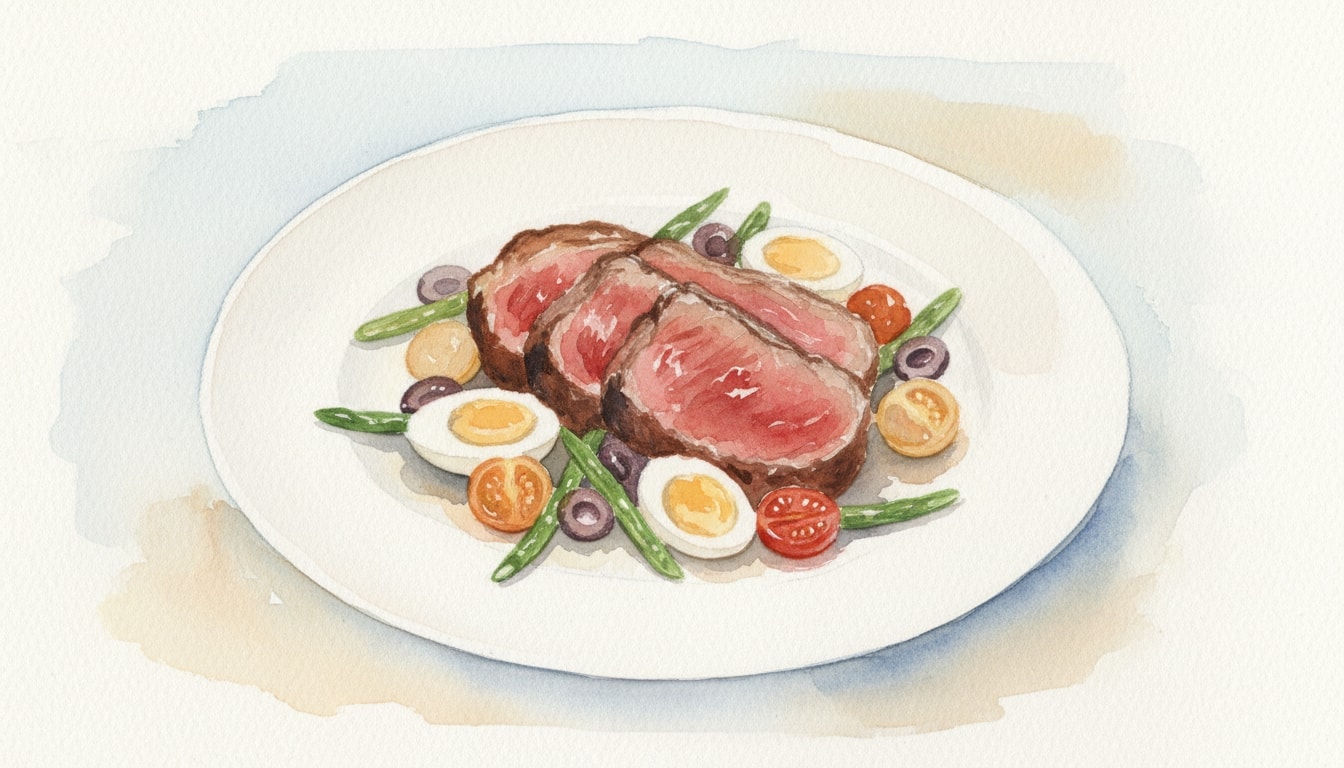
Carve the beef into 1cm slices. Arrange on a warm platter. Combine the potatoes and beans, scattering them around the protein. Garnish with tomato concassé, halved olives, and hand-torn basil leaves. Drizzle any pan juices over the meat.
Chef's Notes
- The secret to this dish is the 'resting' period. Cutting into the beef too early will cause all the juices to run out, leaving the meat dry.
- For the best flavor, use Niçoise olives specifically; they are smaller and more herbal than standard Kalamatas.
Storage
Refrigerator: 3 days — Store beef and vegetable components in separate airtight containers to maintain textures.
Reheating: Gently warm beef in a 120°C/250°F oven until just ambient; do not overcook. Vegetables can be quickly sautéed in olive oil.
Troubleshooting
Beef is grey and dry throughout
Cause: Oven temperature was too high or internal temp was not monitored.
Fix: Serve with a rich Béarnaise sauce or extra pan juices to add moisture.
Prevention: Always use an instant-read thermometer and pull the meat 5 degrees before your target temp.
Haricots verts are dull olive green
Cause: Overcooked or not shocked in ice water quickly enough.
Fix: Toss them in a bright herb oil to mask the color slightly.
Prevention: Set up your ice bath before the beans even hit the boiling water.
Cultural Context
This dish is a 'Terre' (land) interpretation of the classic Salad Niçoise from Nice, France. While the original is traditionally served with tuna or anchovies, the use of beef tenderloin elevates it to a 'Grand Pièce' suitable for formal French service.


