
Equipment
* optional
Ingredients
Stir-Fry Sauce
- 30 ml oyster sauce
- 15 ml light soy sauce
- 15 ml dark soy sauce
- 10 ml fish sauce
- 30 ml water
- 5 g granulated sugar
Aromatics & Protein
- 4 garlic cloves, peeled
- 4 bird's eye chilies, stems removed
- 30 ml neutral cooking oil
- 400 g minced chicken, raw
- 50 g fresh holy basil, leaves picked from stems
For Serving
- 300 g jasmine rice, cooked hot
- 2 eggs, large
- 30 ml neutral cooking oil
Nutrition (per serving)
Nutrition is estimated per serving. Nutrients without complete source data are omitted.
Full nutrition
- Calories
- 1420 kcal
- Protein
- 62 g
- Carbohydrates
- 130 g
- Fat
- 70 g
- Fiber
- 3 g
- Sugar
- 4 g
- Sodium
- 1866 mg
- Saturated Fat
- 16 g
- Trans Fat
- 0 g
- Monounsaturated Fat
- 2 g
- Polyunsaturated Fat
- 1 g
- Cholesterol
- 186 mg
- Potassium
- 887 mg
- Calcium
- 170 mg
- Iron
- 10.7 mg
- Magnesium
- 84 mg
- Phosphorus
- 332 mg
- Zinc
- 2.8 mg
- Vitamin A
- 241 mcg
- Vitamin C
- 18 mg
- Vitamin D
- 1.0 mcg
- Vitamin E
- 0.9 mg
- Vitamin K
- 105 mcg
- Vitamin B6
- 0.6 mg
- Vitamin B12
- 0.5 mcg
- Thiamin
- 0.93 mg
- Riboflavin
- 0.40 mg
- Niacin
- 7.3 mg
- Folate
- 395 mcg
- Water
- 130 g
Sources: Aggregated Public Data, USDA FoodData Central
Method
In a small bowl, whisk together the oyster sauce, light soy sauce, dark soy sauce, fish sauce, water, and granulated sugar until the sugar has completely dissolved. Set aside.
Using a chef's knife and cutting board, coarsely chop the garlic and bird's eye chilies together until they form a rough, fragrant paste.
Heat 30ml of neutral cooking oil in a wok over medium-high heat until shimmering.
Add the garlic and chili paste to the wok. Using a spatula, stir-fry continuously for 20 seconds until highly aromatic, being careful not to let the garlic burn.
Increase heat to high and add the minced chicken. Stir-fry for 4 to 5 minutes, breaking up the meat with your spatula, until lightly browned and fully cooked through. Ensure the internal temperature reaches 74 C / 165 F.
Pour the prepared sauce mixture over the cooked chicken. Stir-fry for an additional 1 to 2 minutes until the liquid reduces slightly and coats the meat in a glossy glaze.
Remove the wok entirely from the heat. Immediately add the basil leaves and gently fold them into the hot chicken mixture for 15 to 20 seconds, just until the leaves wilt from the residual heat.
In a small skillet, heat the remaining 30ml of oil over medium-high heat until almost smoking. Crack the eggs into the oil one at a time, frying until the egg whites are crispy and golden on the edges, but the yolks remain runny.
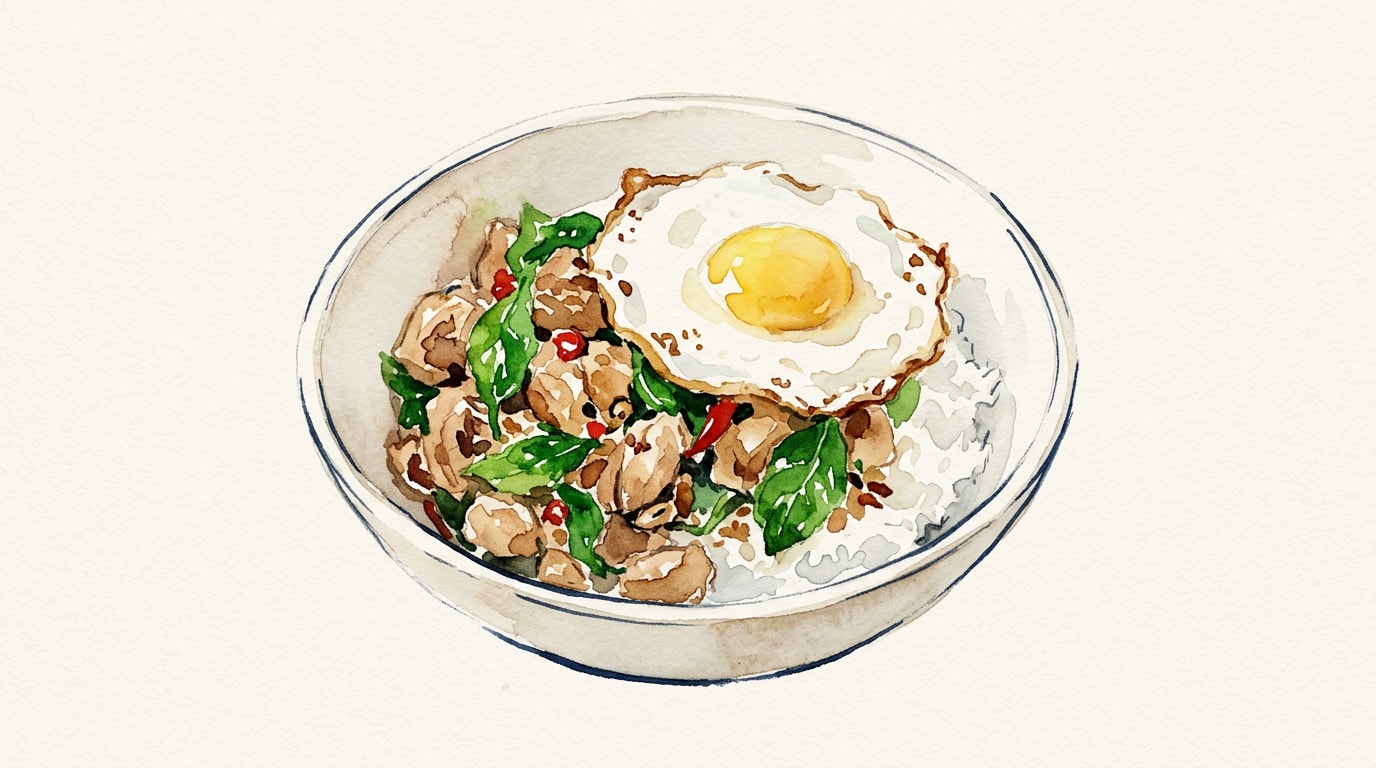
Divide the hot cooked jasmine rice between serving plates. Spoon the hot basil chicken heavily over the rice, pouring any excess pan juices over the top. Crown each portion with a crispy fried egg and serve immediately.
Chef's Notes
- Traditional Thai street food vendors often use a mortar and pestle to pound the garlic and chilies. This crushing action releases far more essential oils than knife chopping, resulting in a significantly more explosive flavor base.
- Holy basil (kra pao) is authentic for this dish, providing a distinct peppery, clove-like bite. If you cannot find it, sweet Thai basil (horapa) is a very common and perfectly acceptable substitute, though it leans slightly more towards anise/licorice notes.
- The hallmark of a Thai-style fried egg (kai dao) is the ultra-crispy, lacy, bubbling edge. To achieve this, do not be shy with the oil, and ensure it is nearly smoking before dropping the egg in.
- Raw egg yolk poses a risk for vulnerable populations. If serving to children, pregnant women, or immunocompromised individuals, consider frying the egg until the yolk is set, or use pasteurized eggs.
Storage
Refrigerator: 3 days — Store chicken and rice in separate airtight containers.
Freezer: 1 month — Freeze chicken mixture only; fresh basil texture will degrade slightly upon thawing.
Reheating: Microwave on high for 2 minutes, or stir-fry in a hot skillet until steaming.
Troubleshooting
Basil leaves turned black and lost their aromatic flavor.
Cause: The basil was exposed to direct, active heat for too long.
Fix: Cannot be fixed.
Prevention: Always remove the wok from the heat source completely before adding the basil, relying only on residual heat to wilt the leaves.
Chicken boiled in its own juices instead of browning.
Cause: Wok was not hot enough before adding chicken, or the pan was overcrowded.
Fix: Continue cooking until the liquid fully evaporates, then allow the chicken to fry in the remaining fat for a few minutes to build color.
Prevention: Ensure wok is smoking hot before adding meat. If making a double batch, cook the chicken in two shifts.
Cultural Context
Pad Kra Pao is arguably the most ubiquitous street food dish in Thailand, often considered the equivalent of a comforting sandwich or burger in Western culture. It emerged in the mid-20th century as Chinese stir-frying techniques merged with heavily aromatic local Thai ingredients like holy basil and fish sauce.


