
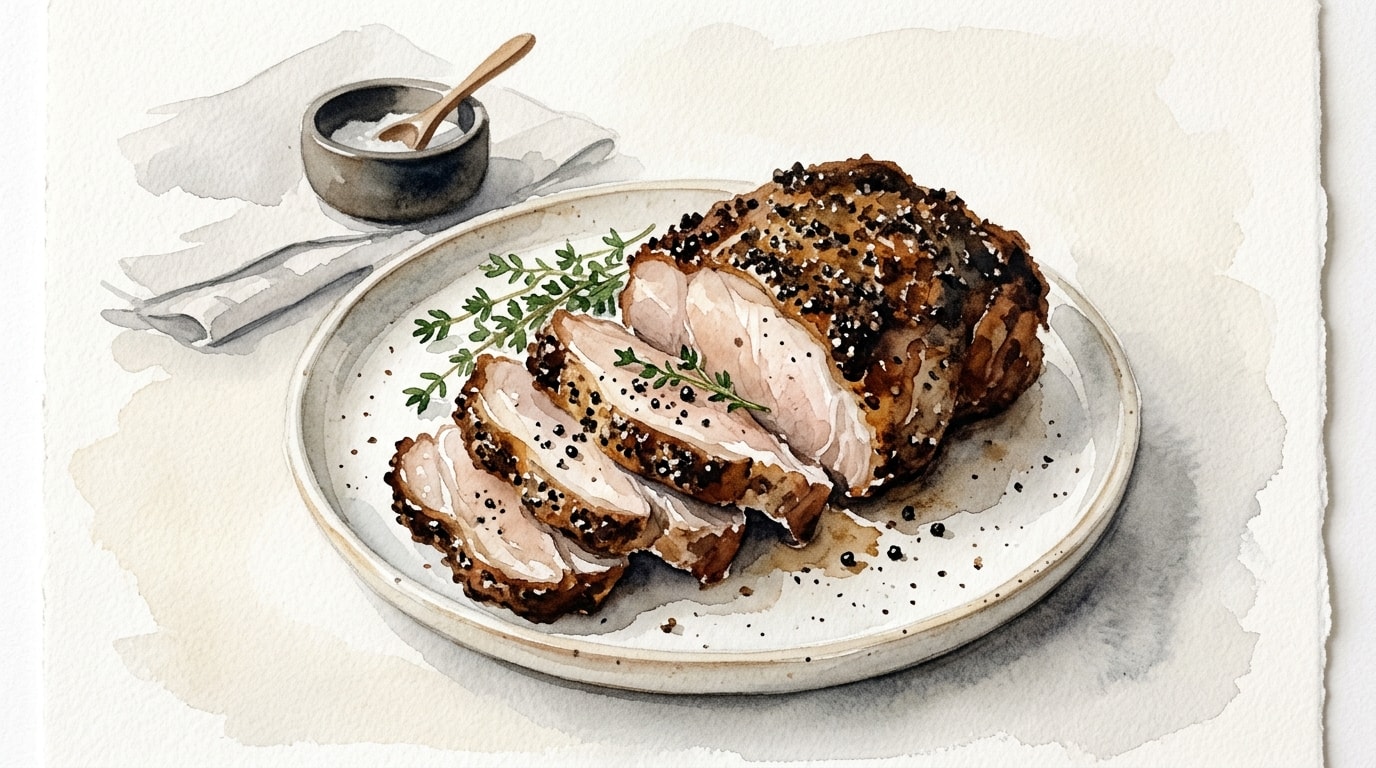
Equipment
Ingredients
Pork
- 2500 g boneless pork shoulder, trimmed of excess surface fat but leaving a thin cap
Miso-Pepper Paste
- 60 g white miso paste
- 15 g black peppercorns, coarsely crushed
- 10 g fresh rosemary, finely chopped
- 20 g garlic, minced
- 30 ml olive oil
- 15 g brown sugar, packed
- 10 g kosher salt
Nutrition (per serving)
Nutrition is estimated per serving. Nutrients without complete source data are omitted.
Full nutrition
- Calories
- 803 kcal
- Protein
- 55 g
- Carbohydrates
- 6 g
- Fat
- 61 g
- Fiber
- 1 g
- Sugar
- 2 g
- Sodium
- 970 mg
- Saturated Fat
- 20 g
- Monounsaturated Fat
- 28 g
- Polyunsaturated Fat
- 7 g
- Cholesterol
- 222 mg
- Potassium
- 1005 mg
- Calcium
- 70 mg
- Iron
- 3.8 mg
- Magnesium
- 65 mg
- Phosphorus
- 588 mg
- Zinc
- 8.7 mg
- Vitamin A
- 9 mcg
- Vitamin C
- 3 mg
- Vitamin D
- 5.3 mcg
- Vitamin E
- 1.2 mg
- Vitamin K
- 8 mcg
- Vitamin B6
- 1.1 mg
- Vitamin B12
- 2.3 mcg
- Thiamin
- 2.42 mg
- Riboflavin
- 0.90 mg
- Niacin
- 12.1 mg
- Folate
- 19 mcg
- Water
- 206 g
Sources: USDA FoodData Central
Method
Using a sharp knife, score the fat cap of the pork shoulder in a crosshatch diamond pattern, cutting about half a centimeter deep. This allows the seasoning to penetrate and the fat to render.
In a small mixing bowl, combine the white miso paste, coarsely crushed black pepper, chopped rosemary, minced garlic, olive oil, brown sugar, and kosher salt. Mix thoroughly until a thick paste forms.
Thoroughly rub the miso-pepper paste all over the pork shoulder, massaging it into the scored fat and all crevices. Place the pork on a wire rack set inside a roasting pan. Refrigerate uncovered for at least 12 hours, up to 24 hours, to allow the surface to dry and flavors to penetrate. Wash hands thoroughly after handling raw pork to prevent cross-contamination.
Preheat the oven to 150C/300F. Roast the pork shoulder uncovered on the center rack for 3 and a half hours, or until the meat is very tender and the internal temperature reaches 90C/195F. If the crust begins to darken too quickly during this phase, tent loosely with aluminum foil.
Increase the oven temperature to 220C/430F. Remove any foil if used. Roast for an additional 30 minutes to blister and deeply caramelize the exterior miso crust.
Remove the roast from the oven and transfer it to a cutting board. Tent loosely with foil and let it rest for at least 30 minutes before slicing or pulling apart. This allows the juices to redistribute and ensures the meat remains moist.
Chef's Notes
- Coarsely crushing your own black peppercorns is crucial here; pre-ground pepper will be entirely overwhelming and lacks the fruity, floral volatile oils needed to balance the heavy pork.
- Leaving the pork uncovered in the refrigerator overnight performs a dry brine. The salt draws out surface moisture, which then reabsorbs, carrying the umami flavors deep into the muscle while leaving the exterior completely dry for a superior crust.
- Do not skip the resting phase. Pork shoulder retains an enormous amount of thermal momentum; resting allows the muscle fibers to relax and hold onto the rendered juices, preventing a dry roast.
- Miso is highly susceptible to scorching due to its sugar and protein content. Keep a close eye on the roast during the final high-heat blast.
Storage
Refrigerator: 4 days — Store leftover sliced pork in an airtight container with any accumulated roasting juices to maintain moisture.
Freezer: 3 months — Freeze slices in portions with juices. Defrost overnight in the refrigerator before reheating.
Reheating: Place slices in a covered baking dish with a splash of water or broth. Heat at 150C/300F until warmed through.
Troubleshooting
The crust is burning before the pork is tender
Cause: The sugars in the miso and brown sugar are caramelizing too quickly in a hot oven spot
Fix: Tent the roast immediately with aluminum foil to shield it from direct radiant heat for the remainder of the slow roast
Prevention: Ensure the oven is accurately calibrated to 150C/300F and check the roast halfway through
Pork is tough and chewy
Cause: The internal temperature did not reach high enough to break down the connective collagen into gelatin
Fix: Return the pork to the oven at 150C/300F, covered tightly in foil, and continue roasting until tender
Prevention: Always use a meat thermometer and aim for at least 90C/195F internally
Cultural Context
While roast pork shoulder is a traditional centerpiece for Western holidays and gatherings, this recipe introduces Japanese white miso (shiro miso) into the flavor profile. Miso acts as a profound umami enhancer that bridges the gap between the aromatic Mediterranean rosemary and the sharp heat of black pepper, resulting in a global fusion dish that feels both comforting and distinctly modern.


